Ghana’s Non-Aligned Foreign Policy Reaffirmed by Mahama
President Mahama reaffirms Ghana’s non-aligned foreign policy, dismissing claims of an Eastern shift following Russia talks and a bid for BRICS partnership.



Mahama Reaffirms Ghana’s Non-Aligned Foreign Policy
In a series of recent diplomatic engagements, President John Dramani Mahama has underscored the foundational principles of Ghana’s non-aligned foreign policy. These statements follow a high-profile working visit to Russia, which sparked international and domestic debate regarding the nation’s future trajectory in a rapidly shifting geopolitical landscape. President Mahama emphasized that Ghana remains committed to its historical stance of neutrality, a position that dates back to the era of Dr. Kwame Nkrumah.
The President’s reaffirmed non-alignment strategy is positioned as a safeguard for national sovereignty, ensuring that Ghana does not become a proxy for the interests of competing global power blocs. By maintaining open channels with all major international actors, the administration seeks to prioritize Ghanaian development over ideological conformity. This approach is increasingly relevant as the world moves toward a multipolar structure, requiring Ghanaian diplomacy to be more agile and pragmatic than ever before.
As part of this broader strategy, the government is also looking toward regional integration efforts, such as the AfCFTA Expansion, to bolster its economic independence. By strengthening ties within the Global South and the African continent, Ghana aims to build a resilient economy that is less vulnerable to the fluctuations of Western or Eastern political pressures.
Clarifying the Shift Toward the East
The recent strengthening of Ghana-Russia relations has led some observers to suggest that the West African nation is pivoting away from its traditional partners in Europe and North America. President Mahama has moved to address these concerns, clarifying that engagement with the “East”—specifically Russia and China—does not equate to an abandonment of the “West.” He noted that seeking new partnerships is a necessary evolution of Ghana’s non-aligned foreign policy rather than a departure from it.
The administration argues that diversifying international relations is a matter of national interest. For decades, Ghana has maintained strong security and developmental ties with Western nations. However, the current global climate necessitates a wider net. The President’s visit to Moscow focused on areas of mutual benefit, including energy security, education, and technological exchange. These discussions are viewed by the administration as a way to supplement existing partnerships, ensuring that Ghana has access to the most diverse range of resources and markets available.
Mahama’s Diplomatic Mission to Russia
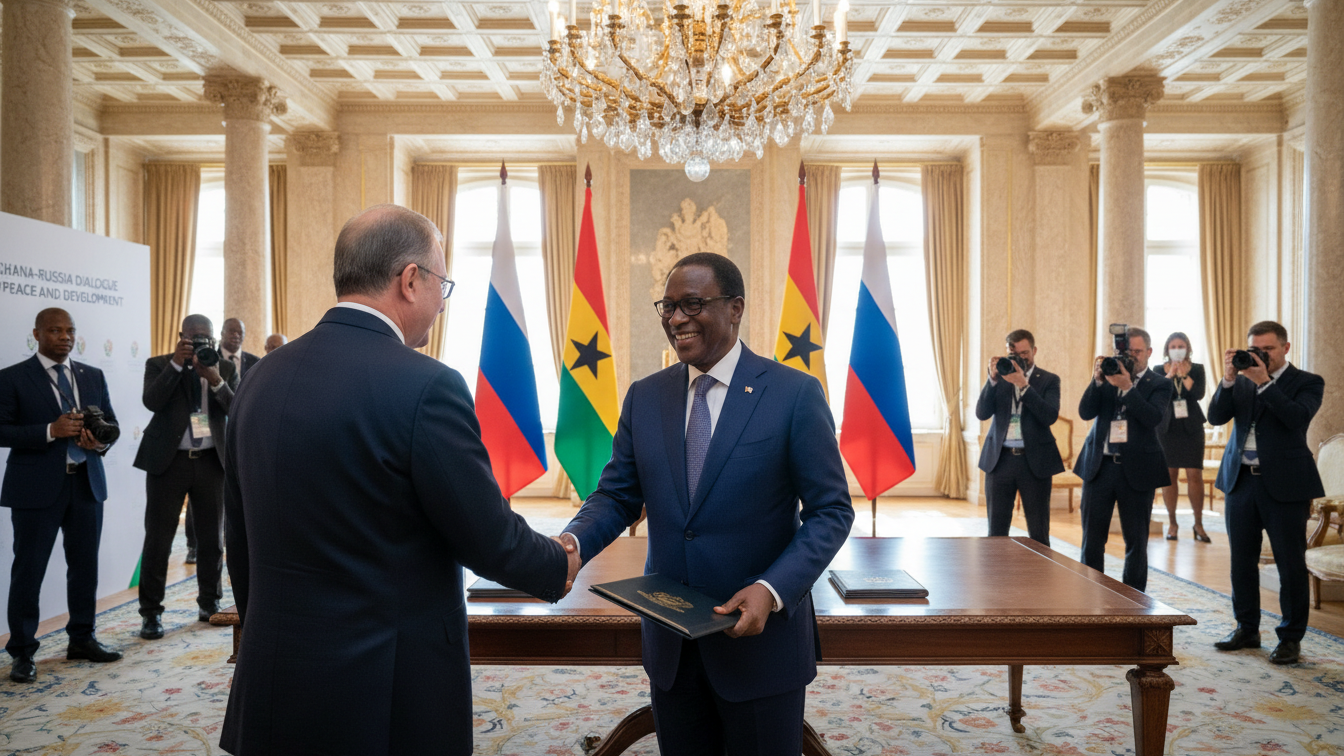
During his time in Russia, President Mahama held discussions that touched upon the historical ties between the two nations, which reached their peak during the mid-20th century. By revitalizing these links, the President is signaling that Ghana is ready to engage with any partner that respects its autonomy and offers favorable terms for economic growth. This is not a rejection of Western values, but a pursuit of a balanced diplomatic portfolio.
Strategic Neutrality in a Bipolar World
Ghana’s non-aligned policy dates back to the era of Dr. Kwame Nkrumah, who famously stated, ‘We face neither East nor West; we face forward.’ Mahama’s current stance is a direct continuation of this foundational diplomatic principle.
“Our commitment is to Ghana’s development. We will partner with anyone who offers mutual benefit without taking sides in global power struggles.”
— John Dramani Mahama
The global order is increasingly characterized by tensions between established Western powers and emerging blocs. In this context, strategic neutrality allows Ghana to navigate the complexities of global power blocs without being forced to choose sides in trade wars or security disputes. President Mahama has highlighted that Ghana’s primary allegiance is to its own citizens and the African Union’s agenda for 2063.
This neutrality is particularly important when dealing with infrastructure and security. By not aligning exclusively with one bloc, Ghana can solicit bids for major projects from a variety of international firms, ensuring competitive pricing and high-quality results. Furthermore, it allows the nation to participate in international forums, from the United Nations to the G20, as a credible and independent voice for the developing world.
The BRICS Partnership Bid: Objectives and Terms
A central pillar of the current administration’s foreign policy is the BRICS partnership bid. This move signifies Ghana’s intention to associate more closely with Brazil, Russia, India, China, and South Africa—nations that represent a significant portion of the world’s population and economic output. The objectives of this bid are multifaceted:
- Access to the New Development Bank: Gaining access to alternative funding for large-scale infrastructure projects without the stringent conditionality often associated with traditional lenders.
- Trade Diversification: Reducing reliance on traditional export markets and tapping into the high-growth economies of the BRICS nations.
- Geopolitical Influence: Strengthening Ghana’s voice in global economic governance and advocating for a more equitable international financial system.
- Technology Transfer: Facilitating exchange programs in fields such as telecommunications, renewable energy, and industrial manufacturing.
President Mahama has been clear that this partnership is intended to be collaborative rather than exclusionary. Ghana seeks “Partner Country” status, a role that allows for deep economic engagement without necessitating a full departure from existing diplomatic obligations or treaties with Western allies.
Economic Implications of BRICS Partnership
The economic implications of a closer relationship with BRICS are substantial. As Ghana seeks to industrialize, the capital and technical expertise available within the BRICS bloc offer a compelling alternative to traditional aid. This is particularly relevant as the government reviews its National Airline Plans and other capital-intensive transport initiatives, where diverse financing and technical partners can provide a competitive edge.
Furthermore, the BRICS partnership bid could open doors for Ghanaian small and medium enterprises (SMEs) to enter vast new markets. By aligning with emerging economies, Ghana can leverage its position as a gateway to West Africa, attracting investment that views the country as a stable hub for regional trade. Critics have raised concerns about potential debt traps or political influence, but the administration maintains that rigorous transparency and a focus on “value for money” will mitigate these risks.
Crucially, this economic expansion is intended to occur alongside continued cooperation with the United States, the European Union, and the United Kingdom. President Mahama asserts that Ghana’s non-aligned foreign policy is robust enough to handle these simultaneous engagements, ensuring that the nation benefits from the best of both worlds.
Conclusion: Maintaining Ghana’s Diplomatic Sovereignty
The reaffirmation of Ghana’s non-aligned foreign policy by President John Dramani Mahama marks a proactive approach to modern statecraft. By engaging with Russia and pursuing a BRICS partnership bid, Ghana is not turning its back on the West; rather, it is expanding its horizons to meet the demands of the 21st century. The administration’s focus remains on diplomatic sovereignty—the right of a nation to determine its own path based on the welfare of its people.
As the international community watches these developments, Ghana’s success will depend on its ability to balance these relationships with transparency and consistency. If managed effectively, this non-aligned stance will secure Ghana’s role as a pivotal player in both African and global affairs, proving that a middle power can indeed maintain its integrity amidst the clashing of giants.
Frequently asked questions
What is the BRICS bloc?
BRICS is a bloc consisting of Brazil, Russia, India, China, and South Africa, alongside newly invited members. It represents major emerging economies seeking to provide an alternative to Western-dominated financial and political systems.
Does Ghana intend to become a full member of BRICS?
Ghana is pursuing a partnership status rather than full membership to maintain its flexibility and non-aligned status while benefiting from economic cooperation with the bloc.
Will this move damage Ghana’s relationship with the West?
No. President Mahama has explicitly stated that the partnership with BRICS does not mean abandoning relations with the United States or Europe.
Related posts:
 Ghana-UK Bilateral Relations Strengthened Ahead of AU Role
 Mahama Directs GH¢300m for 250 Police Apartments in 2027 Budget
 CODEO Warns Against Partisan Appointments to the Electoral Commission
 Russia Backs Ghana’s BRICS Partner Bid, but Membership Decision Remains Pending
 Russia-Ukraine News: Suspect Detained and NATO Growth