Black Challenge Players Receive US$10,000 Each From Sentuo Chairman After Historic World Cup Victory
Sentuo Group Chairman Ningquan Xu has reportedly rewarded each Black Challenge player with US$10,000 following Ghana's amputee football World Cup victory.


Fresh corporate recognition for Ghana’s amputee football champions presents an opportunity to strengthen the funding and development of disability sport.
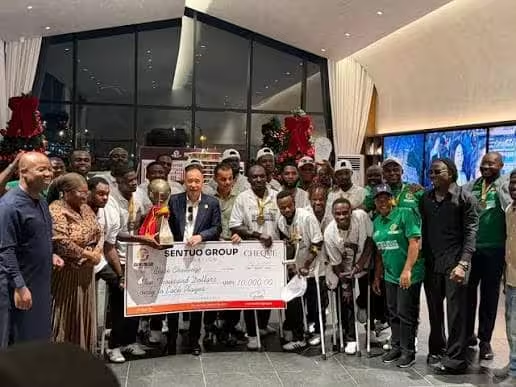
Sentuo Group Executive Chairman Ningquan Xu has reportedly awarded US$10,000 to each player of Ghana’s national amputee football team, the Black Challenge, following their World Cup victory in Mexico. The reward was presented during a dinner in Accra on Friday, 27 November 2026. The gesture follows the team’s return to Ghana and adds to previously announced financial commitments.
Rewarding Champions. Developing Future Champions.
Ghana’s amputee football achievement presents an opportunity to strengthen the financial and institutional foundations of disability sport.
Reported amounts and entitlements. Completed disbursements have not been independently audited by Nukunya.
Financial recognition for Ghana’s champions
The Sentuo contribution follows an announcement by Sports and Recreation Minister Kofi Adams of an additional US$10,000 winning bonus per player. Gold Fields Ghana has also committed support for bonuses and allowances.
| Organisation | Reported amount | Nature of support |
|---|---|---|
| Sentuo chairman | US$10,000 per player | Reported presentation |
| Sports Ministry | US$10,000 per player | Announced bonus |
| Gold Fields Ghana | US$8,000 per delegation member | Reported bonuses and allowances |
Comparing the reported amounts
The bars compare reported amounts, not verified payments. Eligibility descriptions differ between contributions.
Reconciling the reported rewards
Sum of the three listed contributions, assuming common eligibility and no overlap.
Reported total including additional contributions requiring reconciliation.
Building on the World Cup achievement
The latest reward is a new development following Ghana’s championship campaign and the team’s return to Accra.
Attention now turns to how financial recognition can support future sporting achievement and sustained competitiveness.
RELATED NUKUNYA COVERAGE Ghana’s champions return to Accra Read the earlier reportCorporate sponsorship and sustainable sporting achievement
Corporate sponsorship can provide resources extending beyond immediate rewards. Longer-term partnerships could support equipment, facilities, competitions, medical provision and professional coaching.
Post-tournament recognition
- Winning bonuses
- Individual financial rewards
- Recognition of sporting achievement
- Public and commercial visibility
Rewards athletes for accomplishments already achieved.
Pre-tournament investment
- Specialist equipment
- Professional coaching
- Accessible training facilities
- Competition and medical support
Helps establish the conditions required for future performance.
How could future sponsorship be allocated?
Explore how a hypothetical new sponsorship budget could support both athlete remuneration and longer-term football development.
The illustrative allocation provides 40% for athlete remuneration and 60% for institutional development.
Illustrative allocation scenarios
| Athlete allocation | Athlete remuneration | Development investment |
|---|---|---|
| 20% | US$20,000 | US$80,000 |
| 40% | US$40,000 | US$60,000 |
| 50% | US$50,000 | US$50,000 |
| 60% | US$60,000 | US$40,000 |
| 80% | US$80,000 | US$20,000 |
From individual rewards to institutional investment
Sustained competitiveness depends partly on whether emerging athletes can access suitable facilities, organised competitions and development pathways.
Domestic competitions
Establish regular and organised amputee football competitions.
Proposed indicatorsCompleted fixtures, participating clubs and continuity across seasons.
Accessible training facilities
Improve access to appropriate training and rehabilitation environments.
Proposed indicatorsAccessibility audits, facility availability and athlete utilisation.
Equipment and medical support
Provide appropriate specialist equipment, injury prevention and medical services.
Proposed indicatorsEquipment availability, medical coverage and rehabilitation access.
Coaching and officiating
Strengthen professional coaching and officiating development.
Proposed indicatorsQualified coaches, trained officials and continuing professional development.
Transparent athlete remuneration
Establish clear and reliable financial arrangements for athletes.
Proposed indicatorsWritten entitlements, payment timeliness and accessible grievance procedures.
Youth and regional participation
Create opportunities for emerging athletes across Ghana’s regions.
Proposed indicatorsRegional participation, recruitment and progression into competitive teams.
Multi-year corporate partnerships
Develop predictable sponsorship arrangements extending beyond individual tournament successes.
Proposed indicatorsContract duration, funding continuity and delivery against agreed objectives.
These are editorial development opportunities, not established government commitments or independently measured institutional outcomes.
Changing how disability sport is valued
Athletes with disabilities should be recognised as competitive professionals rather than primarily as beneficiaries of charitable assistance.
Excessive emphasis on adversity risks obscuring athletic skill, tactical intelligence and competitive achievement.
Sporting excellence
Evaluate technical ability, tactical performance and competitive achievement on their own merits.
Equal professional recognition
Apply appropriate standards of sporting analysis, remuneration and institutional support to disability sport.
Athlete participation in governance
Include athletes in decisions affecting their welfare, remuneration and sporting development.
Accessible opportunities
Address barriers to participation through suitable infrastructure, equipment and institutional arrangements.
What evidence would establish financial transparency?
The following interactive checklist identifies records that could help reconcile reported rewards and evaluate future investment.
Documentary verification remains necessary.
This is a reader-operated evidence checklist, not a financial audit or validated governance assessment. Unchecked items do not establish that records are unavailable. No responses are stored or transmitted.
Financial transparency should be achieved without unnecessarily publishing athletes’ personal banking or other confidential information.
What should Ghana measure after the celebrations?
| Development dimension | Proposed indicator |
|---|---|
| Financial accountability | Verified commitments fulfilled and payment timeliness |
| Commercial sustainability | Sponsorship renewals and funding continuity |
| Domestic competition | Active clubs and completed fixtures |
| Accessibility | Suitable facilities and equipment access |
| Athlete welfare | Medical support and remuneration arrangements |
| Talent development | Youth recruitment and regional participation |
| Technical development | Coaching and officiating capacity |
| Athlete representation | Meaningful participation in governance |
These proposed indicators require appropriate definitions, baselines and reporting periods before they can support a formal evaluation.
Understanding the Black Challenge rewards
How much did the Sentuo chairman reportedly contribute?
The accompanying article reports US$10,000 per player. Independent disbursement verification remains outstanding.
Has every announced reward been paid?
Nukunya has not independently audited all disbursements. Announcements and entitlements must be distinguished from completed payments.
How much are players reportedly entitled to receive?
The reported combined entitlement is at least US$38,000 per player. However, the three listed contributions account for a conditional US$28,000 subtotal. Additional contributions and eligibility require reconciliation.
Why does the Gold Fields eligibility description matter?
The reported amount applies to delegation members rather than exclusively to players. The eligible population must therefore be established before calculating aggregate financial commitments.
Can corporate donations support future sporting success?
Corporate partnerships could support training, equipment, medical provision and domestic competitions. Their effectiveness depends on governance, continuity and actual delivery.
Does the sponsorship calculator represent actual donations?
No. It illustrates possible allocations of a hypothetical new sponsorship budget. It does not represent confirmed funding or recommend redirecting existing athlete rewards.
The real test begins after the celebrations
One measure of success will be whether announced financial commitments are fulfilled transparently. Another will be whether current interest translates into accessible infrastructure, stronger domestic competitions and sustained opportunities for future athletes.
Institutional change requires coordination between federations, public authorities, commercial partners and athletes themselves.
Ghana must develop a sporting environment in which athletes with disabilities receive consistent opportunities to develop, compete and succeed rather than depending on exceptional victories to attract attention.
Celebrating world champions is important. Building the conditions that produce future champions is equally consequential.Reporting transparency
Related reporting
Additional institutional resources
- Ghana Football Association
- Gold Fields — Corporate information
- World Amputee Football Federation
- United Nations — Disability rights and inclusion resources
General institutional resources provide wider context. Their inclusion does not establish confirmation of the specific financial commitments reported here.
Analytical methodology
The conditional subtotal is calculated by adding US$10,000, US$10,000 and US$8,000. The difference against the reported minimum entitlement is US$10,000.
The sponsorship calculator multiplies a hypothetical new budget by the selected athlete remuneration percentage. The remainder is allocated to institutional development.
The development framework, accountability checklist and proposed evaluation indicators are original editorial explanatory tools. They are not independently validated empirical assessments or financial audits.
Related posts:
 Black Challenge return to Accra as world champions after Mexico triumph
 Andre Ayew Backs Ghana’s Black Challenge Ahead of Amputee World Cup as Funding Questions Remain
 Ghana Make History as Black Challenge Win First Amputee Football World Cup Title
 Ghana Names Squad for 2026 Amputee Football World Cup
 Black Challenge Amputee World Cup Semi-Final Set