
Why a stronger cedi does not automatically make life cheaper for Ghanaians
Why does a stronger cedi not always reduce the cost of living? Ghanaian economic research explains exchange-rate changes, inflation and household prices.



A stronger currency can reduce the cost of imports, but decades of economic research suggest that exchange-rate improvements do not necessarily translate into proportionately lower household prices. Understanding this distinction is essential to assessing Ghana’s economic recovery.
For a household purchasing rice, cooking oil, medicine or other everyday necessities, the most meaningful measure of economic improvement is often not the exchange rate displayed on a screen. It is what the household can afford at the market.
When the Ghanaian cedi strengthens against the US dollar, expectations of lower prices are understandable. Imported goods may become cheaper to purchase, and businesses that depend on foreign currencies may experience some reduction in their costs.
But the relationship between exchange rates and the cost of living is more complicated. Ghanaian economic research suggests that currency movements can influence consumer prices without producing an immediate or proportionate adjustment in household expenditure.
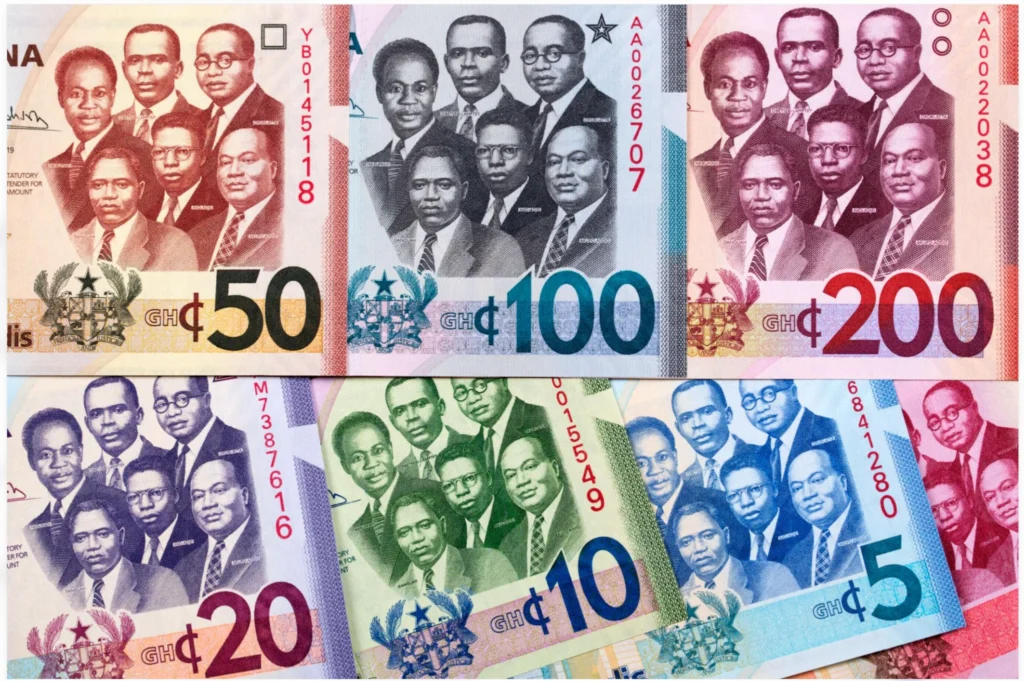
A Stronger Cedi: Are Households Better Off?
Understanding exchange-rate pass-through, consumer prices and household purchasing power.
Research reference date: 26 November 2026. Illustrative calculations are not forecasts of Ghanaian retail prices.
A stronger currency is not the same as lower prices
Cedi appreciation can reduce the domestic currency required to purchase foreign currency. Inflation, however, measures changes in the general price level.
Appreciation
Fewer cedis are required to purchase the same amount of foreign currency.
Disinflation
The inflation rate declines while the general price level may continue rising.
Deflation
The general price level declines over the relevant comparison period.
Explore the effect of inflation
Assume a hypothetical consumer basket originally costs GH¢100.
The general price level remains higher than in the previous year.
| Inflation rate | New basket cost | Price movement |
|---|---|---|
| 20% | GH¢120.00 | Higher prices |
| 10% | GH¢110.00 | Higher prices |
| 5.5% | GH¢105.50 | Higher prices |
| 0% | GH¢100.00 | Unchanged |
| −5% | GH¢95.00 | Lower prices |
Source for October 2026 inflation: Ghana Statistical Service . Basket calculations are illustrative.
What Ghanaian economic research reveals
Exchange-rate pass-through describes the extent to which exchange-rate movements influence domestic prices.
Francis White Loloh
BANK OF GHANA WORKING PAPERResearch covering 1994–2012 identified incomplete transmission of exchange-rate movements into domestic prices.
InterpretationCurrency movements need not produce immediate or equivalent price changes.
Read the working paperLordina Amoah and Meshach Jesse Aziakpono
PUBLISHED ECONOMIC RESEARCHThe study identified evidence that exchange-rate pass-through depended on the direction and magnitude of exchange-rate changes.
InterpretationAppreciation and depreciation may not generate symmetrical price responses.
Read the published studyCamara Obeng and colleagues
PUBLISHED ECONOMIC RESEARCHResearch covering January 1990 to January 2020 identified different short-term and long-term responses to exchange-rate movements.
The estimates did not establish a statistically significant longer-term appreciation effect.
InterpretationA statistically insignificant estimate does not prove that the true economic effect is zero.
Read the published studyWhy prices may adjust slowly
Existing stock
A stronger currency does not retrospectively reduce the original purchasing cost of goods already imported.
Costs beyond foreign currency
Transport, electricity, rent, financing, labour, taxation and distribution can influence final consumer prices.
Future replacement costs
Businesses may consider whether currency gains will persist when determining the prices of existing and future stock.
Competition and pricing decisions
Competitive conditions and pricing strategies may influence the extent and timing of consumer price adjustments.
Four possible economic mechanisms.
Why a 20% import-cost reduction may produce a 12% retail-price reduction
Consider a product originally priced at GH¢100. Foreign purchasing costs account for GH¢60, while domestic costs and other price components account for GH¢40.
Exchange-rate pass-through calculator
Underlying price components
Foreign-cost savings not passed through: GH¢0.00.
Enter a valid price between GH¢0 and GH¢100,000,000.
Domestic cost changes are assumed to pass fully into the final price. The selected pass-through rate applies only to foreign-cost savings. The model does not independently estimate retailer profits or margins.
Alternative pricing scenarios
Each scenario starts with a GH¢100 price, a GH¢60 foreign component and a 20% reduction in foreign purchasing costs.
| Savings passed through | Domestic cost change | New price | Price change |
|---|---|---|---|
| 100% | 0% | GH¢88 | −12% |
| 50% | 0% | GH¢94 | −6% |
| 100% | +20% | GH¢96 | −4% |
| 0% | 0% | GH¢100 | 0% |
| 100% | +40% | GH¢104 | +4% |
How economic gains may reach households
-
01
Exchange-rate movement
Changes the domestic cost of foreign currency.
-
02
Foreign purchasing costs
Depends on supplier prices, contracts and purchasing arrangements.
-
03
Importer and distributor costs
Existing inventory, transport, financing and other expenses.
-
04
Retail pricing decisions
Competition, pricing strategies and expected replacement costs.
-
05
Consumer prices
The magnitude and timing of changes in the prices households pay.
-
06
Household purchasing power
Consumer prices relative to household income and available resources.
Conceptual transmission pathway developed by Nukunya. It does not establish a guaranteed sequence or a validated causal model.
Is household income keeping pace with prices?
Lower inflation may provide relief without restoring purchasing power lost during earlier periods of price increases. Real income depends on how nominal income changes relative to the cost of living.
Real income calculator
Nominal income growth has not kept pace with inflation.
Formula: [(1 + nominal income growth) ÷ (1 + inflation) − 1] × 100. Rates are expressed as decimals in the calculation.
| Nominal income growth | Real income change | Purchasing power |
|---|---|---|
| 0% | −5.21% | Lower |
| 3% | −2.37% | Lower |
| 5% | −0.47% | Lower |
| 5.5% | 0.00% | Unchanged |
| 10% | +4.27% | Higher |
| 15% | +9.00% | Higher |
What households and policymakers should monitor
Essential goods
Actual prices of frequently purchased food, transport, healthcare and other essentials.
Real earnings
Changes in household income after accounting for relevant price movements.
Economic opportunity
Employment conditions, earnings stability and opportunities to increase household income.
Import-to-retail prices
Changes in comparable import, wholesale and retail prices over time.
Production and distribution
Energy, transport, financing, labour and other domestic operating expenses.
Market conditions
Evidence of competitive conditions and differences in pricing across markets.
Proposed economic monitoring framework
| Indicator | Proposed measurement | Purpose |
|---|---|---|
| Essential goods affordability | Cost of a defined essential-goods basket relative to household disposable income. | Assess household financial pressure. |
| Real income growth | Nominal income growth adjusted using a relevant price index. | Assess purchasing power. |
| Import cost transmission | Matched import and retail price series, accounting for other costs and timing. | Examine how cost changes reach consumers. |
| Price adjustment timing | Observed time between purchasing cost changes and comparable retail price changes. | Examine possible adjustment delays. |
| Distributional outcomes | Comparable affordability and real income indicators by income group and location. | Examine whether gains are shared widely. |
| Employment conditions | Employment, earnings and job stability using clearly defined population measures. | Assess broader economic welfare. |
These are editorial recommendations, not official targets or an assertion that Ghana currently collects none of this information. Estimating causal exchange-rate pass-through would require an appropriate empirical design.
What the evidence tells us
Currency movements can influence prices
Historical Ghana-focused research identifies exchange-rate transmission into domestic prices.
Transmission may be incomplete
The magnitude and timing of price responses need not match currency movements.
Current retail pass-through rate
This article does not independently estimate recent exchange-rate pass-through.
Current business pricing conduct
No retailer-level evidence has been analysed to establish the reasons for individual businesses' pricing decisions.
Frequently asked questions
Does a stronger cedi automatically reduce prices?
No. Currency appreciation may reduce foreign purchasing costs, but final prices also depend on domestic costs, purchasing arrangements and market conditions.
Does lower inflation mean goods are cheaper?
Not necessarily. A lower positive inflation rate means that the general price level is rising more slowly relative to the relevant comparison period. Individual product prices may move differently.
Why does a 20% foreign-cost reduction produce only a 12% retail-price reduction in the example?
Foreign purchasing costs represent 60% of the original price. Twenty per cent of that component equals 12% of the original total price, assuming full pass-through and unchanged other components.
Can domestic costs offset currency-related savings?
Yes. In the hypothetical model, higher domestic costs can partly or completely offset reductions in foreign purchasing costs. Actual effects require business-level evidence.
How can household purchasing power improve?
Purchasing power can improve when household income grows faster than the relevant cost of living, or when prices fall relative to available household income.
Do historical economic studies predict Ghana's current retail prices?
No. Historical estimates help explain economic relationships, but changes in market structures, policy and supply chains may influence contemporary outcomes.
From currency stability to household welfare
A stronger cedi may create conditions that support lower import costs and economic stability. Whether those benefits reach households depends on additional economic factors and their interaction over time.
The ultimate test of economic recovery is whether household resources increasingly provide access to food, transport, healthcare, education and other essentials.
Nukunya — Beyond the headlines. Evidence, context and perspective.Sources, calculations and limitations
Research reference date: 26 November 2026. This explainer synthesises official inflation data and published Ghana-focused economic research.
| Source | Period | Contribution | Limitation |
|---|---|---|---|
| Ghana Statistical Service | October 2026 | Reported annual inflation of 5.5% | General price index, not an individual household's expenditure measure. |
| Loloh (2014) | 1994–2012 | Incomplete exchange-rate pass-through | Historical estimates, not current retail price forecasts. |
| Amoah and Aziakpono (2018) | Published 2018 | Direction and magnitude of exchange-rate movements matter. | Historical economic relationships may change over time. |
| Obeng et al. (2022) | January 1990–January 2020 | Different short-term and long-term responses. | Statistical insignificance does not establish a zero economic effect. |
Calculation methodology
P1 = P0 − (F × r × t) + (D × g)
- P0
- Original retail price.
- P1
- Illustrative adjusted retail price.
- F
- Original foreign purchasing cost component.
- D
- Original domestic and other price components.
- r
- Proportional reduction in foreign costs.
- t
- Proportion of foreign-cost savings passed through.
- g
- Proportional change in the domestic component.
F + D = P0. Percentage inputs are converted to decimal proportions.
Real income change = [(1 + nominal income growth) ÷ (1 + inflation) − 1] × 100.
Primary and academic sources
Related posts:
 Ghana’s inflation slows for third consecutive month as food prices ease
 IMF PCI to Strengthen Bank of Ghana’s Balance Sheet
 Ghana’s Economy Shows Signs of Recovery — But Many Households Still Feel the Strain
 Ghana’s Debt Climbs to GH₵674bn Despite IMF Recovery Gains
GhIPSS returns GH¢14.58m dividend to Bank of Ghana after profitable year