
Ghana’s inflation slows for third consecutive month as food prices ease

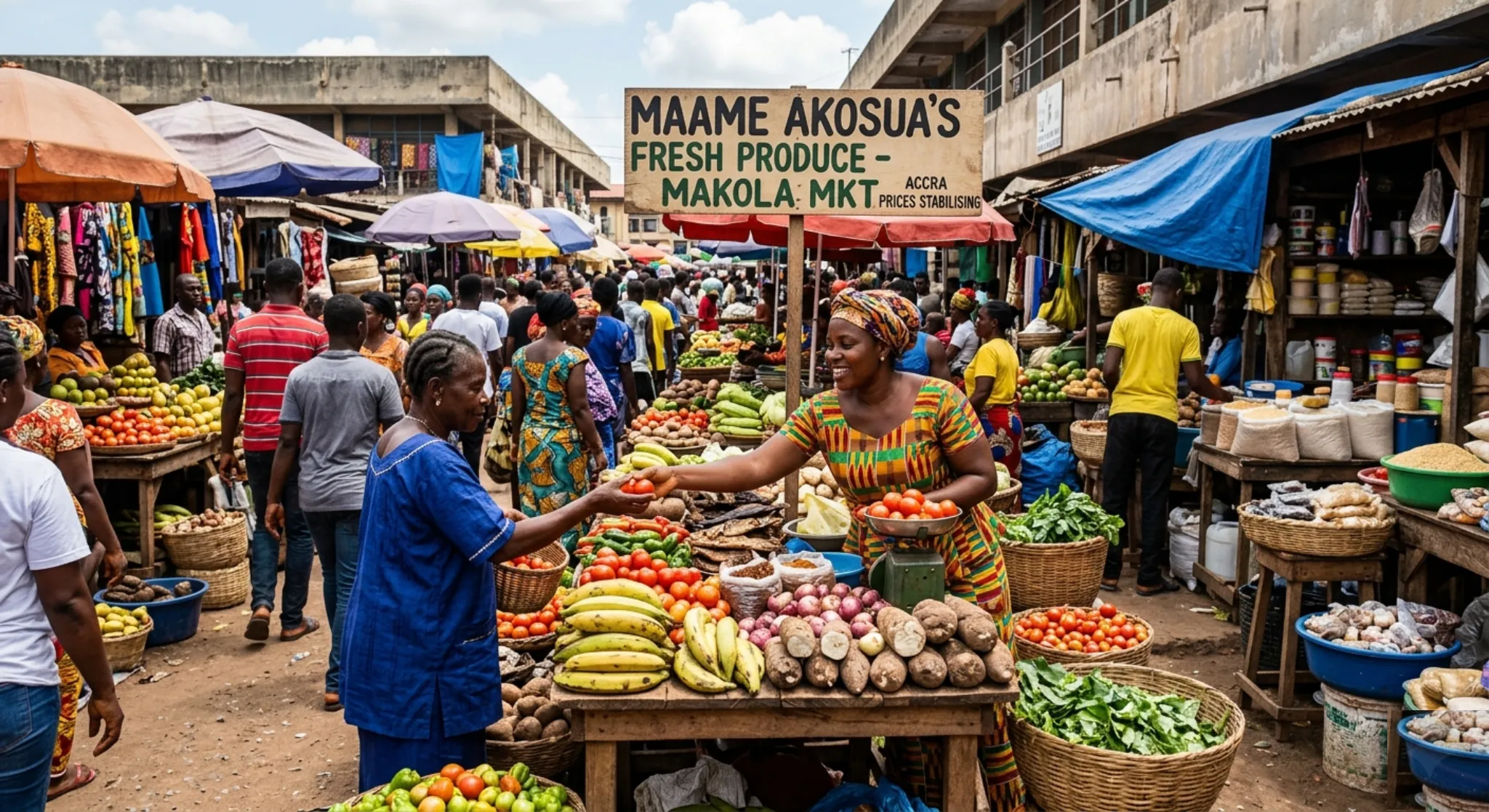

Ghana’s inflation slows for a third straight month, driven by easing food prices and tighter monetary policy, offering cautious relief to households and businesses.
ACCRA, Ghana — 5 May 2026
Ghana’s inflation slows for a third consecutive month, signalling a gradual easing of price pressures that have strained households and businesses over the past year. Data released by the Ghana Statistical Service show that headline inflation declined to 23.2% in April, down from 25.8% in March. Slower increases in food prices largely drove the drop, and they have been the main driver of inflation in recent months. The latest figures suggest that aggressive monetary tightening by the Bank of Ghana, along with stabilising exchange rates, is beginning to have an effect on the economy.
Ghana inflation slows as food prices stabilise
Food inflation, which accounts for a significant share of Ghana’s consumer price index, fell to 27.8% in April from 30.5% the previous month, according to official data. Non-food inflation also declined, reflecting reduced pressure on transport and imported goods. Government officials said the trend indicates that recent policy interventions are working. The Finance Ministry has maintained that fiscal discipline and ongoing reforms under the International Monetary Fund programme are helping to restore macroeconomic stability. “We are beginning to see the impact of coordinated fiscal and monetary policies,” a senior official at the Ministry of Finance said in a statement. “Inflation remains high, but the trajectory is improving.” The Bank of Ghana has kept its benchmark interest rate elevated at 29.5% in recent months in an effort to curb inflation and stabilise the cedi. The currency has shown relative stability against major trading currencies compared with volatility seen in 2023.
Businesses and households see cautious relief
For many Ghanaians, the slowdown in inflation is beginning to translate into modest relief, though prices remain significantly higher than a year ago. At Makola Market in Accra, trader Ama Mensah said the pace of price increases has slowed, even if costs remain elevated. “Before, prices were changing almost every week,” she said. “Now it is not rising as fast, but things are still expensive for customers.”
Small business owners also report improved planning conditions as price volatility eases. Kwame Asare, who runs a transport service in Accra, said fuel costs have stabilised, allowing him to manage fares better. “It is easier to predict costs now,” he said. “But we are not back to normal yet.” Despite these improvements, analysts warn that real incomes remain under pressure, particularly for low-income households facing high food and rent costs.
Opposing view: concerns over sustainability
Some economists caution that the slowdown may not be sustained without continued structural reforms. Dr Patrick Essien, an economist at the University of Ghana Business School, said the current trend could reverse if external conditions deteriorate or fiscal discipline weakens. “Inflation is falling, but the underlying risks remain,” he said. “Global commodity prices, exchange rate pressures, and domestic fiscal challenges could quickly change the outlook.” He added that while monetary tightening has helped, it also comes at a cost to economic growth and access to credit for businesses. High interest rates have made borrowing more expensive, slowing investment and expansion in key sectors such as manufacturing and retail.
Policy context and IMF programme
Ghana is currently implementing a $3bn programme with the International Monetary Fund aimed at restoring macroeconomic stability and debt sustainability. The programme includes fiscal consolidation measures, reforms to state-owned enterprises, and efforts to improve revenue mobilisation. The IMF expects inflation in Ghana to decline gradually if reforms are sustained, with a medium-term target of single-digit inflation. However, we will achieve this target by maintaining exchange rate stability and managing external shocks, including global energy and food prices.
What this means
The slowdown in inflation reflects early signs that Ghana’s policy measures are taking effect, but the broader economic picture remains fragile. Data from the Ghana Statistical Service show that inflation peaked above 50% in 2023 before beginning a gradual decline. Compared with other African economies, Ghana’s inflation remains relatively high, though the downward trend aligns with regional patterns of easing price pressures.
The World Bank expects inflation across Sub-Saharan Africa to moderate in 2026 due to tighter monetary policy and improved supply conditions. However, it warns that countries with high debt levels, including Ghana, face continued vulnerability. In practical terms, slower inflation means that prices are rising less quickly, not falling. Households may experience reduced pressure on weekly expenses, but the overall cost of living remains elevated.
For policymakers, the challenge is to balance inflation control with economic growth. High interest rates help stabilise prices but can constrain business activity and job creation. The gap between policy and lived reality remains significant. While macroeconomic indicators are improving, many households continue to struggle with high costs of food, transport, and housing. Sustained progress will depend on consistent policy implementation, global economic stability, and improvements in domestic production to reduce reliance on imports.
Sources: Ghana Statistical Service; Bank of Ghana; International Monetary Fund; World Bank.
Additional reporting and analysis by Nukunya News Desk
Related posts:
 IMF PCI to Strengthen Bank of Ghana’s Balance Sheet
  Ghana’s Economy Shows Signs of Recovery — But Many Households Still Feel the Strain
  Ghana’s parliament debates new tax policy amid revenue push
  MTN Ghana to Start Charging Customers for MoMo-to-Bank Transfers From June 1
  Ghana Nears First Non-Interest Banking Licence as BoG Warns on Fintech Trust