
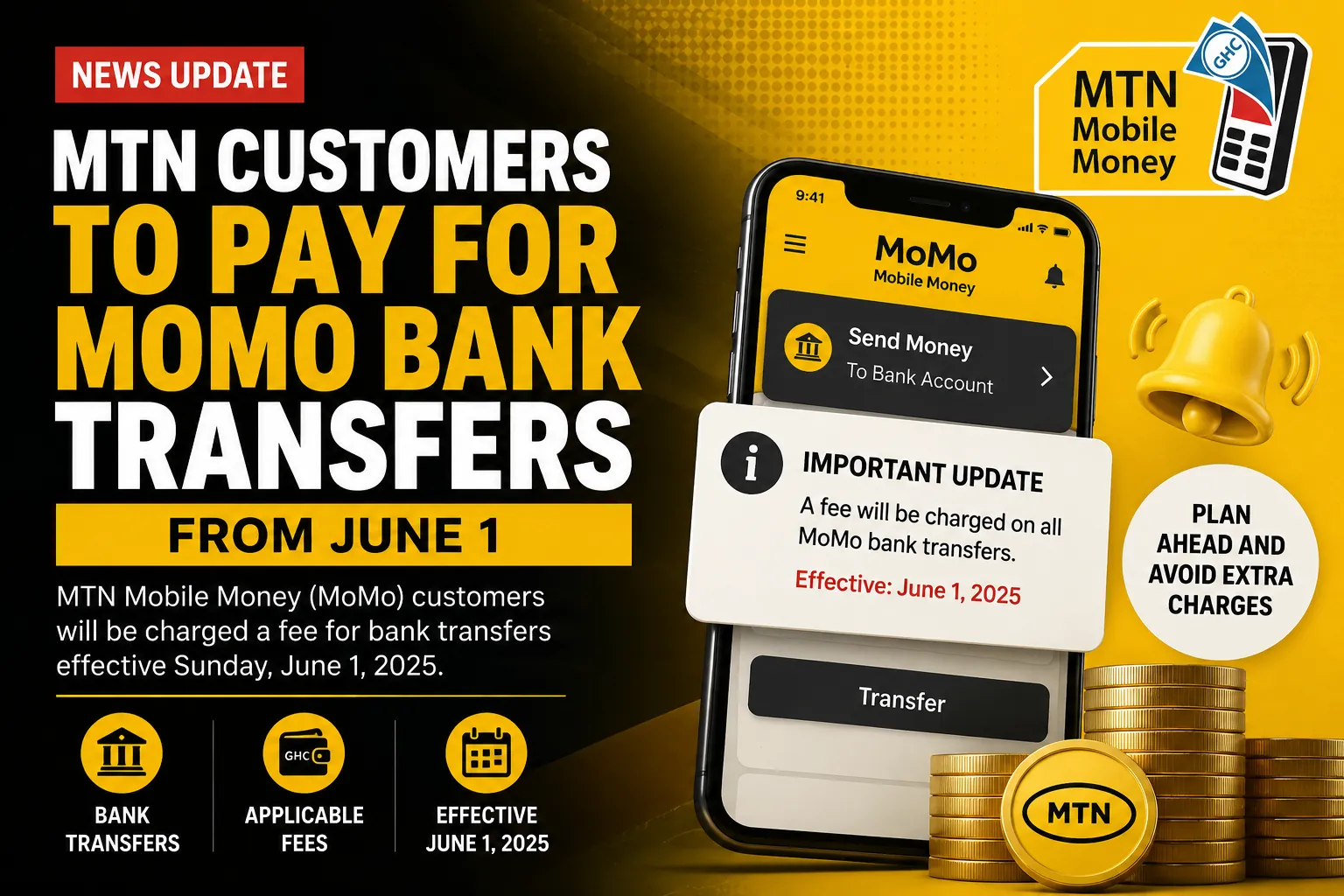
MTN Ghana to Start Charging Customers for MoMo-to-Bank Transfers From June 1


Follow Nukunya
Get the latest breaking news and updates from Nukunya.
MTN Ghana says customers transferring funds from Mobile Money wallets to bank accounts will begin paying a 0.75% transaction fee from June 1, a move likely to reignite debate over digital finance costs in one of Africa’s largest mobile money markets.
ACCRA, Ghana — MTN Ghana has announced that transfers from Mobile Money (MoMo) wallets to bank accounts will attract a 0.75% transaction fee from June 1, ending a widely used free transfer arrangement for millions of customers across Ghana. The telecommunications company informed subscribers through customer notifications on Monday evening that all MoMo-to-bank transfers would now attract a fee capped at GH¢5 per transaction.
“From 1 June 2026, transfers from your MoMo Wallet to bank accounts will attract a fee of 0.75% per transaction, capped at GH¢5,” the message stated. “This will help us continue to serve you better.” The fee applies specifically to transfers from MoMo wallets into bank accounts. Existing charges on cash withdrawals, deposits and peer-to-peer MoMo transfers remain unchanged.
The new pricing structure means:
- a GH¢100 transfer will attract a 75-pesewa charge
- a GH¢500 transfer will cost GH¢3.75
- transfers above roughly GH¢667 will attract the maximum GH¢5 fee
The decision affects one of Ghana’s most heavily used digital financial channels in a country where mobile money has become deeply integrated into daily commerce, salary payments, remittances and small-business transactions.
According to the Bank of Ghana, mobile money transaction values in Ghana exceeded GH¢3 trillion recently, reflecting the growing centrality of digital payments within the national economy. Industry analysts say the move reflects broader commercial pressures across Africa’s telecommunications sector, where operators are increasingly seeking additional revenue streams from digital financial services amid slowing growth in traditional voice and SMS revenues.
Debate over affordability and financial inclusion
The announcement is expected to generate significant public debate because many Ghanaians now rely on MoMo wallets as de facto bank accounts, particularly in areas with limited access to conventional banking infrastructure. For market traders, gig workers, students and small businesses, mobile money has become an essential financial tool rather than simply a convenience payment platform.
Consumer groups and digital finance advocates have long argued that lower transaction costs are essential for sustaining financial inclusion and encouraging broader adoption of cashless payment systems. The new charge also arrives in a politically sensitive environment following nationwide debate over Ghana’s Electronic Transfer Levy (E-Levy), which faced strong public criticism over concerns that transaction costs could discourage digital payment adoption.
Online reactions to MTN’s latest announcement appeared mixed on Monday evening, with some customers questioning the timing of the new charges amid broader economic pressures and rising living costs. Others argued that maintaining secure digital payment infrastructure, interoperability systems and financial technology services requires long-term commercial sustainability.
Technology analysts say the development could intensify competition within Ghana’s fast-growing digital payments ecosystem, potentially benefiting fintech firms and alternative electronic payment providers seeking to attract price-sensitive consumers.
Competition and regulatory pressure
MTN Ghana remains Ghana’s dominant mobile money operator, with MoMo continuing to represent one of the company’s most profitable business segments.
The Bank of Ghana has recently promoted interoperability between banks and mobile wallets as part of broader efforts to deepen financial inclusion and reduce dependence on cash transactions. Analysts say the introduction of additional transfer charges could renew scrutiny over the balance between innovation, profitability, affordability and consumer protection within Ghana’s expanding digital finance sector. Competing digital payment providers, including banks, fintech platforms and alternative wallet services, may also face pressure to reassess pricing structures as customers compare transaction costs across platforms.
Technology companies and financial institutions, however, argue that continued investment in cybersecurity, fraud prevention, transaction infrastructure and platform reliability requires sustainable revenue models.
Why this story matters
The significance of the change extends beyond routine transaction fees. In Ghana, mobile money now underpins large parts of the informal economy and functions as a primary financial access point for millions of people without regular access to traditional banking services.
Any increase in digital transaction costs therefore carries broader implications for:
- financial inclusion
- consumer trust
- digital adoption
- small-business operations
- cashless policy ambitions
- confidence in fintech ecosystems
The decision also highlights the growing tension facing African digital economies as governments, telecom operators and fintech firms attempt to balance:
- accessibility
- profitability
- innovation
- infrastructure costs
- regulatory compliance
- long-term sustainability
Related posts:
 Ghana Nears First Non-Interest Banking Licence as BoG Warns on Fintech Trust
  Bank of Ghana suspends proposed 0.75% mobile money transfer fee
  Ghana’s inflation slows for third consecutive month as food prices ease
  IMF PCI to Strengthen Bank of Ghana’s Balance Sheet
  Ghana’s Debt Climbs to GH₵674bn Despite IMF Recovery Gains