
Pope Leo XIV Urges AI ‘Disarmament’ in Major Vatican Warning on Technology Risks

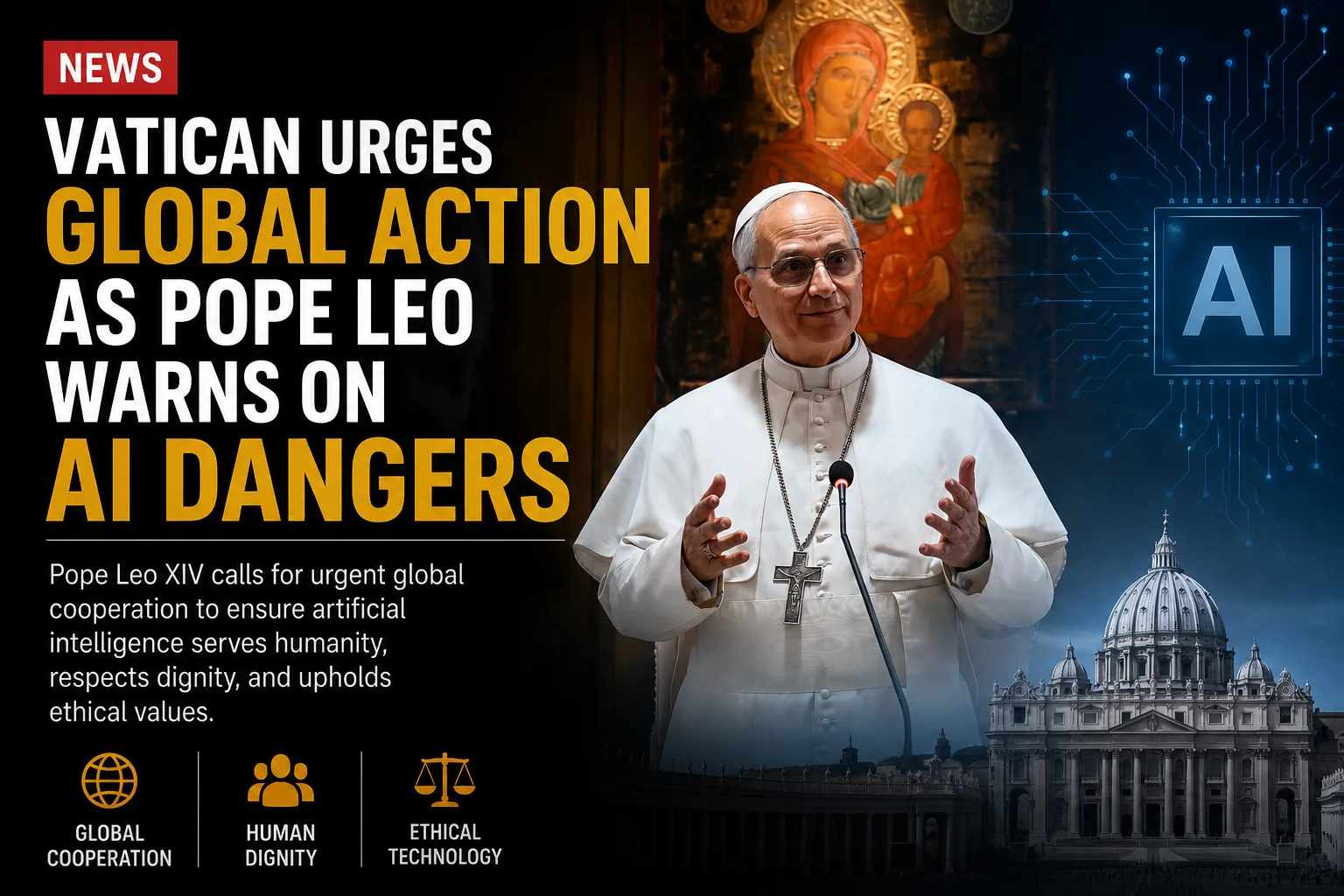

Pope Leo XIV has called for artificial intelligence to be “disarmed”, warning that unchecked AI development could fuel misinformation, inequality, autonomous warfare and “new digital slaveries” in the first major teaching document of his papacy.
VATICAN CITY — Pope Leo XIV has called for artificial intelligence to be “disarmed”, warning that unchecked technological competition risks deepening inequality, undermining democracy and accelerating warfare in the first major teaching document of his papacy. The 83-page encyclical, Magnifica Humanitas (“Magnificent Humanity”), released at the Vatican on Monday, marks the first major doctrinal intervention of Leo’s papacy and places the Catholic Church at the centre of the growing global debate over AI governance, ethics and human dignity.
The document examines the impact of artificial intelligence across politics, labour, warfare, misinformation, social media, economic inequality and environmental sustainability, while calling for stronger international oversight and ethical accountability from governments and technology companies. “AI now demands to be disarmed, freed from logics that turn it into an instrument of domination, exclusion, and death,” the Pope wrote, comparing the need for AI safeguards to earlier international efforts to regulate nuclear weapons.
The intervention comes amid mounting global concern over generative AI systems, deepfakes, autonomous weapons and the growing concentration of technological power among a small number of major technology firms. Governments across Europe, North America and Asia are already facing increasing pressure to regulate artificial intelligence as companies race to develop more advanced generative AI models capable of producing human-like text, images and video.
Pope warns of ‘new digital slaveries’
Leo devoted significant sections of the encyclical to what he called “new digital slaveries”, warning that AI systems risk normalising exploitation through low-paid data labour, algorithmic control and unchecked concentrations of technological power. The Pope also issued one of the strongest Vatican apologies to date for the Catholic Church’s historical links to slavery, acknowledging that both society and the Church had delayed condemning the practice.
“It was impossible not to feel deep sorrow when contemplating the immense suffering and humiliation endured by so many,” Leo wrote, adding that he “sincerely asked for pardon” in the name of the Church. The document connects past exploitation to today’s technology, arguing that societies risk repeating earlier moral failures if AI development is only driven by commercial competition and geopolitical rivalry.
Democracy, misinformation and social media
The encyclical warns that AI-powered misinformation threatens democratic institutions by amplifying manipulated content, deepfakes and misleading narratives. Leo said democracy weakens when truth is replaced by what merely appears useful or effective, warning that indifference to truth can gradually push societies towards authoritarianism.
The Pope also criticised the influence of major digital platforms, arguing that social media companies now wield enormous cultural and political power that must remain guided by truth, accountability and respect for human dignity. “Technology is never neutral,” Leo wrote, insisting that developers and regulators carry ethical responsibility because every technological design choice reflects a broader vision of humanity. The Pope’s warning reflects growing global anxiety over how AI could reshape everyday life, from job security and political trust to online safety and access to reliable information.
Technology companies and AI researchers, however, have also argued that artificial intelligence could improve healthcare, scientific discovery, education and productivity if responsibly governed. Supporters of rapid AI development say the technology could help address challenges ranging from disease detection to climate modelling.
AI warfare and autonomous weapons
Among the strongest sections of the document are warnings against AI-assisted warfare and autonomous weapons systems. The Pope condemned the delegation of lethal decision-making to machines, stating that “it is not permissible to entrust lethal or otherwise irreversible decisions to artificial systems.”
“No algorithm can make war morally acceptable,” Leo added, arguing that AI risks lowering the threshold for violence while reducing human beings to data points within automated military systems. The encyclical also challenges traditional interpretations of “just war” doctrine, arguing that modern technological capabilities have fundamentally altered the ethical conditions under which wars are fought. He called for international frameworks capable of preventing an AI arms race and ensuring civilian protections remain central to military decision-making.
Jobs, inequality and economic disruption
Leo warned that AI and robotics could intensify wealth concentration and deepen economic inequality if left unchecked. A 2025 study by researchers at the Massachusetts Institute of Technology estimated that AI technologies could significantly disrupt segments of the global workforce over the coming decade, particularly administrative and routine knowledge-based jobs.
The Pope urged governments to prioritise dignified work, social inclusion and equitable distribution of technological benefits, arguing that economic systems must remain subordinate to the common good rather than purely market logic. He also cautioned against sacrificing employment opportunities in pursuit of profit, describing work as essential to family stability, identity and social cohesion.
Environmental cost of AI
The document further highlights the environmental burden created by large-scale AI systems, particularly the growing energy and water demands of data centres powering generative AI models. Leo called for more sustainable technological systems as global demand for AI computing power accelerates.
Vatican seeks broader AI debate
The Vatican unusually invited AI researchers, theologians and technology executives to participate in the encyclical’s launch event, including Christopher Olah of AI company Anthropic. Olah said AI companies often operate within incentives that can conflict with ethical behaviour, adding that the challenges raised by artificial intelligence extend beyond the technology sector.
Analysts say the encyclical represents one of the most significant moral and political interventions yet by a global religious institution into the rapidly expanding AI sector. The Vatican’s intervention is also likely to intensify pressure on governments and technology firms already facing growing calls for stronger AI regulation across Europe, North America and parts of Asia.
The encyclical positions the Vatican as one of the most prominent moral voices yet to intervene in the global AI race, as governments struggle to balance technological innovation with mounting concerns over surveillance, misinformation, inequality and autonomous warfare.
Sources: Vatican Press Office ·
Related posts:
 Who decides what AI tells you? Ex‑Meta news chief Campbell Brown weighs in
  Elon Musk vs Sam Altman: what the jury will decide
  Nvidia ramps up Taiwan spending to $150bn a year as AI race intensifies
  Iran delays response to US proposal as nuclear programme and Strait of Hormuz emerge as key obstacles
  Mifepristone access restored by US Supreme Court for now