
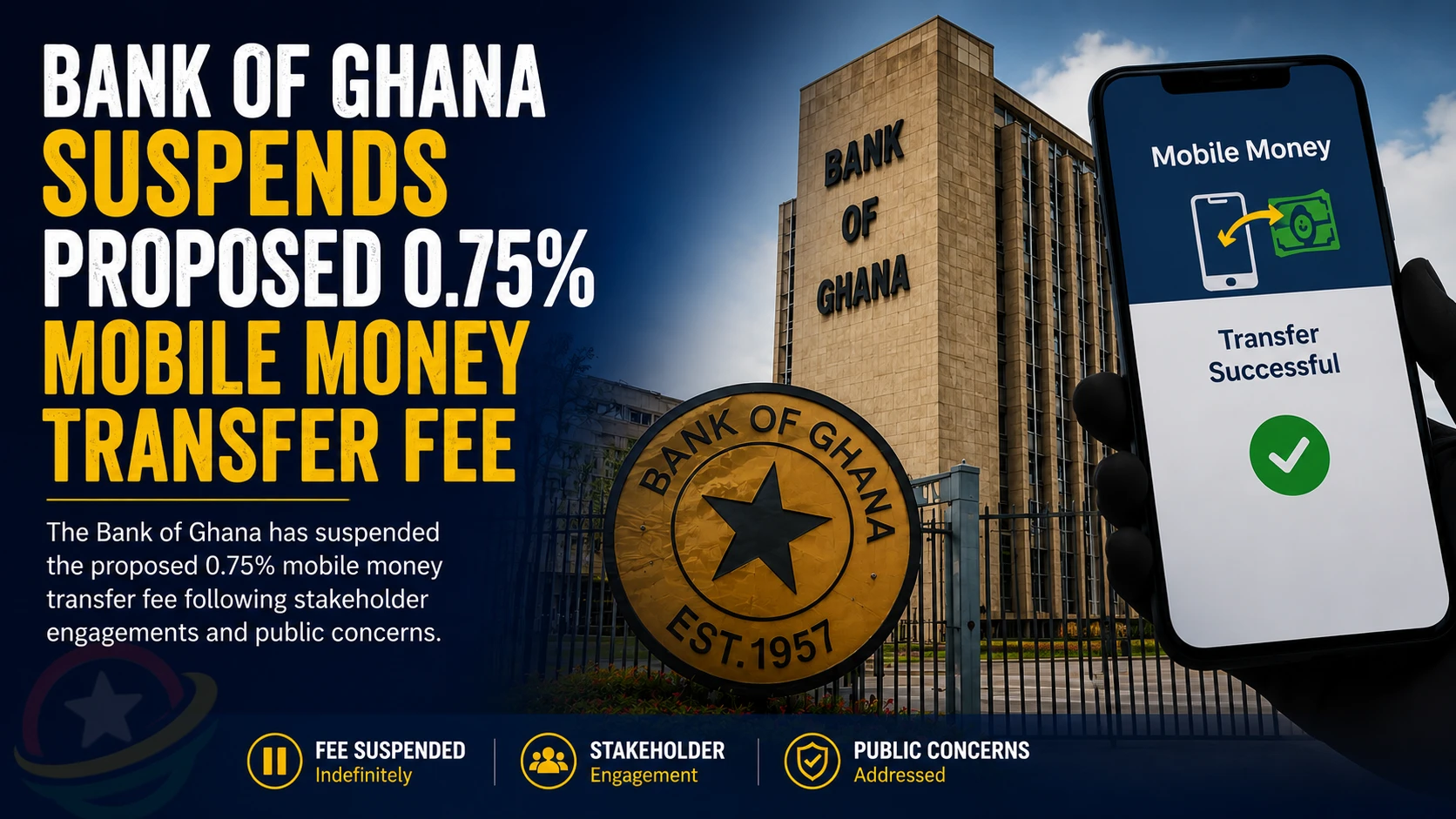
Bank of Ghana suspends proposed 0.75% mobile money transfer fee


Follow Nukunya
Get the latest breaking news and updates from Nukunya.
Ghana’s central bank has suspended a proposed 0.75% charge on wallet-to-bank transfers following criticism from mobile money users and opposition lawmakers over the potential impact on digital payments.
ACCRA, Ghana —
The Bank of Ghana (BoG) has suspended plans to introduce a proposed 0.75% fee on direct mobile wallet-to-bank transfers following criticism over the potential impact on digital payments and financial inclusion. The proposed charge, which had been scheduled to take effect from 1 June 2026, has been placed on hold pending further consultation, according to a statement issued Tuesday by the central bank.
“The Bank of Ghana informs the public that Mobile Money Fintech Limited (MMFL) has been directed to pause the implementation of its proposed 0.75 percent fee on direct wallet-to-bank transfers,” the statement said. The central bank said the decision reflected its commitment to ensuring that any changes within Ghana’s mobile financial services ecosystem are introduced fairly, protect consumers and support financial wellbeing.
Political scrutiny grows over proposed charge
The suspension triggered a political reaction after Minority Leader Alexander Afenyo-Markin questioned the explanation that the proposed fee had been paused for “further consultation”. Addressing a press conference in Parliament, Afenyo-Markin argued that financial measures affecting millions of mobile money users should undergo broader stakeholder engagement and parliamentary scrutiny before implementation. “The question is, for what further consultation in this context?” he said. “Were these not the same people who claimed there must be constructive consultation before any policy is introduced and implemented?”
He also called on the Finance Minister to explain how the proposed charge was developed, communicated and subsequently suspended.
Mobile money central to Ghana’s digital economy
Mobile money services have become central to Ghana’s financial system, with millions of users relying on digital wallets for payments, remittances, savings and transfers between bank accounts and mobile platforms. Industry analysts say additional transaction costs could affect digital payment adoption and financial inclusion, particularly among low-income users and small businesses that depend heavily on mobile money services. The proposed fee generated significant public debate ahead of its planned implementation date, reflecting broader sensitivity around transaction-related charges within Ghana’s digital finance sector. The Bank of Ghana has promoted interoperability and digital finance reforms in recent years as part of efforts to modernise the country’s financial infrastructure and expand access to formal banking services.
Uncertainty remains over future implementation
The central bank did not indicate when consultations would conclude or whether the proposed fee structure could be revised before any future implementation. Telecom operators and mobile money service providers had not publicly announced alternative pricing measures as of Tuesday evening.
The debate comes amid continuing scrutiny of transaction-related fees and digital finance regulation following previous controversies surrounding electronic transfer levies and banking charges in Ghana.
Financial analysts say the outcome of the consultations could shape future policy discussions around mobile money pricing, fintech competition and consumer protection in Ghana’s expanding digital payments industry.
Sources: Bank of Ghana statement and parliamentary remarks
Related posts:
 MTN Ghana to Start Charging Customers for MoMo-to-Bank Transfers From June 1
  Ghana’s Debt Climbs to GH₵674bn Despite IMF Recovery Gains
  Appeal Court reverses GN Savings licence revocation in major BoG setback
  Ghana plans cross-border digital cedi payments to boost African trade
  Ghana Nears First Non-Interest Banking Licence as BoG Warns on Fintech Trust