Uganda media shutdown exposes deeper struggle over press freedom and succession politics

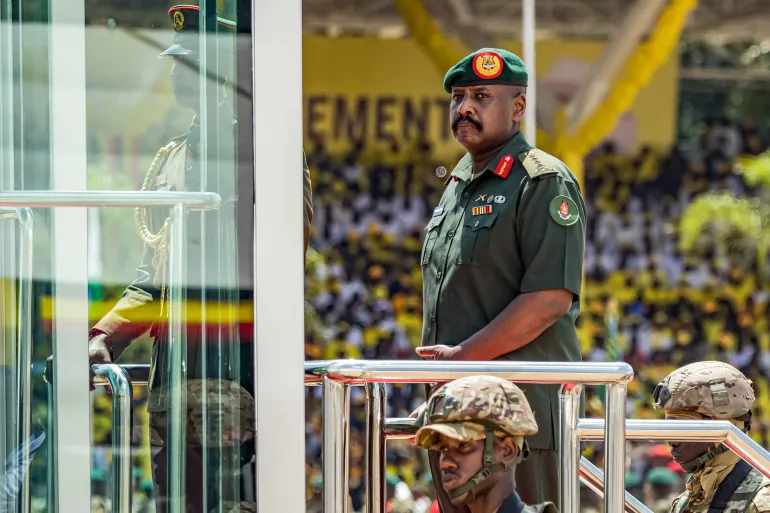

The reported closure of major Ugandan media outlets by army chief Muhoozi Kainerugaba has raised new concerns about press freedom, military power and political succession in one of East Africa’s most strategically important states.
KAMPALA, Uganda — The reported shutdown of major Ugandan media outlets by army chief Muhoozi Kainerugaba is more than a dispute over news coverage. It is a test of the boundary between military authority, civilian institutions and press freedom in a country already facing questions over political succession.
Kainerugaba, Uganda’s Chief of Defence Forces and son of President Yoweri Museveni, said he had ordered the closure of outlets belonging to Nation Media Group, including the Daily Monitor and NTV Uganda. The media group is among the most influential in East Africa.
The immediate concern is press freedom. The wider issue is governance. Uganda’s constitution provides for freedom of expression and the press. But the reported deployment of military personnel around media premises and the temporary disruption of broadcasting suggest that the military remains capable of influencing civic space directly, even in areas normally regulated by civilian institutions.
That matters because media freedom is not only about journalists. It is about whether citizens can access independent information, scrutinise public officials and debate the direction of the state without fear of coercion.
A media dispute with political weight
Kainerugaba’s intervention is politically significant because of who he is. He is not only Uganda’s top military officer. He is also widely discussed as a possible successor to Museveni, who has led Uganda since 1986. Any action he takes therefore carries meaning beyond the military chain of command.
His public criticism of independent media outlets comes at a sensitive moment. Uganda’s politics are already shaped by long-running questions about succession, opposition freedoms and the role of security agencies in public life. When a senior military figure who is also part of the presidential family appears to act against major media institutions, the issue becomes inseparable from debates about state power.
Why press freedom matters
Independent media outlets play a central role in Uganda’s political system because Parliament, courts, civil society and elections all depend on public access to information. A media shutdown, even if temporary, can produce a chilling effect. Editors may avoid sensitive reporting. Journalists may self-censor. Sources may become reluctant to speak. Citizens may be left with fewer independent accounts of public affairs.
That effect can be especially serious in countries where political power is highly centralised.
Uganda has experienced previous restrictions on media outlets. The Daily Monitor was closed for several days in 2013 after reporting linked to succession politics. NTV Uganda has also faced pressure in the past. The latest episode therefore fits into a longer pattern of tension between the state and independent media.
Governance questions
The episode also raises questions about institutional responsibility.
Media regulation is normally handled by civilian legal and regulatory bodies. If a military commander can publicly claim authority to close media houses, the separation between defence institutions and civilian governance becomes blurred. That blurring creates three problems.
First, it weakens regulatory predictability. Media organisations cannot operate confidently if licensing, access and editorial freedom appear vulnerable to informal or military pressure.
Second, it undermines public trust. Citizens may conclude that institutions exist on paper but that real power lies elsewhere. Third, it raises investor and diplomatic concerns. Media freedom is often viewed internationally as a proxy for rule of law, openness and institutional stability.
East African implications
The implications extend beyond Uganda. Nation Media Group is headquartered in Kenya and operates across East Africa. Action against its Ugandan outlets therefore affects a regional media company, not merely a domestic broadcaster or newspaper.
That gives the dispute a cross-border dimension. East Africa has become increasingly interconnected through trade, security cooperation, migration and digital media. When one country restricts a major media platform, the consequences can be felt across the region.
Governments watching from Nairobi, Kigali, Dar es Salaam and Juba will understand that this is not simply a Ugandan domestic story. It touches on how states in the region manage dissent, regulate information and balance security power with constitutional freedoms.
Succession politics in the background
The most sensitive dimension is succession.
Museveni’s long rule has provided Uganda with continuity, but it has also created uncertainty about what comes next. Kainerugaba’s public profile has grown over recent years, and his political interventions are closely watched by both supporters and critics.
Supporters of the ruling establishment argue that Uganda’s leadership has delivered stability and economic recovery after earlier periods of conflict. Critics argue that political space has narrowed and that state institutions are increasingly shaped by the interests of the ruling family. The media shutdown controversy strengthens those concerns because it suggests that future political authority may be closely linked to military power.
The role of opposition and civil society
Opposition figures and human rights groups are likely to frame the shutdown as part of a broader pattern of repression. That framing will resonate with activists who have long accused Ugandan authorities of restricting rallies, detaining opposition supporters and limiting political competition.
Government supporters are likely to respond that Uganda faces security threats, disinformation and irresponsible journalism. Those arguments are not unique to Uganda. Across the continent, governments often justify restrictions on media by citing public order, national security or social cohesion. The democratic test is whether such concerns are handled through lawful, proportionate and transparent mechanisms rather than coercive action.
What happens next
The next important question is whether civilian institutions clarify the legal basis for the shutdown. Statements from the Uganda Communications Commission, the Ministry of Information, the police or the military would be significant. So would any response from the courts, Parliament or the National Association of Broadcasters. If the outlets resume operations quickly, the immediate disruption may fade. But the political message will remain. If restrictions continue, Uganda could face stronger criticism from media rights organisations, foreign governments and regional civil society groups.
Why this matters
The Uganda media shutdown matters because it sits at the intersection of three major issues: press freedom, military influence and succession politics.
For journalists, it is about the right to report without intimidation. For citizens, it is about access to independent information.
For East Africa, it is about whether constitutional institutions can withstand pressure from powerful security actors. For Uganda’s political future, it is a warning that the country’s eventual transition may be shaped not only by elections and party politics but also by the unresolved relationship between the presidency, the military and the public sphere.
Key points
- Uganda’s army chief Muhoozi Kainerugaba reportedly ordered the closure of major Nation Media Group outlets.
- The affected outlets include Daily Monitor and NTV Uganda.
- The case raises concerns over press freedom and civilian control of media regulation.
- Kainerugaba is the son of President Yoweri Museveni and is widely discussed as a possible successor.
- The issue has wider implications for East African media freedom and governance.
Why it matters for Africa
Across Africa, media freedom remains closely linked to governance, accountability and peaceful political transition. Uganda’s latest confrontation with independent media will be watched by governments, journalists and civil society groups across the continent because it shows how quickly military authority can affect public information systems.
Related posts:
 South Africa Police Chief Suspended Over $21m Corruption Probe
  WHO Warns DR Congo Ebola Outbreak May Be Spreading Faster as Death Toll Hits 131
  Southwark Council Recovers Property Linked to Sierra Leone First Lady After Housing Investigation
  Kenya to Charge Eight Students With Murder Over Deadly School Dormitory Fire
  Four charged in Sierra Leone’s first child marriage prosecution under new law