
North Korea Expels Swiss Diplomat as Ukraine Sanctions Derail Renewed Diplomatic Ties
North Korea has ordered a Swiss diplomat to leave within 48 hours following sanctions on a children's camp linked to allegations involving Ukrainian minors. Nukunya examines the implications for diplomatic engagement.

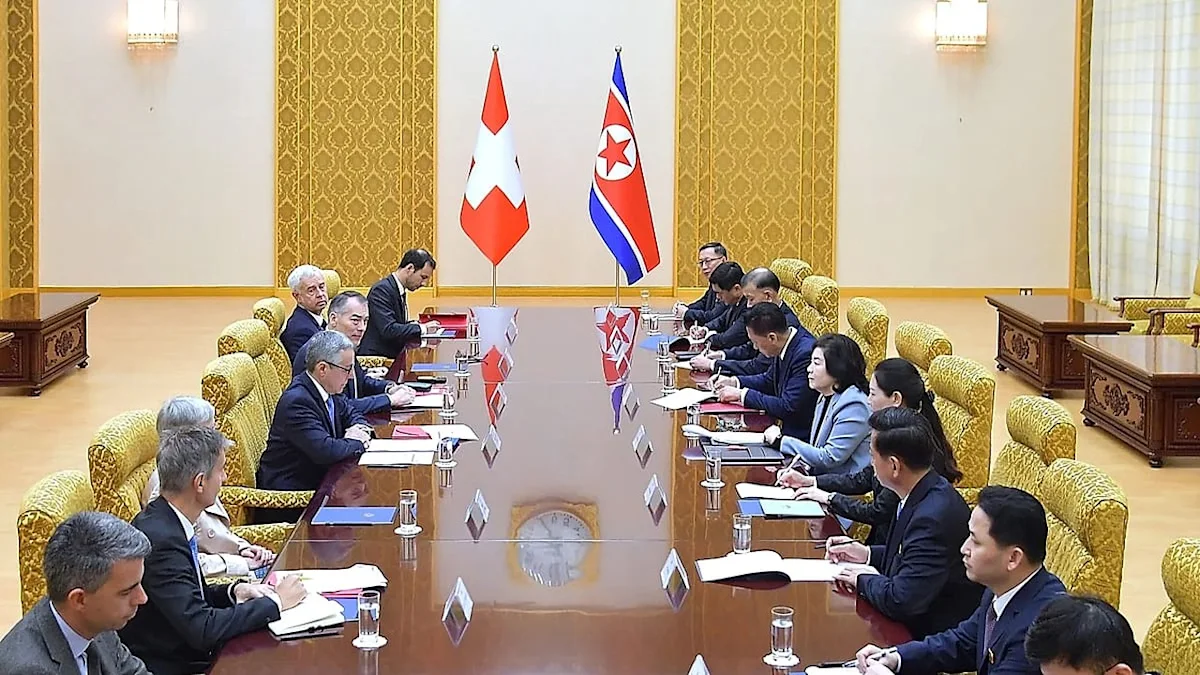

Just 37 days after Switzerland reopened its diplomatic office in Pyongyang, North Korea has demanded its closure in a dispute that tests whether diplomatic dialogue and international accountability can coexist.
North Korea has given Swiss representative Sylvain Astier 48 hours to depart, according to its Foreign Ministry, in a confrontation over sanctions against the Songdowon International Children’s Camp. The decision represents a setback for Swiss efforts to restore direct contact with Pyongyang. The implications extend beyond bilateral relations: a war centred in Eastern Europe is generating diplomatic consequences in East Asia.
Diplomacy Under Pressure
Switzerland, North Korea and the competing demands of diplomatic access, international accountability and humanitarian protection.
Sources: Swiss government diplomatic timeline and Reuters. Nukunya calendar calculations. The reported closure demand does not establish that diplomatic relations have formally ended.
A diplomatic opening tested after 37 days
According to the Swiss government’s diplomatic timeline , the office resumed operations on 19 October 2026.
Foreign Minister Ignazio Cassis visited the Korean peninsula from 29 to 31 October. The office was intended to facilitate political dialogue and explore humanitarian cooperation, while reporting to Switzerland’s embassy in Beijing.
Diplomatic relations established
Switzerland and North Korea establish formal diplomatic relations.
Cooperation office closes
The Swiss cooperation office closes amid pandemic restrictions.
Diplomatic office reopens
The office resumes operations to facilitate political dialogue and explore humanitarian cooperation.
29–31 October 2026 Swiss foreign minister visits
Ignazio Cassis visits the Korean peninsula shortly after the diplomatic reopening.
Expulsion and closure demand
North Korea’s expulsion and closure demand is reported. Physical closure and formal termination of diplomatic relations are not established by the demand alone.
37 elapsed days
| Date | Development |
|---|---|
| 1974 | Formal diplomatic relations established |
| March 2020 | Cooperation office closes amid pandemic restrictions |
| 19 October 2026 | Diplomatic office resumes operations |
| 29–31 October 2026 | Swiss foreign minister visits Korean peninsula |
| 25 November 2026 | Expulsion and closure demand reported |
The children’s camp at the centre of the dispute
Swiss authorities accuse the camp in Wonsan of involvement in moving Ukrainian children from Russian-occupied territory and subjecting them to ideological assimilation. Britain and the European Union have also designated the facility, according to the reporting available to Nukunya.
Explore the competing positions
Showing all perspectives.
Switzerland’s position
Swiss authorities accuse the camp of involvement in the transfer and ideological assimilation of Ukrainian children from Russian-occupied territory.
Switzerland separates its sanctions policy from its diplomatic engagement with Pyongyang.
North Korea’s position
Pyongyang disputes the legitimacy of the sanctions. Kim Yo Jong argues that the measures infringe North Korean sovereignty and has defended the camp’s activities.
Humanitarian accountability
The competing positions do not independently establish the individual circumstances of children involved. Their welfare and protection must remain central to any assessment.
Independent evidence of children’s circumstances and humanitarian outcomes remains necessary.
What the available reporting establishes
| Issue | Evidence status |
|---|---|
| Diplomatic reopening |
Officially documented Swiss government diplomatic timeline. |
| Expulsion and closure demand |
Reported development Actual operational closure remains unconfirmed in the available reporting. |
| Camp-related allegations |
Attributed allegations Individual circumstances are not independently established here. |
| North Korean objections |
Attributed official position Objections to sanctions and defence of the camp’s activities. |
| Sanctions instruments |
Primary verification outstanding Official legal instruments were not independently inspected for this report. |
| Improved child protection |
Outcome not established No verified improvement is demonstrated by the diplomatic confrontation alone. |
Can neutrality and sanctions coexist?
Neutrality does not necessarily require a government to abstain from economic restrictions. Switzerland’s position, as reported by Swissinfo , separates its sanctions policy from diplomatic engagement with Pyongyang.
Dialogue
Maintains channels for communication, negotiation and clarification.
Potential benefits- Humanitarian engagement
- Clarification of intentions
- Management of disagreements
Diplomatic engagement does not imply approval of another government’s conduct.
Targeted sanctions
Can impose restrictions and communicate formal condemnation of targeted conduct.
Potential objectives- Restrict access to financial services
- Constrain targeted activities
- Signal international accountability
Imposing restrictions does not guarantee behavioural change or improved humanitarian outcomes.
This comparison describes potential policy functions and limitations. It is not a legal determination concerning Switzerland’s neutrality obligations or the specific sanctions instruments.
Russia’s war is reshaping diplomacy beyond Europe
The dispute illustrates the difficulty of insulating bilateral relationships from wider geopolitical conflicts.
For African governments seeking to maintain partnerships across competing international blocs, it offers a relevant example of how decisions concerning one conflict can affect relationships elsewhere.
Four questions for foreign-policy decision-makers
Strategic autonomy
How can states preserve independent decision-making across competing international partnerships?
Diplomatic continuity
Which alternative channels remain available when bilateral engagement is disrupted?
International accountability
How can governments uphold their international obligations while managing diplomatic relationships?
Humanitarian consequences
How can policy decisions be assessed against their consequences for vulnerable populations?
Original Nukunya editorial framework. The comparison does not imply that African countries face identical circumstances or must adopt the same foreign policy.
Will the sanctions improve protection for children?
The economic effectiveness of restrictions on the camp remains uncertain. Targeted sanctions can constrain access to financial services and register formal condemnation, but their humanitarian value ultimately depends on outcomes.
From policy intervention to humanitarian outcomes
Targeted sanctions and diplomatic measures
Enforcement of applicable restrictions and monitoring of compliance
Independently documented changes in targeted activities
Independently verified improvements in the protection and welfare of affected children
Conceptual evaluation framework, not an established causal sequence. Each stage requires separate evidence. The existence of sanctions does not demonstrate that subsequent outcomes have occurred.
Proposed accountability indicators
| Indicator | Why it matters |
|---|---|
| Independently verified child welfare | Assesses whether protection has improved. |
| Humanitarian access | Establishes whether appropriate independent monitoring is possible. |
| Family tracing and reunification | Examines progress where relevant, lawful and consistent with the best interests of the child. |
| Sanctions implementation | Assesses whether applicable restrictions are being enforced. |
| Diplomatic continuity | Identifies remaining opportunities for communication and negotiation. |
| Unintended consequences | Examines whether policy measures create additional humanitarian barriers. |
Original Nukunya accountability recommendations. These are not published monitoring results, official sanctions objectives or verified findings about individual children. Reporting should protect children’s identities and sensitive personal information.
What happens next?
Attention now turns to Switzerland’s response, the operational status of the Pyongyang office and whether communication can continue through Beijing.
Operational status
UnresolvedHas the office physically closed, and when did any closure take effect?
Diplomatic communication
UnresolvedWill alternative communication channels remain available through Beijing?
Legal instruments
Verification pendingWhat do the official sanctions instruments specify about the designated facility, restrictions and legal grounds?
Humanitarian access
UnresolvedCan appropriate independent organisations obtain reliable information about affected children?
Sanctions effectiveness
Not establishedIs there independently verified evidence of changes in targeted activities or improved child protection?
Reporting status: 25 November 2026. This is an editorial monitoring framework, not an automatically updated live tracker.
Can diplomatic access and international accountability reinforce one another?
The enduring question is whether governments can preserve meaningful channels of dialogue while pursuing accountability and protecting vulnerable people, rather than treating these objectives as inherently incompatible.
Frequently asked questions
Has Switzerland ended diplomatic relations with North Korea?
The reported expulsion and closure demand does not itself establish that formal diplomatic relations have ended.
How long had the diplomatic office reopened?
There were 37 elapsed calendar days between 19 October and 25 November 2026. This measures the interval to the reported closure demand, not the office’s confirmed total operating duration.
Why is the Wonsan children’s camp controversial?
Swiss authorities accuse the facility of involvement in the transfer and ideological assimilation of Ukrainian children from Russian-occupied territory. North Korea disputes the legitimacy of the sanctions and defends the camp’s activities.
Can a neutral country impose sanctions?
Neutrality does not necessarily preclude economic restrictions. The legal assessment depends on the applicable obligations and specific measures. Switzerland distinguishes its sanctions policy from diplomatic engagement.
Have the sanctions improved children’s welfare?
Improved humanitarian outcomes have not been independently established in the reporting available to Nukunya.
Why does this dispute matter to Africa?
It illustrates how conflicts elsewhere can affect bilateral relationships, strategic partnerships and diplomatic decision-making. African countries do not necessarily face identical circumstances.
Related posts:
 Ukraine Strikes Major Russian Logistics Hub Near Moscow as Massive Warehouse Fire Sends Smoke Across Region
 Ghanaians Recruited Into Russia-Ukraine War: 272 Drawn Into Conflict, 55 Dead
 Ukraine and Russia trade major aerial attacks as deaths are reported on both sides
 Russia and Ukraine Agree to Humanitarian Ceasefire in Oleshky
 Ukraine-Russia Peace Talks Resume in Abu Dhabi as US Pushes for End to War