ECOWAS Court Dismisses Former Chief Justice Torkornoo’s Application Against Ghana


Follow Nukunya
Get the latest breaking news and updates from Nukunya.
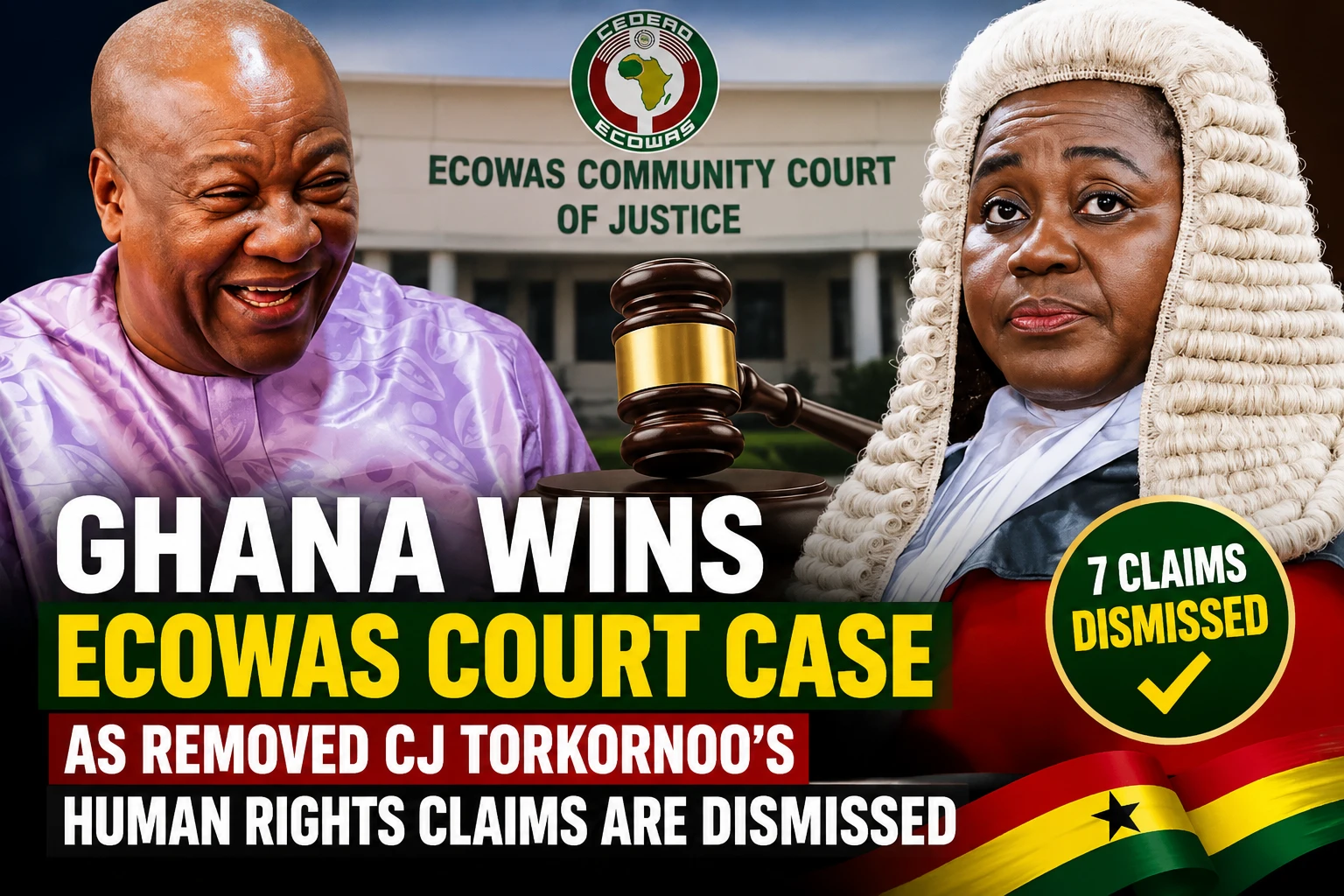
ECOWAS Court dismisses Torkornoo case: Former Chief Justice Gertrude Araba Esaaba Torkornoo has suffered a major legal setback after the ECOWAS Community Court of Justice dismissed her application challenging her removal from office and rejected all claims brought against the Republic of Ghana.
The judgment, delivered on June 24, 2026, ruled in favor of Ghana on all seven issues raised by Justice Torkornoo, finding that the country did not violate any of her rights under the African Charter on Human and Peoples’ Rights.
The Deputy Attorney General and Minister for Justice, Justice Srem-Sai, announced the outcome and described the ruling as a significant legal victory for Ghana.
“The ECOWAS Community Court has dismissed all seven claims brought against the Republic of Ghana,” he stated.
Justice Torkornoo had filed the case after challenging the constitutional process that led to her removal as Chief Justice. She argued that her rights were violated throughout the proceedings and sought several reliefs, including damages amounting to US$10 million.
Key issues considered by the ECOWAS Court
The court examined seven major issues raised by the former Chief Justice and ruled against all of them.
Fair hearing claims rejected
Justice Torkornoo argued that the prima facie determination process violated her right to a fair hearing under Article 7 of the African Charter.
However, the Court ruled that the prima facie stage merely serves as a filtering mechanism and does not amount to the actual hearing process. The judges noted that she was later given the petitions and afforded an opportunity to present her case before the committee.
Bias allegations dismissed
The former Chief Justice also claimed that members of the committee were biased because some justices had handled related matters previously.
The ECOWAS Court found no evidence proving bias and held that participation in previous judicial duties alone could not justify such allegations.
Suspension and removal declared lawful
On claims that her suspension and eventual removal violated her right to work, the court held that Ghana followed procedures outlined under Article 146 of the 1992 Constitution.
According to the judgment, the process was not arbitrary or unlawful.
Claims of indignity rejected
Justice Torkornoo had also alleged that she suffered indignity during proceedings through body searches, exclusion of family members, media leaks and the choice of venue.
The court ruled that the security measures implemented were reasonable considering the sensitive nature of the process.
Regarding the venue selection, judges said no evidence was presented to establish that it was intentionally chosen to traumatize her.
US$10 million damages claim rejected
Since the court concluded that Ghana had not violated any rights, it also declined to award the US$10 million damages requested by Justice Torkornoo.
The judgment stated:
“In light of the Court’s conclusions that Ghana has not violated any of the Applicant’s rights under the African Charter as alleged, the Court makes no decision on reparations.”
Background to the case
Justice Gertrude Torkornoo was suspended by President John Mahama in March 2025 pending investigations into petitions seeking her removal from office.
Parliament later approved the petition in May 2025, leading to her removal as Chief Justice and making her the first Chief Justice in Ghana’s constitutional history to be removed from office.
The ECOWAS Court’s ruling now effectively ends the international legal challenge brought against Ghana over the matter.
Related posts:
 NDC Renames Headquarters ‘Jerry Rawlings House’ on Founder’s 79th Birthday.
  Ghana High Court Adjourns Abronye DC’s Bail Hearing After State Request
  Asiedu Nketia’s tour fuels debate over future NDC flagbearer ambitions
  Mahama Calls for Renewed Pan-African Unity and Reparations Agenda During UK Visit
  Mahama Bans Ministers, State CEOs From Accepting Private Awards Without Approval