
Ghana intensifies fight against money laundering amid major corruption investigations in 2026

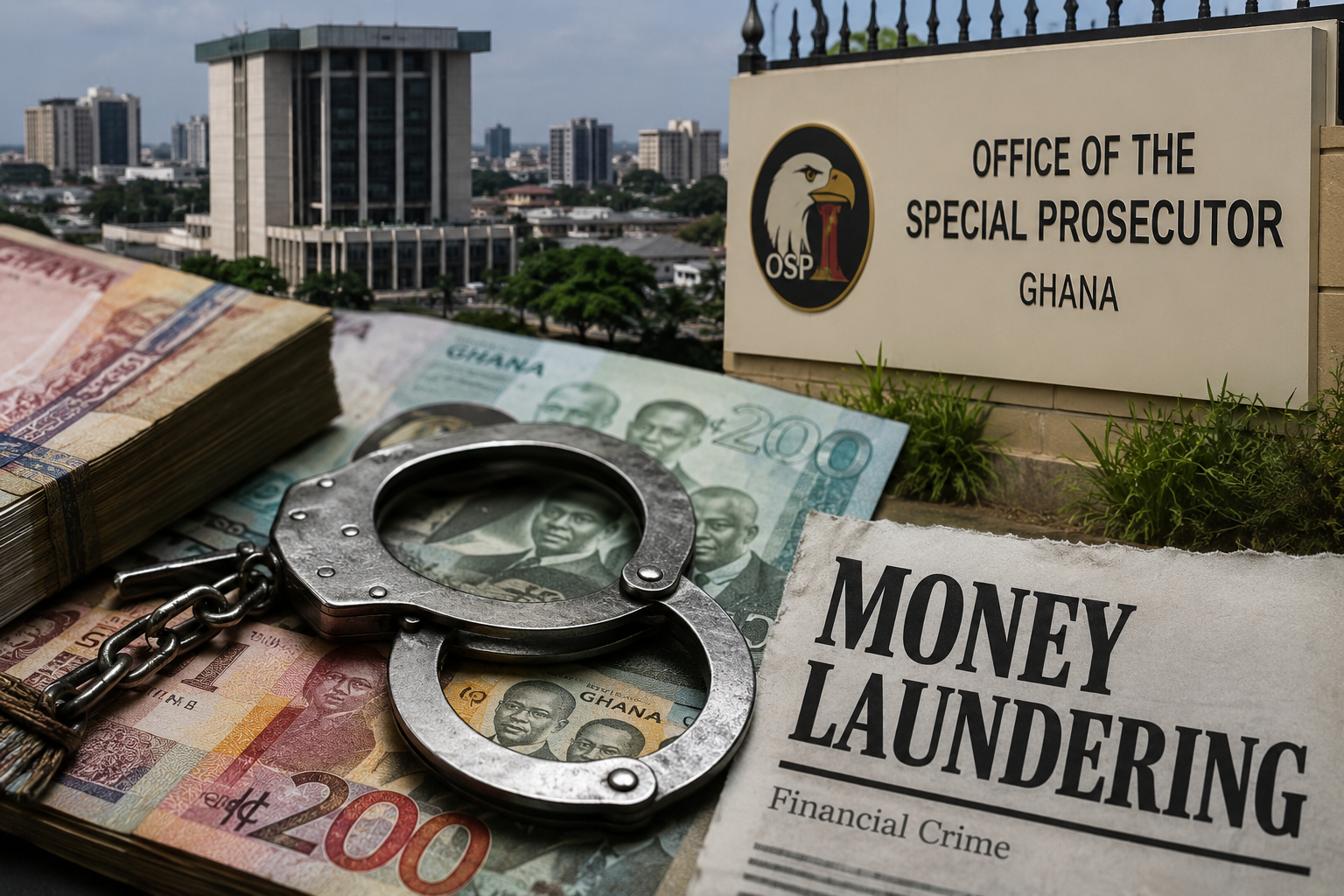

ACCRA, Ghana – Ghanaian authorities are intensifying efforts to combat money laundering and illicit financial flows as the West African nation faces growing concerns over corruption, illegal mining and organised financial crime.
Money laundering, the process of concealing the origins of illegally obtained funds, has become a major challenge for Ghana’s financial regulators and law enforcement agencies. Officials say the crime threatens economic stability, weakens investor confidence and allows criminal networks to operate across borders.
Recent investigations by Ghana’s Office of the Special Prosecutor (OSP) have drawn national attention to the issue after prosecutors launched corruption and money laundering probes involving former officials linked to the petroleum sector. Authorities allege that millions of Ghanaian cedis were unlawfully collected from petroleum transporters and oil marketing companies before being transferred through shell companies and used to acquire fuel stations, real estate and other assets.
Former officials caught
The OSP has said more than 280 million Ghanaian cedis ($26 million) is connected to the investigation, making it one of the country’s largest financial crime cases in recent years. The accused individuals have denied wrongdoing, while court proceedings remain ongoing.
Analysts say Ghana has faced increasing pressure in recent years to strengthen anti-money laundering controls as criminal organisations adopt more sophisticated methods involving digital payments, cryptocurrencies and international bank transfers.
Illegal mining, locally known as “galamsey”, has also contributed significantly to illicit financial flows. Authorities estimate that illegal gold trading and smuggling cost the country billions of dollars in lost revenue every year.
The Financial Intelligence Centre (FIC), Ghana’s national agency responsible for monitoring suspicious financial activity, has expanded oversight of banks, mobile money operators and financial technology firms. Financial institutions are now required to carry out stricter customer verification procedures and report suspicious or unusually large transactions more quickly.
Bank of Ghana
The Bank of Ghana has also introduced tighter regulations for digital payment platforms and fintech companies amid concerns that online transactions and cryptocurrencies could be exploited for money laundering.
In 2025, the government launched a specialised task force aimed at reducing gold smuggling and improving monitoring within the mining sector. Security agencies have increased raids on illegal mining operations, while customs officials have intensified inspections at border crossings and export centres.
Authorities say cooperation with international anti-money laundering organisations has also increased. Ghanaian investigators are working more closely with foreign financial intelligence agencies to trace suspicious cross-border transactions and recover stolen assets. Anti-corruption campaigners have welcomed the recent investigations and enforcement measures but argue that stronger prosecutions and institutional reforms are still needed.
“Enforcement is improving, but prosecutions must lead to convictions to create deterrence,” said a governance analyst based in Accra.
Experts also warn that technological developments are making financial crime more difficult to detect. Cryptocurrency platforms, digital banking systems and online payment networks can allow illicit funds to move rapidly across multiple jurisdictions with limited oversight.
Future of the country
To respond to the growing threat, several financial institutions operating in Ghana are adopting artificial intelligence-powered anti-money laundering systems capable of identifying unusual transaction patterns in real time.
Researchers say ArtificiaI Intelligence (AI) systems can process large volumes of financial data more efficiently than traditional monitoring systems, helping investigators detect suspicious activity earlier. However, experts caution that automated surveillance tools also raise concerns over privacy, transparency and potential algorithmic bias.
Despite the challenges, Ghanaian authorities say the country remains committed to strengthening its anti-money laundering framework and improving transparency within key sectors of the economy.
Officials believe continued cooperation between regulators, law enforcement agencies, financial institutions and international partners will be critical to reducing illicit financial flows and restoring investor confidence in one of West Africa’s fastest-growing economies.
Time will tell how far the country will go.
Related posts:
 EXPLAINER: Why Florida’s Lawsuit Against OpenAI Could Change AI Rules Worldwide
  840,000 Deaths a Year: Why the Future of Work Has Become a Public Health Crisis
  Ghana Rejects $109m US Health Deal Over Data-Sharing Concerns
  Ghana Premier League Fixtures Postponed as Funeral Rites Set for Slain Footballer Dominic Frimpong
  32 Ghanaians Listed in US Homeland Security ‘Worst of the Worst’ Database as Immigration Enforcement Intensifies