
EXPLAINER: Why Florida’s Lawsuit Against OpenAI Could Change AI Rules Worldwide


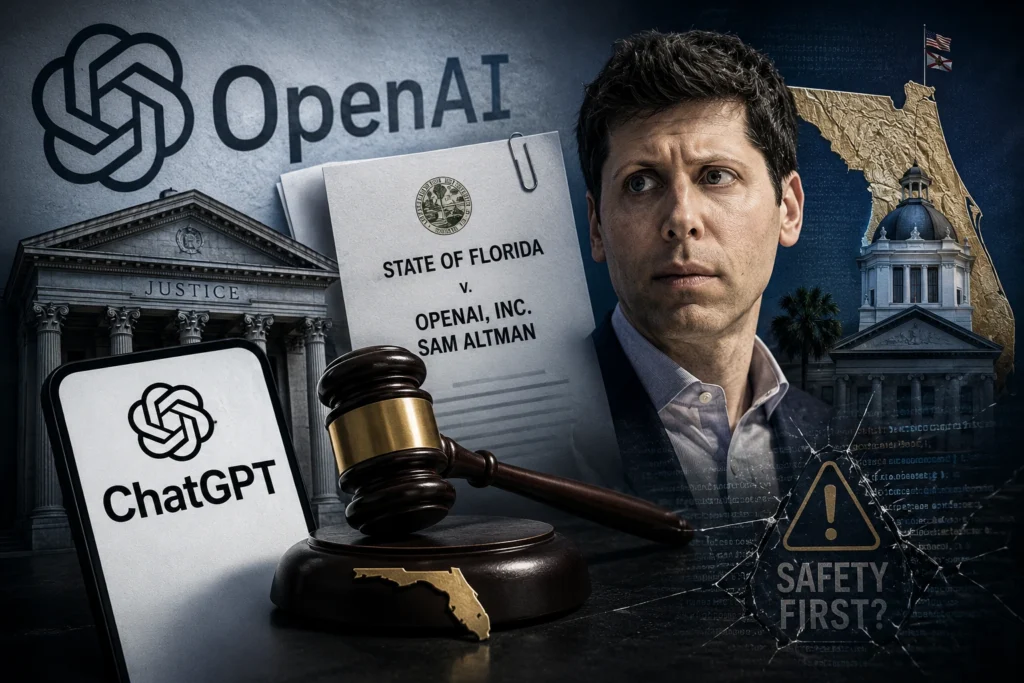
The landmark case could help determine who is responsible when artificial intelligence systems allegedly contribute to harm—and shape the future of AI regulation far beyond the United States.
Key Points
- Florida has become the first US state to sue OpenAI and chief executive Sam Altman over ChatGPT safety allegations.
- The state claims OpenAI prioritised growth over user safety and failed to adequately protect vulnerable users.
- OpenAI strongly disputes the allegations and says ChatGPT includes extensive safety safeguards.
- The lawsuit could influence how courts define responsibility for harms allegedly linked to artificial intelligence.
- The outcome may affect future AI regulation, technology investment and digital governance worldwide.
Why This Matters
The Florida lawsuit is about much more than ChatGPT.
At its core, the case asks one of the most important questions of the artificial intelligence era:
Who should be accountable when AI systems influence human behaviour?
The answer could shape future laws, regulatory frameworks and corporate responsibilities for AI developers around the world.
As governments race to harness artificial intelligence while managing its risks, the case is being closely watched by regulators, technology companies, investors and legal experts.
The Lawsuit
What Florida Alleges
Florida alleges that OpenAI knowingly released and aggressively marketed ChatGPT despite concerns about potential risks to users.
The state claims the company prioritised growth, market expansion and user adoption over adequate safety protections and failed to implement sufficient safeguards for vulnerable users, including children.
Attorney General James Uthmeier argues that OpenAI did not do enough to warn consumers about potential risks associated with the technology.
The lawsuit seeks:
- Financial penalties
- Changes to OpenAI’s business practices
- Court-ordered safety measures
- Personal liability claims against CEO Sam Altman
Importantly, these allegations remain unproven. No court has determined that OpenAI violated the law, and Florida’s claims remain contested.
OpenAI’s Response
OpenAI strongly disputes the allegations.
The company says ChatGPT incorporates multiple layers of safety protections designed to reduce harmful outputs, prevent dangerous interactions and direct users towards appropriate support resources when sensitive issues arise.
OpenAI says it continuously updates safeguards, conducts testing and works with researchers to identify and mitigate emerging risks.
The company has also argued that responsibility for criminal acts rests with individuals rather than AI systems and that no evidence shows ChatGPT caused the harms alleged in the lawsuit.
OpenAI is expected to challenge Florida’s claims vigorously.
The Legal Questions
What the Courts Must Decide
The lawsuit raises several questions that courts have never fully resolved.
Can an AI chatbot be treated as a product?
If courts classify generative AI systems as products, developers could face liability under traditional product-safety laws. Such a decision could fundamentally change how AI systems are built, tested and deployed.
Can Developers Be Responsible for AI Outputs?
Unlike traditional software, generative AI systems create unique responses in real time.
Courts may need to determine whether companies can be held responsible for content generated dynamically by their systems.
What Level of Harm Must Be Foreseeable?
A key issue is whether AI developers should reasonably anticipate and prevent harmful uses of their products.
Are Existing Laws Sufficient?
Judges may also consider whether current consumer-protection and liability laws are capable of addressing technologies that did not exist when many of those laws were written.
Why Some Legal Observers Are Sceptical
Not everyone believes Florida’s case will succeed.
Some legal analysts argue that proving causation could be difficult because courts often require a clear connection between a product and an alleged harm.
Others note that AI systems generate information but do not independently act in the physical world.
It also remains unclear whether courts will accept legal theories that have not yet been widely tested in relation to generative AI systems.
For that reason, many experts view the case as legally significant regardless of its eventual outcome.
Why AI Is Different
Technology companies have faced legal challenges for decades.
Previous disputes have involved:
- Social media misinformation
- Search engine content
- Privacy violations
- Recommendation algorithms
Generative AI introduces a new challenge.
Unlike traditional software, AI systems can produce millions of unique outputs that developers may never directly review.
That creates novel questions about responsibility, oversight and risk management.
Not the First Technology Reckoning
History suggests major technological breakthroughs are often followed by debates over accountability.
| Technology | Regulatory Response |
|---|---|
| Automobiles | Safety standards, licensing and product liability laws |
| Pharmaceuticals | Clinical trials and regulatory approval systems |
| Social Media | Privacy, misinformation and online safety rules |
| Artificial Intelligence | Emerging debates over accountability, transparency and governance |
Many analysts see the Florida lawsuit as part of this broader historical pattern.
What’s at Stake Economically?
The implications extend well beyond OpenAI.
Investors, regulators and technology companies are closely monitoring the case because a ruling that expands liability for AI developers could significantly increase compliance costs and alter how future AI systems are developed.
The outcome could influence:
- AI investment decisions
- Product development strategies
- Corporate risk assessments
- Insurance and compliance requirements
- Future regulatory frameworks
Technology firms developing generative AI are collectively investing billions of dollars in the sector.
The legal environment that emerges from cases such as Florida’s could therefore shape the future direction of the industry.
How the US and Europe Differ
The United States and Europe are taking different approaches to AI governance.
European Union
The EU has introduced the AI Act, one of the world’s most comprehensive AI regulatory frameworks.
The legislation focuses on:
- Transparency
- Risk management
- Accountability
- Safety requirements
United States
The US has largely relied on existing laws, regulatory guidance and litigation.
As a result, lawsuits such as Florida’s may play a significant role in shaping future American AI policy.
Why This Matters for Africa
The implications extend far beyond the United States.
Across Africa, artificial intelligence is increasingly being adopted in:
- Financial services
- Agriculture
- Healthcare
- Education
- Public administration
- Digital government services
Yet many African countries currently have limited AI-specific regulation.
For countries such as Ghana, which are expanding digital economies and exploring AI-enabled public services, questions surrounding accountability, transparency, consumer protection and ethical governance are becoming increasingly important.
Legal principles emerging from major cases in the United States and Europe could influence future AI governance frameworks across the continent.
Timeline: How We Got Here
| Year | Development |
|---|---|
| 2022 | ChatGPT launched publicly |
| 2023 | Global debate over AI regulation intensifies |
| 2024 | Major AI-related lawsuits begin emerging |
| 2025 | Governments expand scrutiny of AI safety and governance |
| 2026 | Florida becomes the first US state to sue OpenAI over ChatGPT safety allegations |
Three Possible Outcomes
1. OpenAI Prevails
The court rejects Florida’s claims, reinforcing the view that existing laws may not easily apply to generative AI systems.
2. Florida Prevails
A ruling against OpenAI could establish important precedents and accelerate calls for stronger AI regulation.
3. Settlement
The parties reach an agreement before trial, potentially resulting in operational changes without a definitive legal ruling.
The Bottom Line
The Florida lawsuit is about much more than OpenAI or ChatGPT.
It represents one of the earliest major attempts to define responsibility in an era where artificial intelligence increasingly shapes how people learn, communicate, work and make decisions.
The courts may not provide a definitive answer to every question raised by AI.
But this case could become one of the first significant legal battles to determine where accountability lies when machines increasingly influence human behaviour.
The outcome may not settle the global debate over artificial intelligence governance.
It could, however, help define the legal, ethical and regulatory framework within which that debate unfolds for years to come.
Source Transparency
This explainer was independently produced by Nukunya using public court filings, official statements and reporting from the Associated Press, CNN, NBC News, Financial Times, Fortune, Miami Herald and other reputable news organisations.
Reporting by Kofi Foli
Related posts:
 Florida Becomes First US State to Sue OpenAI Over ChatGPT Safety Allegations
  Pope Leo XIV Urges AI ‘Disarmament’ in Major Vatican Warning on Technology Risks
  Elon Musk vs Sam Altman: what the jury will decide
  Who decides what AI tells you? Ex‑Meta news chief Campbell Brown weighs in
  Nvidia ramps up Taiwan spending to $150bn a year as AI race intensifies