
Lionel Messi’s Tactical Intelligence Helped Argentina Overcome Switzerland

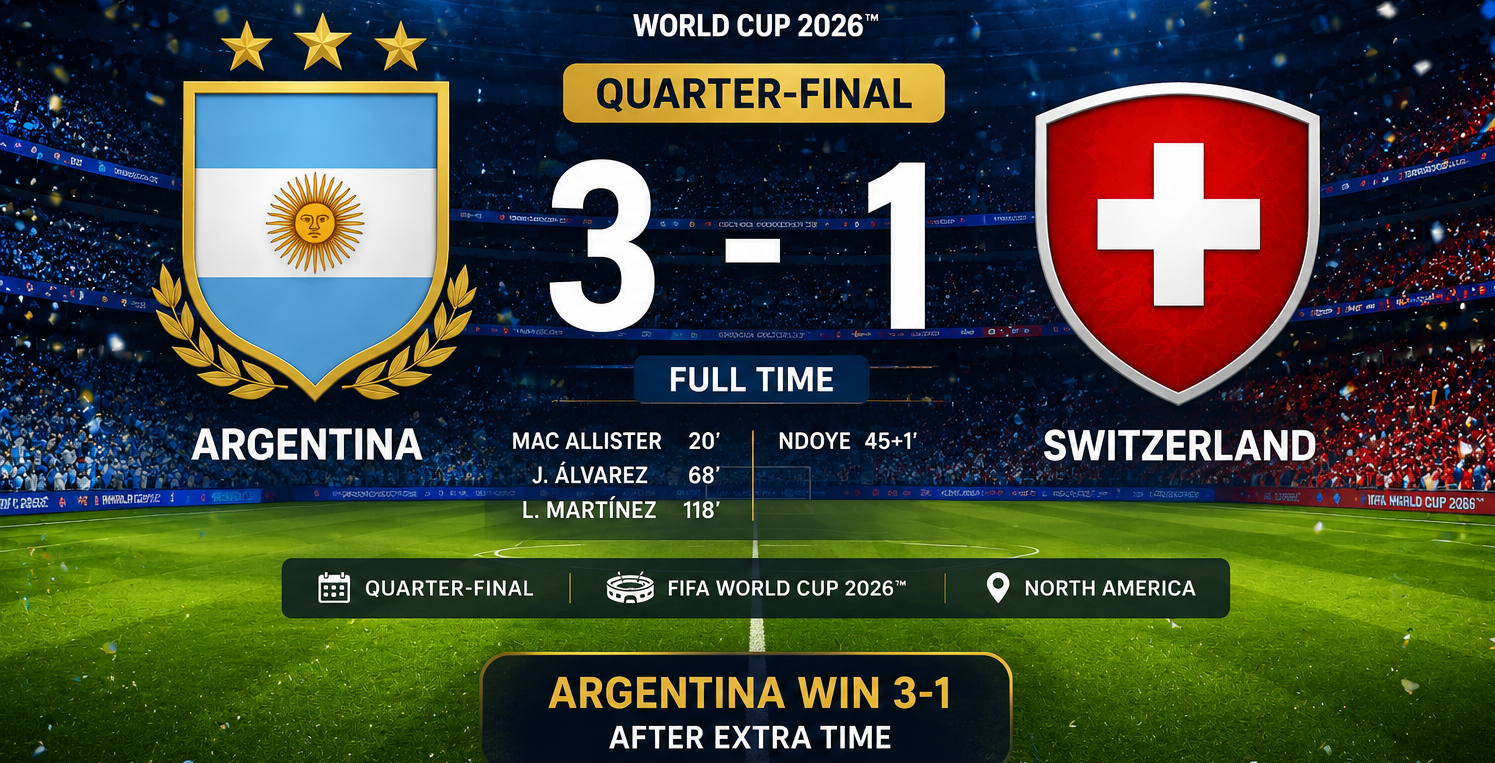

Lionel Messi may not have dominated the scoresheet against Switzerland, but his tactical intelligence once again proved decisive as Argentina secured a dramatic 3-1 extra-time victory to book their place in the FIFA World Cup 2026 semi-finals.
While Alexis Mac Allister, Julián Álvarez and Lautaro Martínez found the net, much of Argentina’s attacking structure revolved around Messi’s movement, positioning and decision-making. Rather than remaining high up the pitch as a traditional forward, the 39-year-old continually drifted into deeper areas, forcing Switzerland to rethink their defensive organisation throughout the match. Argentina eventually broke the Swiss resistance in extra time after a fiercely contested tactical battle.
Lionel Messi operated between the lines
Argentina coach Lionel Scaloni maintained his preferred 4-4-2 system, pairing Messi with Julián Álvarez in attack while allowing the captain complete freedom to roam. Instead of staying close to the Swiss centre-backs, Messi repeatedly dropped into the space between Switzerland’s midfield and defence.
This movement created uncertainty for Switzerland’s defensive block. If central defenders stepped forward to follow Messi, gaps opened behind them for Álvarez to exploit. If they held their position, Messi had the time and space to receive possession and dictate play.
Before the match, analysts widely expected Switzerland to defend with a compact central block rather than assigning a dedicated man-marker to Messi, relying instead on collective discipline to restrict his influence.
Stretching the Swiss defence
One of Argentina’s most effective tactical approaches was to stretch Switzerland horizontally.
As Messi drifted centrally to receive the ball, Argentina’s full-backs and midfielders provided width, forcing Switzerland’s defensive line to spread across the pitch. This created small passing lanes that Messi was able to exploit with quick combinations and disguised through balls.
Even when he was closely marked, Messi’s presence attracted multiple defenders, allowing teammates such as Mac Allister and Rodrigo De Paul to find pockets of space in midfield.
It was a reminder that Messi’s influence is not measured solely by goals or assists. His movement alone altered Switzerland’s defensive shape and opened opportunities for others.
Patience over urgency
Switzerland defended with discipline for long periods, frustrating Argentina and limiting clear-cut chances.
Rather than forcing risky passes, Messi showed patience in possession, recycling the ball and waiting for defensive gaps to appear. This approach helped Argentina maintain territorial control while gradually increasing pressure on the Swiss back line.
Although Switzerland equalised in the second half through Dan Ndoye, Argentina remained committed to their tactical approach instead of abandoning their structured build-up play. The patience paid off during extra time, when tired Swiss legs struggled to contain Argentina’s sustained attacks.
Messi’s off-the-ball movement
Perhaps the most overlooked aspect of Messi’s performance was what he did without the ball.
He regularly drifted away from crowded central areas into the right half-space, dragging defenders out of position and creating passing lanes for advancing midfielders. These subtle movements prevented Switzerland from settling into a predictable defensive rhythm.
Rather than relying on explosive pace, Messi used timing, positioning and awareness to manipulate the defensive structure.
It is a style of play that has become increasingly important as he has adapted his game later in his career.
Argentina’s supporting cast stepped up
Switzerland succeeded in limiting many of Messi’s direct attacking opportunities, but that created space for Argentina’s supporting players to make the difference.
Mac Allister opened the scoring before Switzerland equalised through Ndoye. In extra time, Julián Álvarez produced a stunning long-range strike to restore Argentina’s lead before Lautaro Martínez sealed victory in stoppage time.
The result demonstrated Argentina’s growing tactical flexibility. Opponents can no longer focus exclusively on stopping Messi, as the team’s attacking threat now comes from multiple sources.
What England should learn
Argentina’s semi-final opponents, England, will study how Switzerland attempted to contain Messi.
The Swiss largely succeeded in reducing his shooting opportunities by defending compactly and limiting space between the lines. However, doing so allowed Argentina’s midfield runners and substitute attackers to exploit gaps elsewhere.
England now face a difficult tactical decision. Concentrating too heavily on Messi risks creating opportunities for players such as Álvarez, Mac Allister and Lautaro Martínez. Ignoring Messi’s movement, however, remains one of the biggest tactical mistakes any team can make.
The verdict
Messi’s performance against Switzerland illustrated why he continues to influence matches at the highest level despite approaching the latter stages of his remarkable career.
He was not Argentina’s goalscorer on the night, but his intelligence, movement and ability to dictate the tempo helped create the conditions for victory.
As Argentina prepare to face England in the semi-finals, stopping Messi will remain one of football’s greatest tactical challenges—not simply because of what he does with the ball, but because of how he changes the game around him.
Related posts:
 Ghana Condemns Canada Visa Ban on Thomas Partey Ahead of World Cup Clash Thomas Partey to Miss Ghana’s World Cup Opener After Canada Rejects Visa Appeal
  Ghana’s Yirenkyi Delivers Late Winner to Sink Panama in World Cup Opener
  Ghana Black Stars qualify for FIFA World Cup Round of 32 before Croatia showdown
  Croatia Edge Ghana 2-1 as Both Teams Advance to World Cup Knockout Stage