250,000 Jobs Through Govt’s Oil Palm Plan



250,000 People to Get Jobs Through Govt’s Oil Palm Plan
The government is targeting the creation of about 250,000 jobs through an ambitious plan to establish 100,000 hectares of new oil palm plantations across Ghana.
The initiative forms part of efforts to transform the country’s oil palm industry, increase domestic production and reduce Ghana’s dependence on imported palm oil.
The Minister for Food and Agriculture, Eric Opoku, said the programme must go beyond expanding the acreage under cultivation and focus on improving productivity, processing capacity and incomes for farmers.
Government targets oil palm self-sufficiency
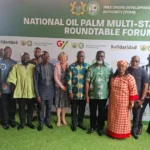
Speaking at a National Oil Palm Multi-Stakeholder Forum in Accra, Mr Opoku said the expansion programme forms part of government’s broader strategy to move agricultural policies from planning to practical results.
He described oil palm as a strategic crop that connects agriculture to industry, supporting farmers, processors, traders, transport operators and manufacturers.
According to the Minister, Ghana’s demand for palm oil currently exceeds domestic production, forcing the country to rely heavily on imports.
He said closing the production gap would not only strengthen food security but also create employment opportunities and retain more foreign exchange within the Ghanaian economy.
TCDA to coordinate expansion programme
The Tree Crops Development Authority (TCDA) is expected to play a central role in implementing the programme through production planning, licensing, traceability and quality assurance.
The Chief Executive Officer of TCDA, Dr Andy Osei Okrah, said the authority’s goal is to help Ghana achieve palm oil self-sufficiency by 2032 while positioning the country as a competitive player in the global market.
He said the authority would coordinate planting programmes, facilitate access to certified seeds and seedlings and create opportunities for sustainable investment in the sector.
Dr Okrah said the stakeholder forum was intended to develop a structured programme, build consensus and establish a clear implementation plan to unlock the full potential of Ghana’s oil palm industry.
Focus on productivity and investment
The Board Chairman of the TCDA, Professor William Oduro, said the authority would prioritise access to improved planting materials and higher farm productivity.
He also identified efficient extension services, aggregation, trading, processing and value addition as key areas requiring attention.
Prof. Oduro further stressed the need for farmers and other players in the industry to have access to affordable, long-term financing to support the expansion of plantations and processing facilities.
CSIR-OPRI supports expansion agenda
As part of preparations for the programme, the leadership of the TCDA, led by Dr Andy Osei Okrah, recently paid a courtesy visit to the Council for Scientific and Industrial Research–Oil Palm Research Institute (CSIR-OPRI).
The visit was aimed at assessing the institute’s operational readiness and capacity to support the government’s oil palm expansion agenda under the National Policy on Integrated Oil Palm Development (2026–2032).
The national policy was announced as part of the 2026 Budget.
The government says the proposed 100,000-hectare expansion will be measured not only by the size of land cultivated but also by its impact on productivity, farmer incomes, processing, employment and Ghana’s ability to meet domestic palm oil demand.