
COP31 Climate Finance Talks Expose Funding Gap as Africa Demands Action
COP31 negotiations expose the adaptation finance challenge facing Africa. UNEP estimates $305bn in annual needs by 2035, while international public flows lag far behind.

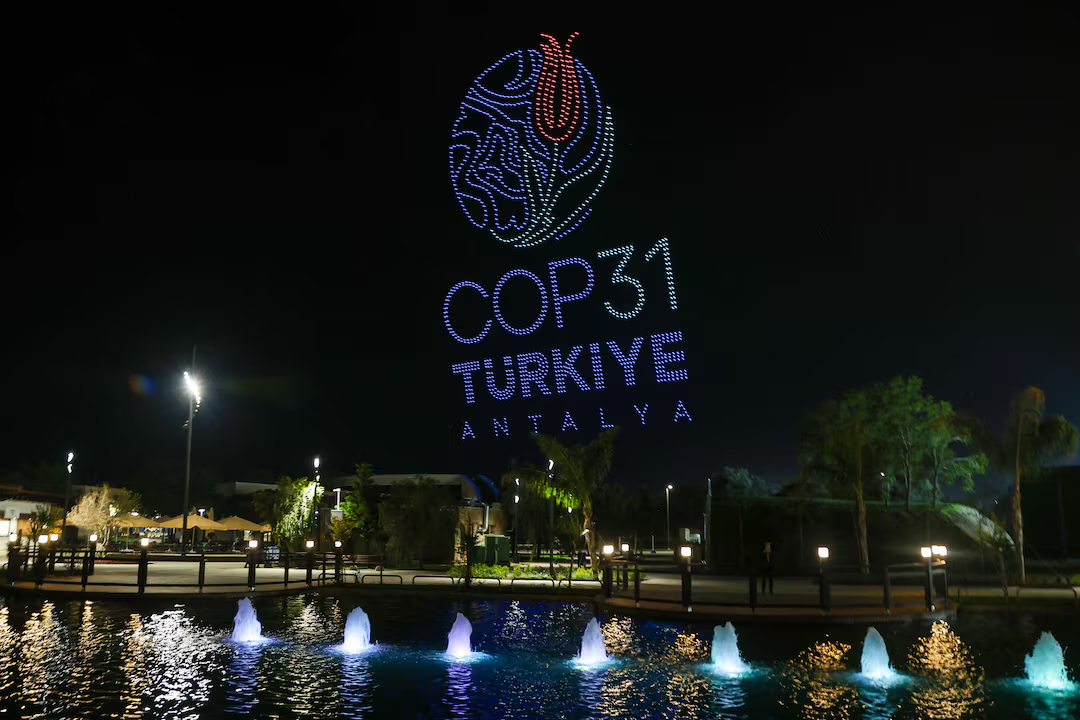

Developing countries face estimated annual adaptation needs of $305 billion by 2035, while international public finance remains far below that level. As COP31 negotiations continue in Türkiye, Ghana and other African states are demanding more reliable support.
Antalya, Türkiye — African governments are pressing for stronger climate-finance commitments as the COP31 United Nations summit enters its scheduled final day, with a revised draft agreement omitting a proposed $120 billion annual adaptation-finance benchmark.
Reuters reported that the revised text released on Thursday removed the proposed figure and references to ending fossil fuel use. The text is a negotiating draft, not a final agreement. The IISD Earth Negotiations Bulletin reported on Friday that delegates had still not reached substantive agreement on several agenda items.
For Ghana, the stakes extend beyond diplomacy: flooding, coastal erosion, changing rainfall patterns and heat threaten homes, farming, infrastructure and livelihoods. Yet international finance announcements do not automatically translate into approved and disbursed projects.
The $305 billion adaptation challenge
How much finance do developing countries need, how much international public funding is flowing, and what could the gap mean for Ghana?
Explore the adaptation-finance comparison
Compare estimated annual needs in 2035 with reported international public adaptation flows in 2024.
The lower estimate of 2024 international public flows is equivalent to approximately 9.2% of estimated annual needs in 2035.
How to interpret this: The two figures refer to different years and financing scopes. This is not the percentage of all adaptation needs already funded, nor a verified financing shortfall.
Five figures, five different meanings
These amounts must not be added together. They represent different categories, periods and stages of financing.
What could adaptation funding mean for Ghana?
Choose a sector to explore possible investments and the safeguards needed to deliver meaningful results.
Reducing flood risks
Possible investments include flood-risk mapping, drainage improvements and early-warning systems.
Delivery test: Are projects technically justified, maintained and shown to reduce exposure and vulnerability?
Grants and loans are not interchangeable
Grants
Generally do not require repayment. They may be particularly important for public-interest projects that do not generate revenue.
Concessional loans
Offer more favourable terms than ordinary commercial borrowing but still require repayment and can affect public debt.
The financing structure should reflect the project’s public benefits, repayment capacity, risks and maintenance needs.
Adaptation versus loss and damage
Adaptation
Reducing future or ongoing climate risks through measures such as flood defences, resilient crops and water management.
Loss and damage
Responding to climate-related harms that cannot be fully avoided, including certain economic and non-economic losses.
Compared with a $342m initial envelope. Requests are not approved disbursements, and the envelope is not an estimate of total global losses.
Five tests for any COP31 agreement
1. Scale — Is the amount meaningful?
Compare the precise commitment with independently assessed needs, preserving differences in years and financing definitions.
2. Quality — What type of finance is offered?
Examine grants, concessionality, repayment obligations and debt implications.
3. Access — Can vulnerable communities benefit?
Assess eligibility, application complexity, local participation and administrative barriers.
4. Delivery — Has money actually been transferred?
Distinguish pledges, commitments, approvals and disbursements.
5. Results — Has vulnerability been reduced?
Evaluate outcomes such as reduced flood exposure, improved warning coverage and resilient infrastructure.
What happens next?
COP31 is scheduled to conclude on 20 November 2026, although negotiations may continue beyond the scheduled deadline.
The revised draft discussed in this report must not be treated as a final adopted agreement. Any subsequent decision should be assessed against its exact wording, timetable and accountability arrangements.
For Ghana and other African countries, the key question is whether commitments translate into accessible funding and measurable protection for communities.
Related posts:
 Ghana Pushes Border Cooperation as Sahel Insecurity Raises Regional Security Risks
 Only one Ghanaian reports for South Africa evacuation flight amid xenophobia fears
 Ghana floods displace families as heavy rains hit Cape Coast
 Ghana Immigration Service apprehends 1,055 in street-begging operation, including 662 children
 Zanetor Agyeman-Rawlings Assumes Office as Environment Minister