
SDG 4 Ghana Education Progress: Access and Quality Goals
Source: World Bank indicators / Trading Economics



Tracking Recent SDG 4 Ghana Education Progress

Over the past two decades, Ghana has achieved remarkable success in expanding access to its school system. However, as the global community moves toward the 2030 deadline for the United Nations’ Sustainable Development Goals, the focus of
SDG 4 Ghana education progressis shifting. While the initial challenge was getting children into classrooms, the current priority has moved toward ensuring those children actually acquire foundational skills. The Ministry of Education in Ghana is now transitioning from a focus on “schooling” to “learning.” By pioneering new methods of data collection and assessment, the nation is working to ensure that its public investments translate into measurable cognitive skills, specifically targeting the benchmarks set by SDG 4.1.1, which tracks proficiency in reading and mathematics at various stages of a child’s education.
Statistical Milestones: Enrollment Trends (2000–2024)
The data regarding
Ghana primary enrollment statisticspaints a picture of a nation that has successfully democratized access to basic education. According to the UNESCO Institute for Statistics (UIS) Data Browser, Ghana raised its primary enrollment rate from a modest 65.52% in 2000 to an impressive 95.23% in 2024. This growth was mirrored in the lower secondary sector, which expanded from 59.23% to 94.83% during the same period. The sheer volume of students within the system has also seen a dramatic rise. World Bank indicators reported by Trading Economics show that the number of secondary education pupils in Ghana reached 3,289,607 in 2022. This historical high represents a significant increase from the 2.06 million pupils recorded just a decade earlier in 2011, illustrating the immense pressure on the state to provide infrastructure and resources for a rapidly growing student body.
Defining ‘Learning Poverty’ in the Ghanaian Context
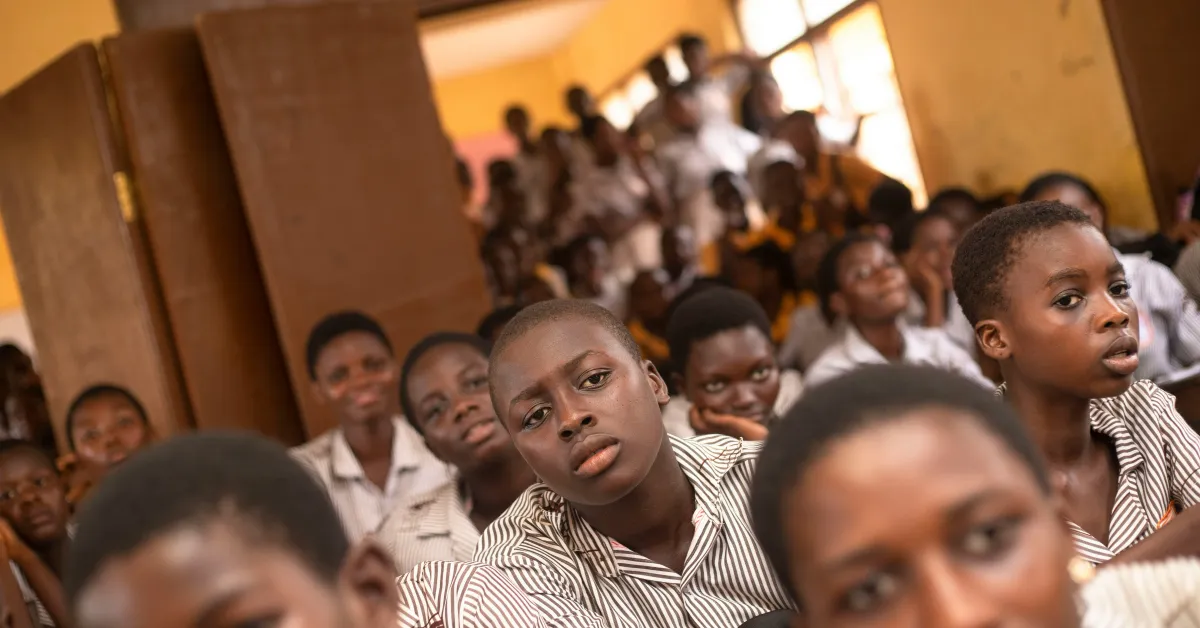
Despite high enrollment numbers, a critical gap persists between the years spent in a classroom and the knowledge gained. This phenomenon is often described as
Ghana learning poverty. Data from the World Bank highlights a stark disparity: while a Ghanaian child can expect to complete approximately 12.1 years of school by the age of 18, their actual learning equivalent is estimated at only 5.89 years. This suggests that nearly half of the time spent in school does not result in the acquisition of expected skills. To address this, the Ghanaian government has emphasized the need for high-quality, globally comparable data to diagnose these learning gaps and drive evidence-based policy-making. Without such data, it is difficult to determine whether students are attaining international proficiency levels in literacy and numeracy.
Pioneering Data: The Ghana National Standardized Test (NST)
In a landmark achievement for
SDG 4.1.1 reporting Ghanabecame a global pioneer by successfully leveraging its domestic assessment data for international benchmarks. Traditionally, national learning assessments remained confined to local use because they lacked the technical comparability required for UN reporting. The
Ghana National Standardized Test (NST)changed this dynamic. As a nationwide, census-based assessment, the NST satisfies the necessary population coverage and sampling requirements. By working with the UIS Data Readiness Review and Support Mechanism, Ghana aligned the NST’s design, administration, and documentation with international standards. Mr. Clement Osei Antwi, Deputy Director of Learning Assessment, noted that this process helps the Ministry identify exactly where learners fall short of international proficiency levels, strengthening internal assessment capabilities.
Curriculum Evolution: The Resurgence of History Education
The quality of education is also being addressed through curriculum reforms that reflect national identity and heritage. Research indicates that
education quality in Ghanais being bolstered by a renewed focus on history education. Historically, the teaching of history in Ghana was heavily influenced by Western historiographical ideals and colonial ambitions. However, recent developments suggest that history education is “regaining its grounds” in Ghanaian schools. Through the 2021 social reforms and updates to teacher education, the curriculum is moving away from imperialist-shaped narratives toward a more robust understanding of African history. This shift is seen as essential for fostering critical thinking and a sense of national belonging among the millions of students currently enrolled in the system.
Future Forecasts and Strengthening Educational Quality
The path forward for Ghana involves more than just maintaining high enrollment; it requires a rigorous focus on the quality of learning outcomes. By institutionalizing the SDG 4.1.1 indicator, the Ministry of Education can monitor progress at three critical stages: the end of lower primary, the end of primary, and lower secondary education. The success of the Ghana National Standardized Test serves as a model for other nations in the region. By prioritizing leadership commitment, functional structures, and international collaboration, Ghana is working to ensure that the “12.1 years” children spend in school eventually result in 12.1 years’ worth of actual knowledge. Continued investment in foundational reading and mathematics will be the ultimate measure of whether Ghana’s educational quantity has truly transformed into educational quality.
Conclusion
Ghana stands at a critical juncture in its educational journey. Having achieved near-universal access to primary and secondary schools, the nation is now leading the way in transparently reporting learning outcomes. Through the integration of the National Standardized Test into global SDG frameworks and the revitalization of its history curriculum, Ghana is demonstrating that data-driven policy is the most effective tool for eradicating learning poverty and securing a better future for its three million-plus students.
Related posts:
 $300 Million World Bank Loan: 5 Key Facts Isaac Adongo Says It’s Not for Free SHS
 Graduates with Disabilities Petition Presidency Over 5% Job Quota
 John Dumelo Supporting SHS Students in Ayawaso West
 UK Student Visa Rules 2026: Students to Show Up to £14,130 From November
 Caleb Kwaku Afaglo Awarded Doctor of Business Administration