South Africa Police Inquiry Hears Corruption, Drug Raid and Crime Syndicate Allegations


Follow Nukunya
Get the latest breaking news and updates from Nukunya.
An interim report highlights claims involving senior South African police officers, disputed gifts and alleged failures in major cocaine investigations
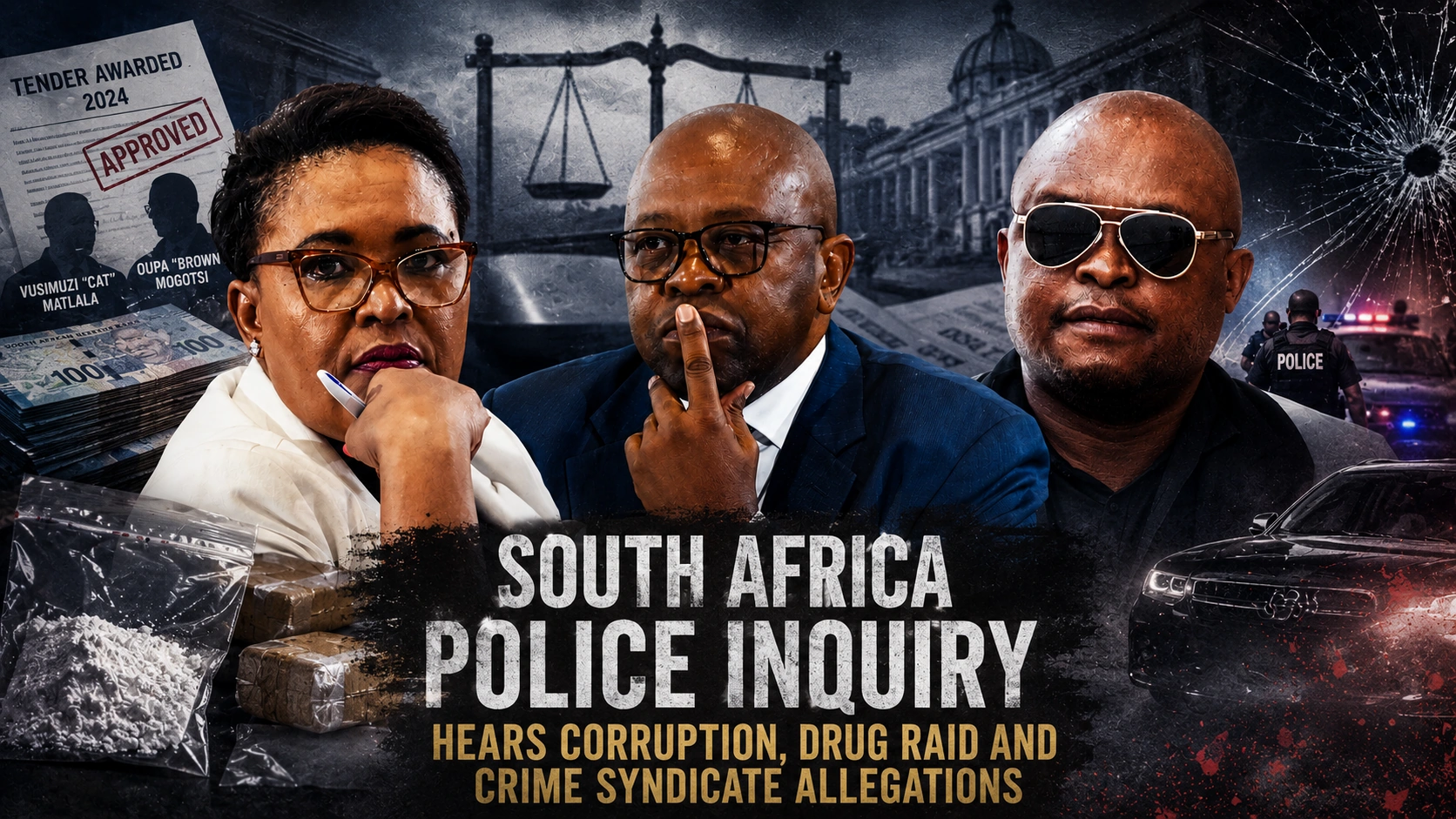
JOHANNESBURG, South Africa — A high-profile judicial inquiry examining allegations of corruption and organised crime links within South Africa’s police service has heard claims involving controversial business relationships, disputed gifts, alleged investigative failures and questions over the handling of major drug seizures. The inquiry, known as the Madlanga Commission, was established by President Cyril Ramaphosa following allegations made by senior police officials that organised criminal networks had infiltrated sections of the country’s law enforcement and criminal justice institutions.
An interim report from the commission has now been presented to the president, although its contents have not yet been made public. The commission is expected to resume hearings later this year before producing a final report.
Questions Over Gifts and Public Contracts
Among the most closely watched testimonies was that of senior police officer Brigadier Rachel Matjeng, who appeared before the commission in February. The inquiry examined her role in overseeing a public contract awarded in 2024 to a company linked to businessman Vusimuzi “Cat” Matlala. The contract was intended to provide healthcare services to members of the South African police service.
Matjeng denied allegations that she received kickbacks linked to the contract.
She acknowledged receiving gifts from Matlala but rejected claims that they were connected to any improper conduct. According to testimony presented to the commission, the gifts included medication used for weight management. Matlala has denied wrongdoing. He is currently facing separate criminal charges and has yet to formally respond to all allegations examined by the commission.
Related Court Proceedings
The allegations examined by the commission have also attracted scrutiny from South Africa’s criminal justice system.
Separately, South African broadcaster eNCA reported that Brigadier Rachel Matjeng, businessman Vusimuzi “Cat” Matlala and several other accused appeared before a Pretoria court earlier this year in connection with charges including corruption, fraud and alleged violations of public finance legislation. According to the report, the case centres on a healthcare services contract awarded to Medicare24, a company linked to Matlala. The accused have not been convicted, and legal proceedings remain ongoing.
The court proceedings are separate from the Madlanga Commission, which has not yet reached final conclusions regarding many of the allegations aired during public hearings.
Scrutiny of Major Cocaine Seizures
The commission has also focused on two major cocaine seizures that occurred in 2021 and the subsequent handling of evidence. One case involved the interception of more than 500 kilograms of cocaine hidden inside a shipping container in Durban. Another involved approximately 700 kilograms of cocaine discovered in Johannesburg.
Witnesses described a series of procedural failures, including alleged shortcomings in crime scene management, evidence handling and storage procedures. Senior Hawks official Major-General Hendrik Flynn told the inquiry that the sequence of events surrounding the seizures raised serious concerns and warranted closer examination. Testimony presented to the commission alleged that some evidence later disappeared while under official control, prompting further questions about oversight and accountability. No findings of criminal liability have yet been made by the commission, and several individuals named during proceedings have denied wrongdoing.
Witnesses and Political Fallout
Another prominent witness was businessman and political figure Oupa “Brown” Mogotsi, who has been linked by some testimony to individuals allegedly involved in efforts to influence police operations. Mogotsi has denied the allegations and rejected claims connecting him to organised criminal activity. He also faces separate legal proceedings relating to an alleged incident that he maintains was fabricated. The inquiry has attracted significant public attention in South Africa because of the senior officials involved and the potential implications for public confidence in law enforcement institutions.
Why the Inquiry Matters
South Africa has faced recurring concerns over corruption, organised crime and institutional accountability in recent years. The Madlanga Commission was established to determine whether criminal networks exerted influence within policing structures and whether state institutions responded appropriately to those threats. The commission has not reached final conclusions, and no definitive findings have yet been issued regarding many of the allegations aired during public hearings.
Its final report, expected later this year, could shape future reforms of South Africa’s policing and criminal justice systems and may lead to further investigations or prosecutions if evidence warrants such action. For now, the inquiry continues to expose allegations that have raised difficult questions about governance, accountability and public trust in one of Africa’s most important democracies.
Reporting by Edem Hodasi
Additional sourcing: BBC
Related posts:
 First group of Ghanaians repatriated from South Africa after migrant protests
  Nigeria Warns Against Reprisal Attacks Amid South Africa Anti-Migrant Tensions
  Mali Defence Minister Sadio Camara Killed in Coordinated Attacks Across Country
  South Africa Police Chief Suspended Over $21m Corruption Probe
  Ghana Challenges South Africa Over Xenophobic Attacks, Rejects Crime Allegations Against Ghanaians