
Former Nigerian Oil Minister Diezani Alison-Madueke Cleared in UK Bribery Case

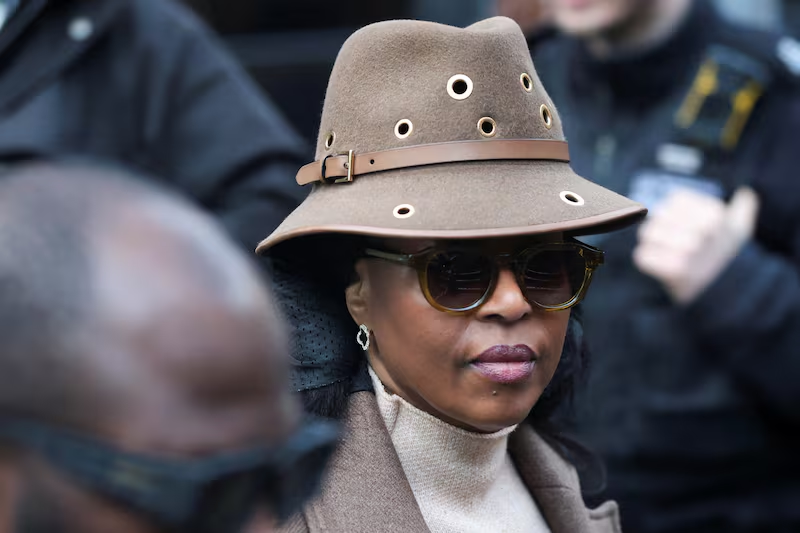

A London jury has acquitted former Nigerian oil minister and former OPEC president Diezani Alison-Madueke of six bribery charges, ending one of the United Kingdom’s highest-profile corruption prosecutions involving an African political figure.
LONDON, United Kingdom — Former Nigerian petroleum minister and former OPEC president Diezani Alison-Madueke has been acquitted of six bribery-related charges by a jury at Southwark Crown Court, bringing to a close one of the United Kingdom’s most prominent corruption prosecutions involving a senior African political figure.
The verdict follows a lengthy investigation and a five-month trial centred on allegations that Alison-Madueke accepted luxury benefits from wealthy oil industry executives while serving as Nigeria’s minister of petroleum resources between 2010 and 2015. Prosecutors alleged that accommodation, travel and other benefits were provided by individuals seeking influence within Nigeria’s oil sector. Alison-Madueke denied wrongdoing throughout the proceedings.
After more than 46 hours of deliberation, jurors found her not guilty on all six counts. Her brother, Doye Agama, and oil industry executive Olatimbo Ayinde were also acquitted of charges linked to the case.
The verdict marks the end of one of the UK’s most closely watched international corruption prosecutions and raises fresh questions about the challenges investigators face when pursuing complex bribery cases spanning multiple jurisdictions, legal systems and years of financial records.
In a statement issued after the verdict, Alison-Madueke described the outcome as the end of a long personal ordeal. The UK’s National Crime Agency, which led the investigation, said it respected the jury’s decision.
One of Africa’s Most Powerful Energy Figures
The case attracted global attention because of Alison-Madueke’s position within both Nigerian politics and the international energy industry.
She served as Nigeria’s petroleum minister under former President Goodluck Jonathan and became the first woman to serve as president of the Organization of the Petroleum Exporting Countries (OPEC) in 2014. At the time, she was regarded as one of the most influential figures in global energy policy and one of Africa’s most powerful female political leaders.
British authorities launched investigations into her activities more than a decade ago, making the case one of the longest-running corruption probes involving a former African cabinet minister in the United Kingdom.
During the trial, prosecutors argued that powerful oil executives financed aspects of Alison-Madueke’s lifestyle while she held public office. Defence lawyers rejected those claims and argued that the prosecution had failed to establish evidence of criminal conduct. The jury ultimately acquitted her on all charges.
Questions About International Corruption Investigations
The outcome represents a setback for the National Crime Agency after more than a decade of investigation. The trial exposed some of the difficulties authorities face when pursuing alleged corruption involving senior public officials across borders. Such cases often depend on evidence collected in different countries, cooperation between multiple agencies and the reconstruction of financial transactions that may have occurred many years earlier. Legal analysts note that criminal prosecutions require evidence capable of proving guilt beyond reasonable doubt, one of the highest legal standards in the justice system. In this case, jurors concluded that threshold had not been met.
Significance for Nigeria
The verdict is also likely to reignite debate within Nigeria, where allegations surrounding the management of the country’s oil wealth have remained politically sensitive for years. Nigeria is Africa’s largest oil producer, and successive governments have faced scrutiny over transparency, revenue management and corruption allegations linked to the petroleum sector. For supporters of Alison-Madueke, the acquittal represents vindication after years of investigations and public scrutiny. Critics, however, argue that broader questions surrounding governance and accountability in Nigeria’s oil industry remain unresolved.
The jury’s verdict addresses the criminal charges brought before the London court but does not end wider debates about transparency, public trust and anti-corruption efforts within Africa’s largest economy.
What the Verdict Means
Beyond the courtroom, the case carries broader implications for governance and anti-corruption enforcement. Experts say the proceedings highlight how difficult it can be to prosecute alleged corruption involving senior public officials years after the events in question. Such cases frequently rely on international cooperation, witness testimony, documentary evidence and financial records gathered across several jurisdictions.
The outcome is likely to be studied by prosecutors, anti-corruption agencies and policymakers seeking to strengthen future investigations involving complex international financial crimes. For African governments, the verdict may also renew discussion about the effectiveness of existing anti-corruption frameworks and the importance of strong domestic institutions capable of investigating allegations promptly and independently.
Looking Ahead
The acquittal closes a major chapter in a case that has remained in the public spotlight for more than a decade. For Alison-Madueke, it marks the conclusion of a long-running criminal prosecution that attracted attention across Africa, Europe and the global energy sector. For investigators and policymakers, it leaves behind important questions about how complex international corruption allegations should be investigated, prosecuted and ultimately judged in court.
Related posts:
 Nigeria Arrests Former Power Minister After 75-Year Corruption Sentence
  Senegal power struggle escalates as ousted Sonko elected parliament speaker
  Four Sentenced to Death Over Nigeria’s Deadly Owo Church Attack
  Chimamanda Adichie Says Lagos Hospital Delayed Inquiry Into Son’s Death
  Nigerian Troops Rescue Widow of Ex-General Rabe Abubakar After His Death in Captivity