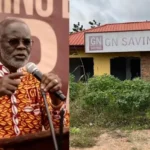
Nigeria Arrests Former Power Minister After 75-Year Corruption Sentence



Nigerian anti-corruption authorities have arrested former Power Minister Saleh Mamman days after a court sentenced him in absentia to 75 years in prison over a ₦33.8 billion money laundering case tied to hydroelectric power projects.
ABUJA, Nigeria —
Nigeria’s anti-corruption agency has arrested former Power Minister Saleh Mamman days after a court sentenced him in absentia to 75 years in prison over a ₦33.8 billion corruption and money laundering case linked to government-backed hydroelectric projects.
The Economic and Financial Crimes Commission (EFCC) said Mamman was arrested in Kaduna State during an overnight operation after authorities accused him of going into hiding following his conviction earlier this month.
EFCC Chairman Ola Olukoyede said the former minister was arrested alongside two other suspects accused of harbouring him while investigators also examined the property where he was found.
“I’m happy to announce to Nigerians that at about 3:30 a.m. this morning, we arrested Mr Saleh Mamman,” Olukoyede told reporters in Abuja.
Mamman, who served under former President Muhammadu Buhari between 2019 and 2021, was convicted on 12 counts bordering on corruption and money laundering involving funds linked to two government-backed hydroelectric projects.
Reuters reported that the Federal High Court sentenced Mamman to seven years on each of 10 counts, alongside additional three-year and two-year terms on separate charges, to run concurrently.
The court also ordered him to repay ₦22 billion connected to the case, according to BBC Africa reporting.
Rare high-level corruption conviction
The arrest marks one of the most significant anti-corruption enforcement actions involving a former senior Nigerian cabinet minister in recent years.
Analysts say prosecutions and convictions involving high-ranking political figures in Nigeria are often lengthy and rarely end in substantial prison terms.
Reuters described the arrest as a “rare follow-through” in Nigeria’s campaign against high-level corruption, where convictions of senior officials remain uncommon and enforcement has historically been inconsistent.
The EFCC alleged Mamman used private companies to channel public funds connected to major power infrastructure projects. Authorities said he had been “out of circulation” since his conviction earlier this month.
Mamman has not publicly commented on the allegations or the court ruling.
Just weeks before his sentencing, the former minister announced plans to contest the 2027 Taraba State governorship election under the ruling All Progressives Congress (APC), according to BBC Africa.
It was not immediately clear whether Mamman’s legal team planned to appeal the ruling.
Nigeria’s electricity crisis under renewed scrutiny
The case has revived debate over Nigeria’s long-running electricity crisis and allegations of corruption within the power sector.
Despite being one of Africa’s largest oil producers and economies, Nigeria continues to face chronic electricity shortages, repeated grid collapses and widespread dependence on fuel-powered generators.
Many households and businesses rely on private generators because of an unstable public electricity supply, significantly increasing operating and living costs.
Mamman served during a period when Buhari’s administration pledged to improve electricity generation and strengthen anti-corruption reforms across public institutions.
He was later removed from office during a cabinet reshuffle that Buhari described at the time as part of a broader “independent and critical self-review”, according to BBC Africa.
Wider anti-corruption investigations continue.
The arrest comes as Nigerian authorities continue broader investigations involving former public officials and politically exposed individuals.
BBC Africa reported that recent EFCC investigations have also involved former Justice Minister Abubakar Malami and former Humanitarian Affairs Minister Sadiya Umar Farouq, both of whom have denied wrongdoing.
Political observers say the Mamman case could become an important test of whether Nigerian anti-corruption agencies can sustain prosecutions beyond headline arrests and deliver broader institutional accountability.
Civil society groups in Nigeria have repeatedly argued that anti-corruption campaigns lose credibility when prosecutions are viewed as selective or politically motivated.
For many Nigerians dealing with rising living costs and persistent electricity shortages, the case has become symbolic of wider frustrations over governance, public accountability and the management of state resources.
Sources: Reuters · BBC Africa · EFCC.
Related posts:
 South Africa Police Chief Suspended Over $21m Corruption Probe
  Gabon’s social media clampdown draws rights concerns after platform suspensions and phone seizures
  Ghana Pushes Border Cooperation as Sahel Insecurity Raises Regional Security Risks
  Ghana Repatriates Nearly 300 Citizens From South Africa Amid Migrant Tensions
  Senegal power struggle escalates as ousted Sonko elected parliament speaker