ANALYSIS: Omar Artan Case Exposes the Limits of FIFA’s Power at World Cup 2026
Omar Artan’s exclusion from the 2026 FIFA World Cup is more than a personal setback. It exposes the limits of FIFA’s authority when national borders, immigration policy and global sport collide.


Follow Nukunya
Get the latest breaking news and updates from Nukunya.
The exclusion of Somali referee Omar Abdulkadir Artan from the 2026 FIFA World Cup is more than a personal setback. It highlights a difficult reality for global football: FIFA may organise the tournament, but host governments still control the borders.
When Omar Abdulkadir Artan was selected among the referees for the 2026 FIFA World Cup, it was meant to be a landmark moment for Somali football. The 34-year-old was set to become the first Somali referee to officiate at a World Cup, a symbolic achievement for a country whose football development has long been affected by conflict, fragile institutions and limited international visibility.
Instead, Omar Artan’s World Cup ended before it began.
He was denied entry to the United States after arriving in Miami, where FIFA has established its central training base for match officials. FIFA later confirmed he would be unable to train or officiate at the tournament. The case has triggered anger in Somalia, scrutiny of US immigration policy, and uncomfortable questions for FIFA as football’s global governing body prepares to stage its largest-ever World Cup across the United States, Canada and Mexico.
FIFA’s authority stops at the border
The central issue is simple but significant: FIFA controls the competition, but it does not control immigration decisions. All appointed referees are required to report to FIFA’s training base in the United States before receiving match assignments. That means a referee who cannot enter the US cannot take part in the tournament, even if some matches are being staged in Canada or Mexico.
FIFA has said it is not involved in host-country immigration processes, including visa adjudications, and that Artan’s status will not be changed at present.
That position may be legally understandable, but it leaves FIFA facing a credibility problem.
If the governing body appoints an official to the World Cup, the public expectation is that it has secured the necessary access for that official to participate. Artan’s exclusion shows that this assumption is fragile.
The incident also raises a wider governance question: how much practical control does FIFA really have over its own tournament when national governments can determine who enters, who participates and who is excluded?
Security concerns versus sporting inclusion
US officials have linked Artan’s exclusion to security concerns. A Trump administration source said the referee was refused admission because of alleged associations with individuals suspected of involvement in terrorist organisations.
Those allegations are serious. They must also be treated carefully.
No public evidence has been released to substantiate the claim. Artan has denied wrongdoing and has said he had valid documentation, including a visa. Somali officials have also stated that he travelled with proper documents.
This creates a difficult tension.
Governments have a legitimate responsibility to protect national security and control their borders. International sporting bodies also have a responsibility to ensure that global tournaments are accessible, fair and not undermined by avoidable administrative or political barriers.
The Artan case sits precisely at that intersection. Without fuller transparency, the controversy risks being interpreted through competing political narratives rather than verified public evidence.
Why the case matters to Africa
For Somalia, this was not merely about one referee missing one tournament.
Artan’s appointment carried national significance. He had risen through the Somali domestic football system, became a FIFA-listed referee in 2018, officiated at Africa Cup of Nations tournaments, and was recognised by the Confederation of African Football as one of the continent’s leading officials.
His selection had been celebrated as proof that Somali football could produce elite talent capable of reaching the game’s highest level.
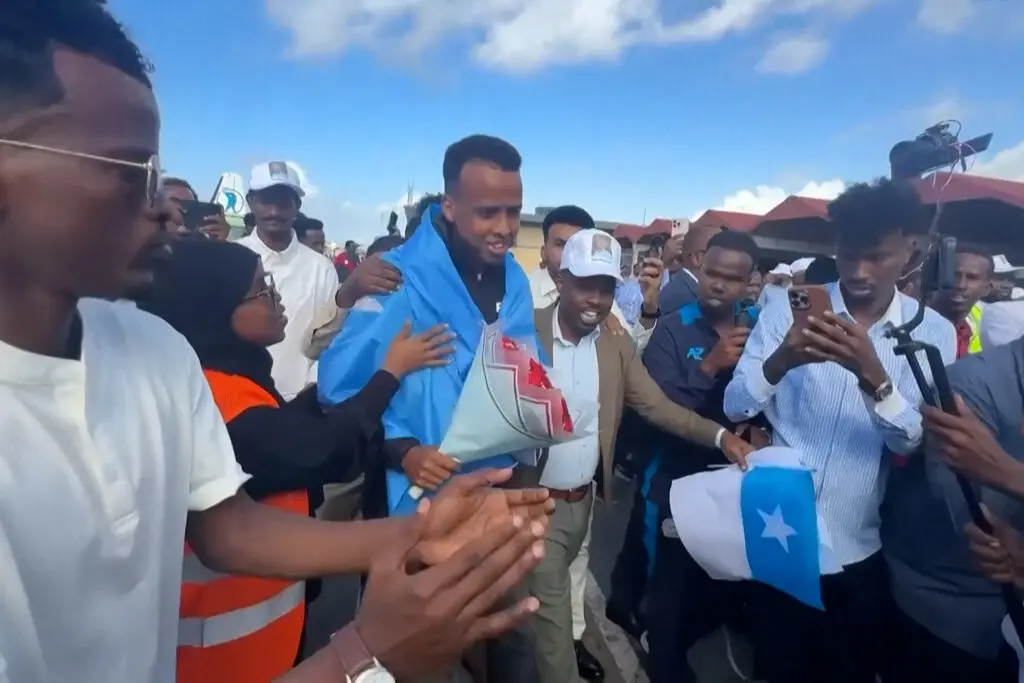
That is why his return to Mogadishu drew a hero’s welcome. Supporters saw him not as a failed participant, but as a symbol of national pride interrupted by politics and border control.
For African football more broadly, the episode also matters because representation remains sensitive. FIFA’s global tournaments often celebrate inclusion, but access to the tournament is still shaped by visas, passports, security vetting and diplomatic relations.
When an African official from a fragile state is excluded after selection, the optics are difficult — even if the host government believes it acted lawfully.
A warning for World Cup 2026
The 2026 World Cup is already expected to test football’s organisational capacity.
It is the first World Cup to feature 48 teams and will be hosted across three countries. That means more players, more officials, more supporters, more journalists and more cross-border movement than any previous edition.
Artan’s case may therefore be an early warning.
If a FIFA-appointed referee with tournament accreditation can be refused entry, questions will inevitably follow about fans, journalists, support staff and other participants from countries affected by travel restrictions or heightened scrutiny.
The issue is not whether states should abandon security checks. They will not, and they should not. The issue is whether FIFA and host governments have built a transparent, predictable and fair system capable of protecting both security and the integrity of the tournament. At present, Artan’s case suggests that uncertainty remains.
FIFA’s reputational challenge
FIFA has spent years presenting the World Cup as a unifying global event. The tournament is marketed as a celebration of football’s ability to bring nations together. But the politics of the host country always shape the tournament.
In Russia in 2018, Qatar in 2022 and now North America in 2026, FIFA has repeatedly faced questions about whether its commercial and diplomatic ambitions are compatible with the values it promotes.
Artan’s exclusion adds another layer.
This is not only about US immigration law. It is about whether FIFA can guarantee equal access to its own competition once it awards hosting rights to sovereign states with their own political priorities and security systems. The answer, in practice, appears to be no.
The human cost
Amid the governance arguments, the human dimension should not be lost. Artan was preparing for the biggest moment of his professional life. He had described the opportunity as the dream of a lifetime. Instead, after an 11-hour immigration interview, he was sent back.
For supporters in Somalia, his exclusion felt like the removal of a rare positive national story from the global stage. For US officials, the matter is framed through national security and border control.
For FIFA, it is an immigration decision outside its jurisdiction. All three positions can be understood. But together they expose the central contradiction of modern global sport: football sells a borderless dream, while the World Cup still depends on borders.
Why this story will not disappear
The Artan controversy is unlikely to be remembered only as a refereeing issue. It will be seen as a test case for World Cup governance, immigration fairness, African representation and the political limits of sporting globalisation. If FIFA wants the 2026 World Cup to be remembered for football rather than access disputes, it will need to show that this case is an exception rather than an early sign of a wider problem.
For now, Omar Artan’s absence from the World Cup sends a clear message.
Football may belong to the world, but entry to the World Cup still belongs to the state.
Sources
BBC Sport; BBC; Al Jazeera; FIFA.
Related posts:
 Somali Referee Omar Artan Denied Entry to United States Days Before 2026 World Cup
  Mexico’s Missing Persons Crisis Cast Into World Cup Spotlight as Activists Demand Action
  DR Congo World Cup Preparations Disrupted by Ebola Fears
  Iran Says World Cup Ticket Allocation Revoked Days Before Tournament Opens
  England Beat Costa Rica 3-0 as Gordon Impresses Before World Cup Opener