
Pete Edochie Dies at 79: The Man Who Gave African Storytelling a Voice of Authority
Veteran Nigerian actor Pete Edochie has died aged 79. Nukunya explores his career, cultural influence and enduring contribution to African storytelling.

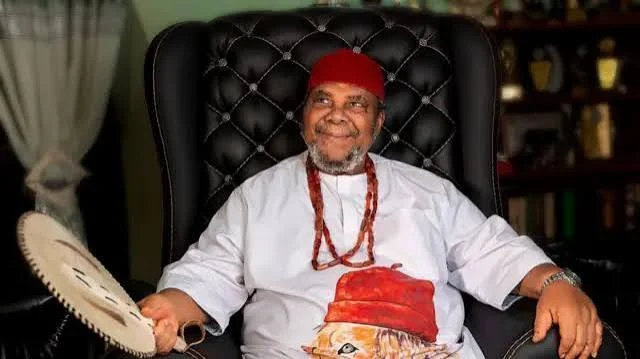

From Okonkwo in Things Fall Apart to the patriarchs of Nollywood, Pete Edochie helped shape how Africa told its own stories.
Veteran Nigerian actor and broadcaster Pete Edochie has died aged 79, his family has announced. According to a family statement, he died in Enugu on Wednesday, 25 November 2026, following a prolonged battle with prostate cancer. His greater contribution was helping African audiences recognise their histories, traditions and social realities on screen.
Before Nollywood, there was Okonkwo.
Born on 7 March 1947 in Zaria, Edochie began broadcasting in 1967 and rose to senior management. In 1987, he portrayed Okonkwo in the Nigerian Television Authority adaptation of Chinua Achebe’s Things Fall Apart, earning international recognition.
Okonkwo was neither a straightforward hero nor a conventional villain. His strength and loyalty to tradition coexisted with pride and an inability to adapt. Edochie’s performance gave a human face to the tensions between indigenous institutions and colonial transformation. African stories did not need to abandon their cultural foundations to command international attention.
1947–2026
Pete Edochie
The Voice Across Generations
From broadcasting and Things Fall Apart to Nollywood, international streaming and contemporary digital culture.
His death on 25 November 2026 was announced by his family and acknowledged by the Nigerian Presidency and cultural authorities.
From home videos to global streaming
Edochie’s measured delivery, expressive reactions and use of proverbs communicated authority through language, gesture and silence. For audiences across West Africa, including Ghana, these performances offered points of cultural recognition even where languages and customs differed.
His career connected television, home video and international streaming, reflecting wider changes in African screen culture.
Explore the career timeline
Showing all career milestones.
Born in Zaria
Pete Edochie was born in Zaria, Nigeria, on 7 March 1947.
Broadcasting career begins
Entered broadcasting, establishing the foundations of a professional career in African media.
Things Fall Apart
His portrayal of Okonkwo in the television adaptation of Chinua Achebe’s novel brought widespread recognition and explored tradition, authority and historical change.
Rituals
A selected milestone associated with his Nollywood home-video career.
Igodo
A notable production from his Nollywood filmography.
National honour and film career
Received the national honour of Member of the Order of the Niger (MON). Billionaire’s Club also features in the selected career chronology.
Idemili
A selected production from his later acting career.
Lionheart
Played Chief Ernest Obiagu in Genevieve Nnaji’s film exploring family enterprise, leadership, gender and business succession.
African Film Legend Award
Recognition of his contribution to African cinema, as recorded in the accompanying article.
Foreigner’s God
A selected production from his later film career.
Died aged 79
His family announced his death in Enugu. Nigeria’s Presidency, cultural authorities and the Actors Guild of Nigeria subsequently acknowledged his contribution to cinema.
Selected career milestones, not an exhaustive filmography. Individual production dates and award records require archival verification where original records are unavailable.
A career across changing media environments
Things Fall Apart
Role: Okonkwo
The television adaptation of Chinua Achebe’s novel explored the tensions between individual identity, traditional authority and historical transformation.
Edochie’s portrayal became a defining performance in his career.
Rituals
Selected Nollywood home-video production.
Igodo
Selected milestone in his film career.
Billionaire’s Club
Selected production from his filmography.
Idemili
Selected production from his later career.
Lionheart
Played Chief Ernest Obiagu, connecting family authority with questions of business succession.
Foreigner’s God
Selected production from his later career.
Why Lionheart matters
In Genevieve Nnaji’s Lionheart, Chief Ernest Obiagu’s illness forces his daughter to assume responsibility for the family transport business.
The film offers a lens through which to examine leadership, gender, family expectations and intergenerational business succession.
Film themes represent editorial interpretation. This is a curated selection, not a ranking of performances or a comprehensive film ledger.
Four dimensions of Edochie’s cultural influence
His contribution can be examined through language, cultural identity, digital participation and audiovisual heritage.
Showing all cultural dimensions.
Language and oral tradition
His measured delivery, use of proverbs and expressive pauses demonstrated how language and silence can communicate authority, uncertainty and wisdom.
Cultural identity
His performances explored family, ambition, tradition, power and responsibility through culturally grounded African storytelling.
Digital reinterpretation
Scenes from his films became material for memes and reaction images, allowing audiences to reinterpret performances in contemporary online communication.
Audiovisual heritage
His career highlights the importance of preserving classic African television and early home-video productions for future audiences and researchers.
Original Nukunya analytical framework. The four dimensions are interpretive categories, not measured influence scores.
When an actor becomes a language of the internet
Scenes from Edochie’s films acquired new meanings as younger audiences circulated them through memes and reaction images. Expressions originally intended to communicate suspicion or disbelief became digital shorthand.
How screen performances acquire new meanings
Original performance
A character expresses an emotion within a scripted dramatic context.
Digital circulation
A scene or expression is selected and circulated by online audiences.
Recontextualisation
Audiences attach new meanings to the performance in different communication contexts.
Intergenerational cultural participation
Younger audiences encounter and reinterpret earlier creative work.
Conceptual illustration of digital cultural circulation. No platform-level audience, engagement or meme-frequency dataset was available for this analysis.
A legacy beyond entertainment
Edochie’s influence extended beyond Nigeria’s borders. His performances offered audiences across West Africa culturally recognisable stories of family, leadership and responsibility.
His connection with Ghana also extended beyond cinema. In October 2026, Nukunya reported GoldBod’s support for his African youth mentorship initiative.
Investing in the next generation
The mentorship initiative offers a further perspective on Edochie’s involvement in developing younger African talent.
Read Nukunya’s earlier reportPublic tributes
Nigerian Presidency
President Bola Tinubu acknowledged Edochie’s role in shaping Nollywood and projecting Nigerian cultural heritage to international audiences.
Official presidential statementNigeria’s culture minister
Hannatu Musa Musawa recognised his contribution to storytelling, language and cultural heritage.
Official ministerial statementActors Guild of Nigeria
The guild commemorated his professional influence and contribution to the development of Nigerian cinema.
Voice of Nigeria reportHe is survived by his wife Josephine and his children. Funeral arrangements were to be announced by the family, according to its initial statement reported on 25 November 2026.
Global visibility without cultural dilution
International investment and streaming have expanded opportunities for African filmmakers. But greater visibility raises a question: how can African cinema reach global audiences without sacrificing its cultural specificity?
Edochie’s performances were rooted in African experiences while exploring widely recognisable themes of power, family, ambition and responsibility.
Four overlapping media environments
Broadcasting and television
Performance and storytelling transmitted through established broadcast institutions.
Home-video cinema
Locally rooted filmmaking distributed across domestic and regional markets.
International streaming
Digital distribution and opportunities to reach audiences across national borders.
Participatory digital culture
Audiences actively reinterpret performances through online communication and creative reuse.
Original Nukunya conceptual framework. These environments overlap and do not represent mutually exclusive historical periods or a complete history of African cinema.
Preserving Africa’s audiovisual heritage
Classic television and early home-video productions deserve preservation, restoration and accessibility.
| Priority | Proposed action |
|---|---|
| Archival preservation | Identify and safeguard original film and television materials. |
| Digital restoration | Restore deteriorating audiovisual works where technically feasible. |
| Rights management | Establish ownership, licensing and lawful distribution arrangements. |
| Cultural accessibility | Support legitimate public access, captions, subtitles and appropriate language preservation. |
| Historical documentation | Record production histories, performer contributions and original cultural contexts. |
| Emerging filmmakers | Support mentorship, professional development and opportunities for locally grounded storytelling. |
These are editorial recommendations, not announced government programmes or measured industry outcomes.
The voice that remains
Edochie did not create Nollywood alone. His achievements formed part of a collective effort by actors, writers, producers and directors.
Through Okonkwo he explored tradition and historical change; through later films, the obligations of family and the consequences of power.
Through digital culture, his performances reached new generations.
For an actor whose career was defined by the spoken word, that may be his most enduring legacy.
Frequently asked questions
Who was Pete Edochie?
Pete Edochie was a Nigerian broadcaster and actor recognised for his portrayal of Okonkwo in Things Fall Apart and his extensive contribution to Nollywood.
When did Pete Edochie die?
His family announced that he died on 25 November 2026 in Enugu, Nigeria, aged 79.
What was his role in Things Fall Apart?
He portrayed Okonkwo in the television adaptation of Chinua Achebe’s novel.
What role did he play in Lionheart?
He played Chief Ernest Obiagu in Genevieve Nnaji’s 2018 film.
Did Pete Edochie receive a national honour?
He received Nigeria’s national honour of Member of the Order of the Niger (MON) in 2003.
What was Pete Edochie’s connection with Ghana?
His films reached West African audiences, including Ghana. Nukunya also reported GoldBod’s support for his African youth mentorship initiative in October 2026.
Why is his work important to digital culture?
Audiences have reused expressions and scenes from his films in memes and reaction images, giving earlier performances new cultural contexts.
Related posts:
 Dr Likee’s London Success Draws Corporate Backing as Ghanaian Comedy Expands Abroad
 Miss Ghana unveils Stacy Amoateng, Okyeame Kwame and Kafui Dey as judges for 69th Miss Ghana auditions
 Olu Jacobs Laid to Rest as Nollywood Pays Final Tribute to Legendary Actor
 Agbara Nla: The Return Makes ₦71 Million as Nollywood Film Sets Major Box Office Record
 Gyakie Begins New Chapter as Independent Artist With Warner Music Africa Deal