
Mexico’s Missing Persons Crisis Cast Into World Cup Spotlight as Activists Demand Action


Follow Nukunya
Get the latest breaking news and updates from Nukunya.
As Mexico prepares to co-host the 2026 FIFA World Cup, activists have launched a campaign near major football venues to draw attention to the country’s more than 130,000 officially registered missing persons, arguing that global celebrations should not overshadow a continuing human rights crisis.
MEXICO CITY — Activists campaigning for families of missing persons in Mexico have staged demonstrations near football stadiums set to host matches during the 2026 FIFA World Cup, seeking to draw international attention to a disappearance crisis that continues to affect thousands of families across the country.
The campaign comes as Mexico accelerates preparations for the tournament, which it will co-host with the United States and Canada beginning later this month. Activists say the arrival of the world’s biggest sporting event presents a rare opportunity to highlight a humanitarian issue they fear receives insufficient international attention.
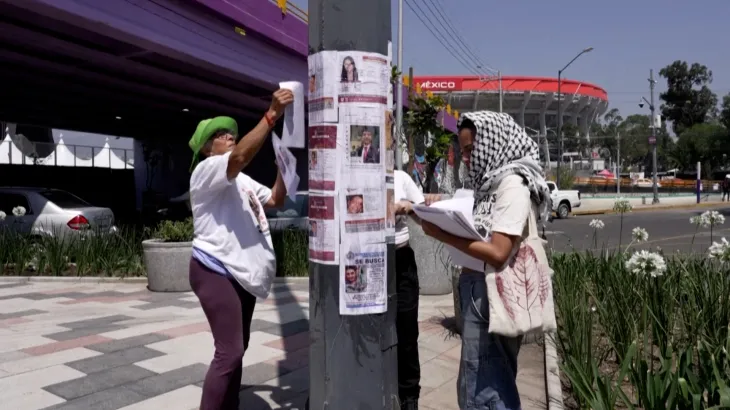
Protesters displayed photographs, posters and banners bearing the images of missing relatives around areas surrounding major football venues in Mexico City, including locations close to stadiums expected to feature prominently during the tournament.
More Than 130,000 Missing
According to official government records cited by international media, more than 130,000 people have been reported missing in Mexico since 2006, when the government intensified its campaign against organised crime and drug trafficking networks.
Activists and some human rights organisations argue that the true figure could be significantly higher, pointing to challenges in reporting, identifying remains and investigating disappearances in parts of the country affected by criminal violence.
Families searching for loved ones have become a powerful symbol of Mexico’s long-running security crisis, often organising independent search efforts and public awareness campaigns when official investigations fail to deliver answers. “We cannot allow the World Cup to distract from the reality faced by thousands of families,” campaigners said during the demonstrations, according to reports from the scene. Their message was clear: while the world focuses on football, many Mexicans continue to search for relatives who vanished years ago.
Football’s Global Stage
The 2026 FIFA World Cup is expected to attract millions of visitors and billions of television viewers worldwide, making it one of the most-watched events on the planet.
Activists believe the tournament’s global audience offers an opportunity to amplify calls for justice, accountability and improved investigations into disappearances.
Near stadiums and public spaces associated with the World Cup, campaigners pasted missing-person posters and distributed leaflets detailing individual cases. Images shared by international broadcasters showed photographs of missing individuals displayed alongside football-related infrastructure and promotional areas.
Some demonstrators also used symbolic artwork and masks to criticise political leaders, arguing that authorities have not done enough to address the scale of the crisis.
Human Rights Concerns Persist
Disappearances remain one of the most sensitive human rights issues in Mexico.
The United Nations and international rights organisations have repeatedly expressed concern over disappearances linked to organised crime, forced disappearances and weaknesses in criminal investigations.
Successive Mexican governments have pledged to strengthen search efforts, improve forensic identification systems and support affected families. However, advocacy groups argue that progress has been uneven and that many cases remain unresolved.
The issue has become increasingly prominent ahead of the World Cup, with campaigners urging visiting supporters, journalists and international organisations to recognise the experiences of families still searching for answers.
Balancing Celebration and Accountability
Mexico’s role as a World Cup host represents a significant moment of national pride and international visibility. Officials have promoted the tournament as an opportunity to showcase the country’s culture, tourism and economic potential.
Yet activists insist that the event should also serve as a platform to confront difficult realities.
By bringing images of missing persons to some of the country’s most recognisable sporting venues, campaigners hope to ensure that the stories of those who disappeared are not forgotten amid the excitement of the global football spectacle.
As the countdown to kick-off continues, the demonstrations highlight a broader debate facing many host nations of major sporting events: whether moments of international celebration can also become opportunities to address longstanding social and human rights challenges.
Reporting by Edem Hodasi
Additional reporting based on information from Reuters, France 24 and Al Jazeera.
Related posts:
 Iran Says World Cup Ticket Allocation Revoked Days Before Tournament Opens
  England Beat Costa Rica 3-0 as Gordon Impresses Before World Cup Opener
  PSG Retain Champions League Title After Penalty Shootout Victory Over Arsenal
  Asamoah Gyan: Antoine Semenyo Is the Face of Ghana Football Now
  DR Congo World Cup Preparations Disrupted by Ebola Fears