

How to Buy Land Safely in Ghana: 10 Checks You Must Make Before Paying


Follow Nukunya
Get the latest breaking news and updates from Nukunya.
Buying land in Ghana can be an excellent investment, but failing to carry out proper checks can leave buyers facing fraud, ownership disputes, boundary problems and significant financial losses. Here are 10 essential checks everyone should make before buying land in Ghana.
Land remains one of the most attractive investments in Ghana. From building a family home to developing rental property or securing land for retirement, thousands of people buy plots every year.
However, buying land is also one of the transactions where rushing can be extremely costly.
A seller may present what appears to be genuine documentation, an estate agent may promise that everything is legitimate, or a relative may recommend a particular plot. But none of these should replace independent verification.
The Ghana Lands Commission is responsible for important aspects of land administration, including land registration, surveying and mapping, valuation and maintaining land information.
Under Ghana’s Land Act, 2020 (Act 1036), land transactions are subject to specific legal requirements.
For anyone considering buying land in Ghana — particularly Ghanaians living abroad — proper due diligence is essential.
1. Verify Who Actually Owns the Land
The first question should not be:
“How much does the land cost?”
It should be:
“Who legally owns this land?”
Land in Ghana can be held under different forms of tenure, including customary and leasehold interests. The person offering the land for sale must have the legal authority to transfer the interest they claim to have.
Ask the seller for the relevant ownership documents and supporting records.
Depending on the property, these could include:
- An indenture or conveyance
- Lease documents
- Land certificate
- Approved site plan
- Previous transaction documents
- Family or customary documentation
- Evidence of authority to sell
Do not automatically assume that someone who has occupied a piece of land for many years has the legal right to sell it.
This is particularly important when dealing with family land, stool land, skin land or land being sold through an agent.
2. Conduct an Official Land Search
One of the most important steps when buying land in Ghana is conducting an official search.
Do not rely solely on a search provided by the seller, estate agent or developer.
An independent search through the Lands Commission can help establish whether the information provided by the seller corresponds with official land records.
A search may help identify existing registered interests and other issues affecting the property.
The Ministry of Lands and Natural Resources lists a Lands Commission search report among the documents required for land registration.
Before making a substantial payment, make sure the land has been independently checked.
Remember:
Never assume land is genuine simply because the seller has documents. Verify those documents.
3. Check That the Site Plan Matches the Land
A site plan is an important document, but having one does not automatically mean the land is safe to buy.
The information on the plan should correspond with the actual property.
A qualified surveyor can help establish:
- The exact location of the land
- The size of the plot
- The boundaries
- The coordinates
- The location of boundary markers
- Whether the land overlaps another parcel
- Whether the site matches the documentation
The Ghana Lands Commission requires a site plan prepared by a licensed surveyor for land registration.
This makes professional surveying an important part of the buying process.
Never rely solely on someone pointing at a piece of land and saying:
“This is your plot.”
The physical land should match the legal description.
4. Visit the Land and Check the Boundaries
Always inspect the land before buying it.
If you live outside Ghana, arrange for someone you trust to inspect the property, but where possible, have a qualified surveyor carry out an independent inspection.
Look at the surrounding area and not just the plot itself.
Check for:
- Access roads
- Drainage
- Electricity infrastructure
- Water availability
- Existing buildings
- Boundary markers
- Streams and waterways
- Nearby developments
- Roads planned through the area
- Possible encroachment
Speaking with people living nearby can also provide useful information about the history of the land.
A plot advertised as having road access, for example, may have limited or difficult access once you inspect it physically.
5. Find Out Whether There Is a Dispute
Before buying land, investigate its history.
Ask whether the land has ever been involved in:
- A family dispute
- Chieftaincy or customary disputes
- Court proceedings
- Boundary disagreements
- Previous sales
- Multiple claims of ownership
- Encroachment
- Occupation by another person
This is particularly important when buying customary land.
A low price should never convince you to ignore a dispute.
Land that appears cheap today can become extremely expensive if you later have to spend years dealing with litigation or competing claims.
6. Confirm That the Seller Has Authority to Sell
Finding the owner is not always enough.
You also need to establish whether the person selling the land has the legal authority to complete the transaction.
This is particularly important when dealing with:
- Family land
- Stool land
- Skin land
- Clan land
- Company-owned property
- Agents
- Representatives
- Developers
If someone is acting on behalf of another person or organisation, ask for evidence of their authority.
Where a Power of Attorney is being relied upon, have your lawyer verify that it is valid and covers the transaction.
Do not accept statements such as:
“I represent the family.”
or
“The chief has approved the sale.”
as a substitute for proper documentation.
7. Check for Existing Interests, Restrictions or Mortgages
Land may have existing interests attached to it.
This is another reason an official search is so important.
Your lawyer should review the search results and determine whether there are issues such as:
- Existing leases
- Mortgages
- Registered interests
- Restrictions
- Competing claims
- Previous transfers
- Court-related matters
Never assume that a seller will disclose every issue affecting the land.
Independent checks are designed to protect the buyer.
If a problem is discovered, do not simply accept a promise that it will be “sorted out later.”
Make sure the issue is properly resolved and documented before completing the purchase.
8. Use a Proper Written Agreement
A verbal agreement or handwritten receipt should not be treated as sufficient protection for a major land purchase.
Your transaction should be properly documented.
Depending on the type of transaction, documents may include:
- Sale agreement
- Conveyance or assignment
- Lease
- Approved site plan
- Ownership documents
- Identification documents
- Evidence of authority to sell
- Evidence of payment
- Relevant Power of Attorney
Use an independent property lawyer to review the transaction before making a significant payment.
Ideally, the lawyer should be acting in your interests rather than simply being the seller’s representative.
A lawyer can also help identify problems in the documents before you commit your money.
9. Find Out the Total Cost — Not Just the Land Price
The advertised price of a plot is not necessarily the total amount you will spend.
Additional costs may include:
- Legal fees
- Surveyor’s fees
- Search fees
- Stamp duty
- Lands Commission fees
- Registration costs
- Documentation charges
- Other applicable statutory charges
Ask for a clear breakdown of the expected costs before committing to the transaction.
The Lands Commission’s online services also provide tools for certain land-related payments and bill calculations.
Most importantly, keep records of every payment.
Avoid making large undocumented cash payments.
Use traceable payment methods wherever possible and keep receipts, bank records and signed acknowledgements.
10. Register Your Interest After Buying the Land
Completing the purchase does not necessarily mean the process is finished.
Registration is an important part of protecting your interest in the property.
The Ministry of Lands and Natural Resources lists documents such as the site plan, proof of ownership, identification, a Lands Commission search report and applicable payment receipts among the requirements for land registration, although additional documents may be required depending on the transaction and location.
Once your transaction has been completed, make sure the appropriate registration process is followed.
Keep secure copies of all your documents, including:
- Signed agreements
- Conveyance or lease
- Site plan
- Search report
- Payment receipts
- Stamp duty documents
- Registration documents
- Correspondence with the seller
- Legal documents
Do not assume that handing documents to an agent means your registration is complete.
Follow up and keep evidence of the progress of the application.
Buying Land in Ghana From Abroad
For Ghanaians living in the UK, United States, Canada, Europe and other parts of the world, buying land remotely requires additional caution.
You may not be able to visit the property yourself. You may communicate with the seller through WhatsApp. You may rely on a relative or friend to inspect the land. You may transfer money from another country.
These circumstances can increase the risk of mistakes and fraud.
Do Not Rely Entirely on Relatives
A trusted relative can help with a physical inspection, but they should not be expected to replace professional legal and surveying checks.
Consider using:
- An independent Ghanaian property lawyer
- A qualified surveyor
- A trusted person for physical inspections
Your lawyer should independently verify the documents and the seller’s authority.
Be Careful With WhatsApp Documents
Receiving a photograph of a land document on WhatsApp does not prove that it is genuine.
A scanned document can be altered, outdated or unrelated to the land being offered to you.
Verify important documents through the appropriate official channels.
Do Not Allow Anyone to Rush You
One of the biggest warning signs is pressure to pay immediately.
You may hear:
“Someone else is ready to buy it.”
“The price will increase tomorrow.”
“Pay the deposit now and we will do the search later.”
Do not allow pressure to make you skip due diligence.
A genuine transaction should allow you reasonable time to verify the land and obtain independent professional advice.
Can Foreigners Buy Land in Ghana?
Yes, non-citizens can acquire certain interests in land in Ghana, but there are important restrictions.
Under the Land Act, 2020, a non-citizen cannot acquire a freehold interest in land.
The Act also states that a leasehold interest granted to a non-citizen cannot exceed 50 years at any one time.
This means foreigners and non-Ghanaian citizens should obtain professional legal advice before entering into a land transaction.
The exact structure of the transaction matters, particularly where companies or partnerships involving non-citizens are involved.
10 Land-Buying Red Flags You Should Never Ignore
Be extremely cautious if:
- The seller refuses to allow an official search.
- You are pressured to pay immediately.
- The seller cannot provide convincing ownership documents.
- The site plan does not match the physical land.
- More than one person claims ownership.
- You are asked to make a large cash payment without proper documentation.
- You are told that registration is unnecessary.
- The seller discourages you from using your own lawyer.
- The seller refuses to allow an independent survey.
- The property is involved in an unresolved dispute.
One warning sign does not automatically prove fraud, but several warning signs together should make you reconsider the transaction.
The Safest Way to Buy Land in Ghana
A safer land-buying process can be summarised as follows:
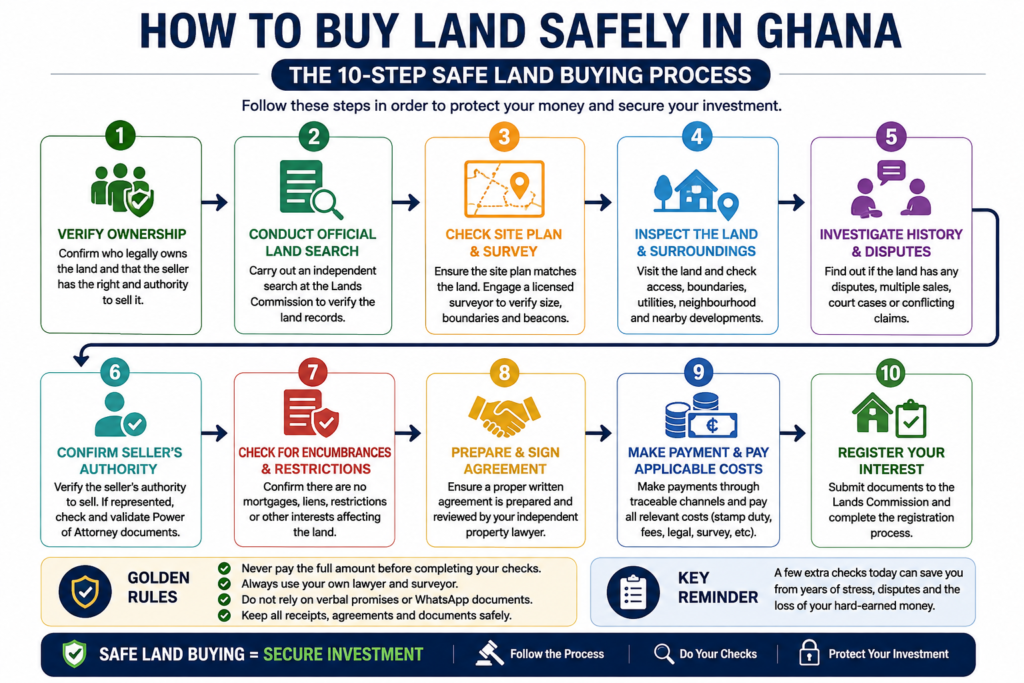
Taking these steps may require additional time and money, but they can significantly reduce the risk of losing your investment.
Related posts:
 Ghana International Bank Names Ian Greenstreet as CEO After Leadership Change
  Imported Product Prices Rise in Ghana: What the Price Hikes Mean for the Diaspora
  Bank of Ghana suspends proposed 0.75% mobile money transfer fee
  MoMo Wallet-to-Bank Charges
  GhIPSS returns GH¢14.58m dividend to Bank of Ghana after profitable year