
Trump OpenAI Equity Stake

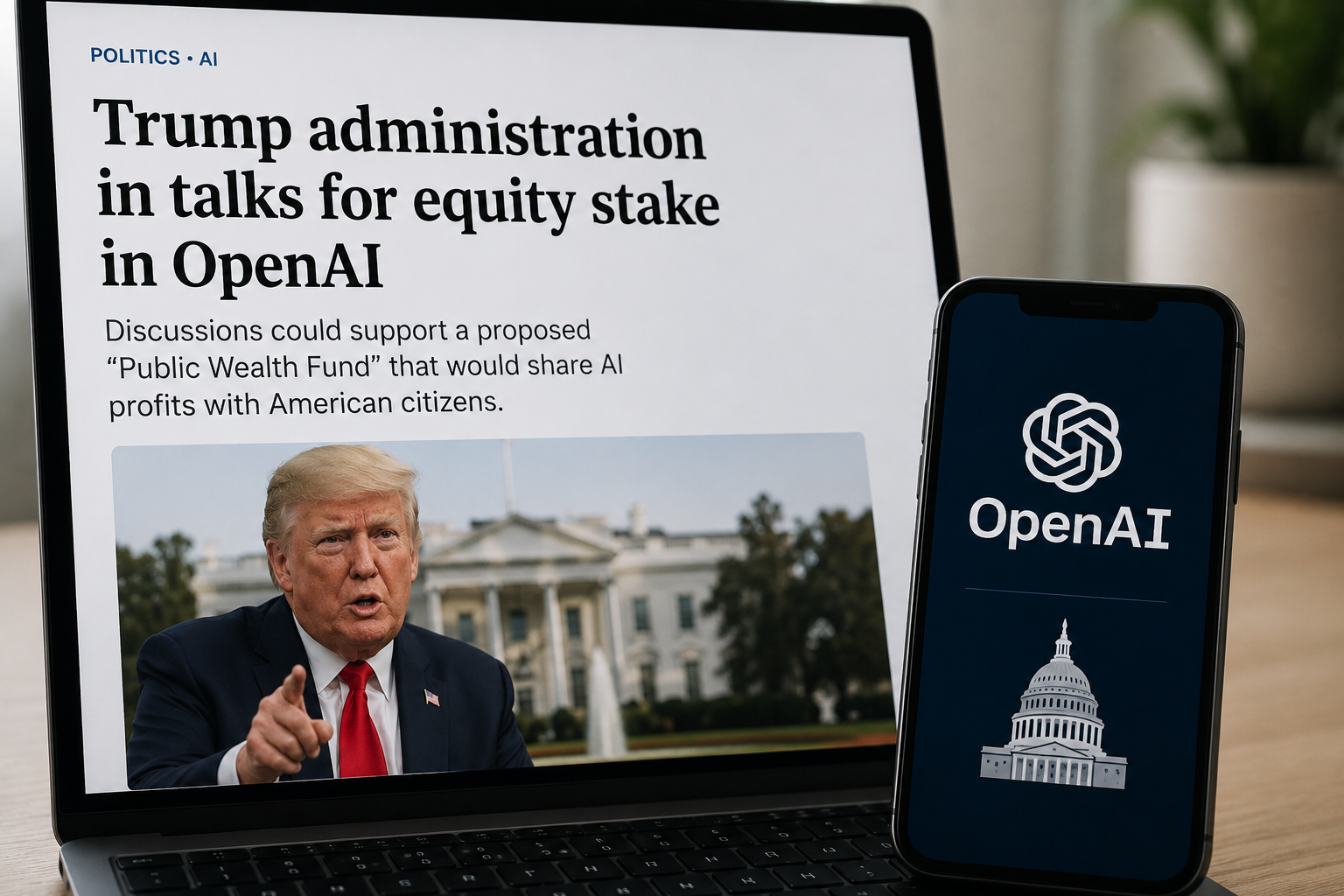

Trump OpenAI Equity Stake: Could Americans Become Partners in AI Growth?
The relationship between governments and technology companies may be entering a new phase.
Reports from multiple sources suggest that the Trump administration and OpenAI have been discussing a potential arrangement that could give the U.S. government an equity stake in the artificial intelligence company. While no agreement has been finalized, the discussions raise a bigger question: should citizens directly benefit from the wealth created by AI?
If such a deal moves forward, it could become one of the most significant experiments in public participation in private technology growth.
Why Is the Trump Administration Interested in OpenAI?
President Donald Trump recently confirmed that his administration has been speaking with AI companies about ways the American public could benefit from the rapid growth of artificial intelligence.
Speaking to reporters aboard Air Force One, Trump said discussions included concepts where the public could become “a partner” with AI companies.
Although he did not mention OpenAI directly, several reports indicate that OpenAI is one of the companies involved in these conversations.
The idea represents a departure from the traditional relationship between government and private technology firms. Instead of simply regulating AI, the government could potentially share in the economic value created by the industry.
The Public Wealth Fund Proposal
At the center of these discussions is OpenAI’s proposed Public Wealth Fund.
Earlier this year, OpenAI outlined a vision for a nationally managed investment fund that could be partially funded through contributions from AI companies.
The concept is relatively simple:
- AI companies contribute equity or assets.
- The fund invests in long-term growth opportunities.
- Returns generated by the fund are distributed to citizens.
According to OpenAI, such a system could allow more people to benefit from AI-driven economic growth regardless of their income level or access to investment capital.
Supporters argue that if AI is expected to generate trillions of dollars in future value, ordinary citizens should share in that success rather than leaving the benefits concentrated among investors and technology executives.
Sam Altman’s Vision for Public Participation
Reports indicate that OpenAI CEO Sam Altman has been discussing versions of this idea with policymakers since early 2025.
Altman has repeatedly warned that advanced AI could dramatically reshape labor markets, productivity, and wealth creation.
The Public Wealth Fund concept appears to be one attempt to address concerns that AI could create enormous economic gains while concentrating wealth among a relatively small group of companies.
Under the proposal being discussed, OpenAI could potentially donate a portion of its equity to help establish such a fund.
Bernie Sanders Offers a More Aggressive Alternative
Interestingly, the idea of public ownership in AI companies is attracting attention from both sides of the political spectrum.
Senator Bernie Sanders recently proposed legislation that would require major AI companies, including OpenAI, Anthropic, and xAI, to pay a one-time tax in the form of company stock.
Sanders argues that AI is built on decades of publicly funded research and the collective contributions of society. As a result, he believes the public deserves a direct stake in the industry’s future profits.
His proposal would go much further than OpenAI’s voluntary approach by giving the government voting rights and board representation in major AI firms.
Critics Warn of Serious Risks
Not everyone is convinced.
Critics argue that government ownership of AI companies could create major conflicts of interest.
If regulators also become shareholders, questions arise about whether they can fairly oversee the companies in which they hold financial interests.
Others worry that government investment could create a “too big to fail” scenario similar to concerns raised after the 2008 financial crisis. If taxpayers become investors in AI companies, political pressure could emerge to protect those companies from failure.
Some analysts have also warned that government stakes could reduce competition by favoring certain AI firms over others.
What This Could Mean for the Future of AI
Whether or not a deal between OpenAI and the U.S. government ultimately happens, the discussions reveal a growing shift in how policymakers are thinking about artificial intelligence.
The debate is no longer focused solely on AI regulation or safety.
It is increasingly about ownership, wealth creation, and who gets to benefit from one of the most transformative technologies of the modern era.
For decades, technology companies generated enormous value primarily for founders, employees, and investors. The emerging conversation around AI suggests governments may want citizens to participate more directly in those gains.
Conclusion
The reported discussions between the Trump administration and OpenAI highlight a new and potentially controversial approach to AI governance. Through a Public Wealth Fund or other mechanisms, policymakers are exploring ways to ensure citizens benefit from the economic growth generated by artificial intelligence.
Whether this becomes a landmark innovation in public wealth creation or a cautionary tale about government involvement in private enterprise remains to be seen. One thing is certain: the future of AI ownership is becoming just as important as the future of AI itself.
Read more from Tech News
Related posts:
 US Expands AI Safety Testing Before Public Release of New Models
  Google I/O 2026: Google Unveils Gemini 3.5, AI Search and New AI Tools
  Nvidia ramps up Taiwan spending to $150bn a year as AI race intensifies
  Florida Becomes First US State to Sue OpenAI Over ChatGPT Safety Allegations
  Microsoft Scout