
South Korea’s World Cup Comeback Offers a Lesson in Patience, Depth and Tournament Footbal
South Korea came from behind to beat the Czech Republic 2-1, showcasing the depth and tactical maturity that could make them one of Group A's surprise contenders.

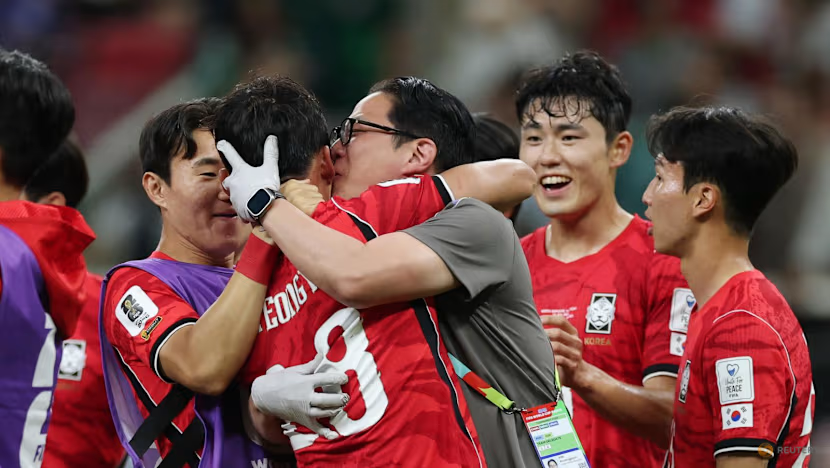

Hwang In-beom inspired South Korea’s fightback against the Czech Republic, but the bigger story may be what the result reveals about modern World Cup success.
Hwang In-beom 67′
Oh Hyeon-gyu 80′
Ladislav Krejčí 59′
GUADALAJARA, Mexico — Opening matches at the FIFA World Cup often reveal more than final scores suggest. Some victories expose weaknesses. Some defeats conceal promise. And some matches offer an early glimpse of teams capable of going much further than many expect.
South Korea’s 2-1 comeback victory over the Czech Republic in Guadalajara may ultimately prove to be one of those matches. While Mexico’s opening-night win over South Africa understandably dominated headlines, South Korea quietly produced one of the most tactically mature performances of the tournament’s opening day.
The result leaves both Mexico and South Korea on three points in Group A, immediately transforming their forthcoming meeting into one of the most intriguing fixtures of the early stages of World Cup 2026. Yet beyond the standings, South Korea’s comeback offered valuable insight into how international football is evolving and why tactical flexibility may matter more than star power in a tournament expanded to 48 teams.
The Scoreline Does Not Tell the Whole Story
At first glance, the match appears straightforward.
The Czech Republic took the lead through captain Ladislav Krejčí in the 59th minute before South Korea responded through Hwang In-beom and substitute Oh Hyeon-gyu to secure a 2-1 victory. But the statistics and match reports suggest a more nuanced reality.
South Korea controlled possession for long periods, generated more chances and carried the greater attacking threat throughout much of the contest. Reuters reported that Hong Myung-bo’s side dominated possession and passing exchanges, while The Independent noted that the Koreans had most of the significant scoring opportunities despite initially failing to convert them.
In many previous tournaments, South Korea have often been cast as energetic outsiders capable of causing occasional upsets. This performance suggested something different.
Rather than relying on speed, pressing or counter-attacks alone, South Korea displayed patience, structure and tactical discipline.
When they fell behind, they did not panic.
They continued playing.
That composure ultimately won them the match.
Hwang In-beom’s Defining Performance
Every major tournament produces players who seize the moment.
On opening day, that player was Hwang In-beom.
The Feyenoord midfielder equalised in the 67th minute after a clever piece of skill deceived Czech goalkeeper Matej Kovář before calmly finishing. He later provided the assist for Oh Hyeon-gyu’s winning goal.
In modern football, much attention naturally gravitates towards forwards and goalscorers.
Yet matches are often decided in midfield.
Hwang’s performance demonstrated why.
He connected defence and attack, controlled tempo and consistently found space between the Czech lines. By scoring one goal and creating another, he influenced the match in the most visible way possible. But his broader contribution was arguably even more significant.
BBC Sport named him player of the match, while multiple reports identified him as the central figure in South Korea’s turnaround. For South Korea to progress deep into this tournament, performances like this may prove more important than individual brilliance from any single striker.
Son Heung-min’s Influence Extended Beyond Goals
One of the more interesting aspects of the match was that South Korea won despite captain Son Heung-min failing to score. For years, South Korea’s fortunes have often appeared closely tied to the performances of their most famous player.
The former Tottenham Hotspur forward remains one of Asia’s greatest footballers and entered the tournament as the nation’s leading attacking figure. Yet Reuters noted that Son missed several opportunities and remains short of the national scoring record. Ordinarily, an off-day from a team’s biggest star might prove costly.
Instead, South Korea demonstrated something that successful tournament teams often possess: multiple routes to victory. The burden no longer appears to rest solely on Son’s shoulders.
That should concern future opponents. Teams become far more dangerous when they are not dependent on one player.
Depth Wins Tournaments
Perhaps the most important moment of the game arrived in the 80th minute. Not because of the goal itself, but because of who scored it.
Oh Hyeon-gyu began the match on the bench before entering as a substitute and delivering the decisive finish from Hwang’s cross. World Cups are rarely won by starting elevens alone.
They are won by squads. In the expanded 48-team tournament, where matches arrive quickly and recovery periods are limited, depth becomes even more important.
South Korea’s ability to alter the game through substitutions highlights a strength that can sometimes be overlooked when assessing international sides.
While the world’s elite nations often dominate headlines because of their star names, tournament football frequently rewards balance, adaptability and squad cohesion. South Korea showed all three.
What the Czech Republic Can Take From Defeat
For the Czech Republic, the result was disappointing but not necessarily disastrous. The Europeans were making their first World Cup appearance since 2006 and demonstrated enough organisation and defensive structure to suggest they remain capable of competing in Group A.
Ladislav Krejčí’s goal briefly put them in control and showcased one of their greatest strengths: set pieces. Indeed, the Czech Republic nearly benefited from another dead-ball situation later in the game when a second goal was ruled out for offside. Reuters and BBC Sport both highlighted the incident as a key turning point.
The challenge for the Czechs now is psychological as much as tactical. Opening-match defeats often place enormous pressure on subsequent fixtures. Their encounter with South Africa now assumes even greater importance.
The Emerging Shape of Group A
One day into the tournament and Group A already appears to be taking shape. Mexico’s 2-0 victory over South Africa and South Korea’s comeback against the Czech Republic place the two winners in a strong early position.
The next round of fixtures could prove decisive. South Korea face co-hosts Mexico in what may become one of the most significant group-stage matches of the tournament’s opening week. The Czech Republic, meanwhile, meets South Africa in a game neither side can realistically afford to lose.
While qualification remains far from settled, the opening results have shifted momentum. In tournament football, momentum matters.
A Broader Lesson for International Football
Perhaps the most interesting lesson from South Korea’s victory extends beyond Group A. Modern international football increasingly rewards systems over individuals. The era when a single superstar could carry a nation deep into a tournament appears to be fading.
Successful teams now require tactical organisation, midfield control, squad depth and flexibility. South Korea displayed each of those qualities against the Czech Republic.
They fell behind.
They adapted.
They found solutions.
And they won.
That sequence may sound simple, but it reflects a maturity that many teams spend years trying to develop. The World Cup remains young, and one victory guarantees nothing.
Powerhouses such as Argentina, France, Spain, England and Brazil remain among the favourites to lift the trophy. Yet every World Cup also produces teams that exceed expectations.
Based on opening-day evidence, South Korea may be one of them. If Hwang In-beom continues to influence matches in this manner, if Son Heung-min remains a threat even when not scoring, and if South Korea continues demonstrating the depth and resilience shown in Guadalajara, they may emerge as one of the tournament’s most dangerous outsiders.
For now, the headlines belong to a comeback victory.
The deeper significance may be that South Korea has announced itself as far more than a participant. They look capable of becoming contenders.
Related posts:
 Mexico Beat South Africa 2-0 in World Cup Opener Marked by Three Red Cards
  Harry Maguire omitted from England World Cup squad as Ivan Toney recalled
  Michael Olise Hits Hat-Trick as France Beat Northern Ireland in Final World Cup Warm-Up
  Ghana Embassy in US Yet to Receive World Cup Tickets for Diaspora Distribution
  FIFA Targets End of Delayed Offside Flags at 2026 World Cup