
Wontumi Requests Plea Negotiations in EXIM Bank Criminal Case
A High Court filing confirms that Chairman Wontumi has requested plea negotiations with Ghana's Attorney-General in the ongoing EXIM Bank criminal case.

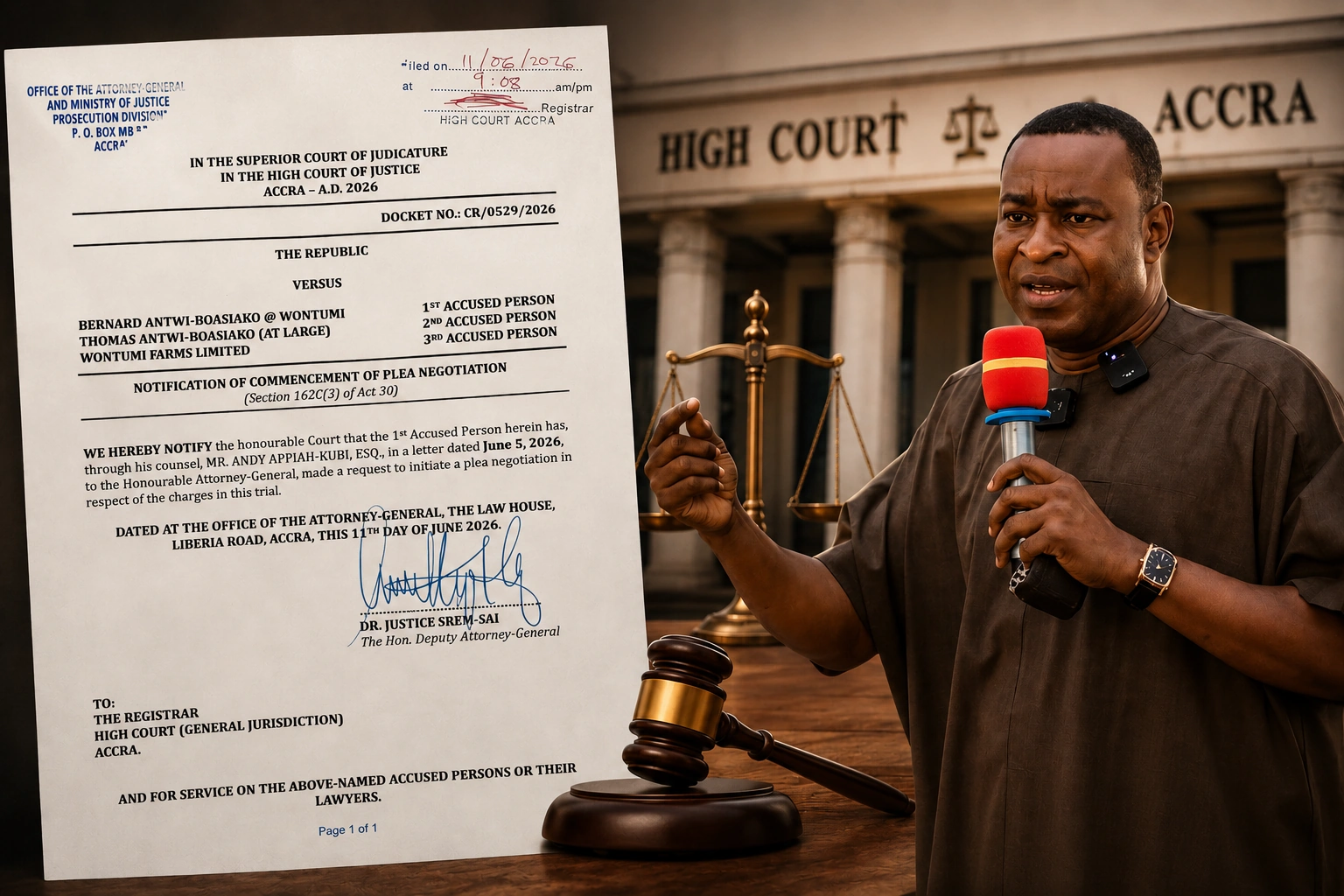

Bernard Antwi-Boasiako, popularly known as Chairman Wontumi, has formally requested plea negotiations with Ghana’s Attorney-General in an ongoing criminal case involving alleged financial losses to the Ghana Export-Import Bank (EXIM Bank). A court filing lodged by the Attorney-General’s Office confirms the request, adding a significant new dimension to one of Ghana’s most closely watched financial crime prosecutions. Wontumi has pleaded not guilty to all charges, and the allegations remain unproven before the court.
ACCRA, Ghana – The Attorney-General’s Office has formally notified the Accra High Court that New Patriotic Party (NPP) Ashanti Regional Chairman Bernard Antwi-Boasiako, widely known as Chairman Wontumi, has requested the commencement of plea negotiations in an ongoing criminal case involving the Ghana Export-Import Bank (EXIM Bank).
A court document dated 11 June 2026 and signed by Deputy Attorney-General Dr Justice Srem-Sai confirms that Wontumi, through his lawyer Andy Appiah-Kubi, submitted a request on 5 June seeking to initiate plea negotiations under Section 162C(3) of Act 30, Ghana’s criminal procedure framework. The notification was subsequently filed before the High Court in Accra.
The filing states:
“The 1st Accused Person herein has, through his counsel, Mr Andy Appiah-Kubi, Esq., in a letter dated June 5, 2026, to the Honourable Attorney-General, made a request to initiate a plea negotiation in respect of the charges in this trial.”
The court document, now publicly circulating, provides the strongest official confirmation to date that plea negotiations have been formally initiated in the matter.
The Case Before the Court
The criminal proceedings involve three accused parties:
- Bernard Antwi-Boasiako (Chairman Wontumi)
- Thomas Antwi-Boasiako, who court documents describe as being at large
- Wontumi Farms Limited
According to prosecutors, Wontumi Farms Limited allegedly secured loan facilities from EXIM Bank using documentation that investigators contend contained false representations. Prosecutors further allege that the transactions caused financial losses exceeding GH¢30 million to the state-owned financial institution.
Court filings indicate that the prosecution’s case includes allegations relating to:
- Defrauding by false pretence
- Forgery of documents
- Money laundering
- Causing financial loss to a public institution
Prosecutors have alleged that a loan facility of approximately GH¢19 million was obtained for a proposed agricultural project involving a claimed 100,000-acre farming concession. The prosecution also alleges that certain supporting documents contained inconsistencies and that substantial portions of the funds were diverted from the stated purpose.
The allegations have not been tested or proven in court.
Wontumi has pleaded not guilty to all charges.
What Plea Negotiations Mean Under Ghanaian Law
The development has generated significant public debate, particularly on social media, where some observers have interpreted the request as an admission of wrongdoing.
Legal experts say that interpretation is incorrect.
Speaking on Joy News, private legal practitioner Martin Kpebu explained that plea negotiations do not automatically amount to a confession of guilt and can lead to a variety of outcomes under Ghanaian law. According to Kpebu, plea bargaining may result in reduced charges, negotiated settlements, cooperation agreements, sentence reductions or other legal outcomes depending on the circumstances of a case. In some instances, prosecutors may even agree to withdraw certain charges.
“It depends on when you enter into one and what the outcome of the negotiations will be,” Kpebu said.
The legal process is designed to encourage efficient case resolution while preserving the rights of accused persons and the public interest. Importantly, the commencement of negotiations does not automatically suspend the case, nor does it guarantee that an agreement will ultimately be reached.
Why This Matters
The significance of the development extends beyond the fate of a single defendant.
The case involves a prominent political figure, a state-owned financial institution and allegations concerning the use of public resources. As a result, any eventual outcome is likely to attract close scrutiny from legal practitioners, political observers and civil society groups. The matter also represents one of the most visible tests of Ghana’s relatively modern plea bargaining framework.
Supporters of plea bargaining argue that it helps reduce court backlogs, lowers prosecution costs and improves judicial efficiency. Critics contend that high-profile plea agreements must be handled transparently to maintain public confidence in the justice system. For that reason, the process itself may prove almost as significant as the eventual outcome.
What Happens Next?
The High Court is expected to continue managing the case while discussions proceed between the Attorney-General’s Office and the defence. If both parties reach an agreement, it would be subject to the legal requirements governing plea negotiations. If no agreement is reached, the case could proceed through the normal trial process.
At this stage, neither the Attorney-General’s Office nor Wontumi’s legal team has publicly disclosed the specific terms being discussed. For now, the only established fact is that a formal request for plea negotiations has been made and acknowledged before the High Court. Whether those negotiations lead to a settlement or a full trial remains uncertain.
NUKUNYA ANALYSIS : Why Wontumi’s Plea Negotiation Request Matters Beyond the Courtroom
This story is not primarily about whether Chairman Wontumi is guilty or innocent. That remains a matter for the courts.
The bigger story is what the development reveals about Ghana’s evolving criminal justice system. For many Ghanaians, plea bargaining remains poorly understood. Yet across jurisdictions such as the United Kingdom, the United States and Canada, negotiated settlements play a significant role in resolving complex criminal cases.
The Wontumi case may therefore become a national test of public confidence in Ghana’s plea bargaining framework. If negotiations succeed, questions will arise about transparency, accountability and public interest. If negotiations fail, prosecutors will still bear the burden of proving their allegations beyond reasonable doubt. Either way, the proceedings are likely to shape public understanding of how Ghana balances efficiency, fairness and accountability in high-profile criminal prosecutions.
Related posts:
 Ghana High Court Adjourns Abronye DC’s Bail Hearing After State Request
  Mahama Calls for Renewed Pan-African Unity and Reparations Agenda During UK Visit
  Mahama Begins Belarus Visit as Ghana Pursues Agriculture and Investment Deals
  Bawumia Pledges Closer Partnership with New Christian Council Leadership
  Mahama Bans Ministers, State CEOs From Accepting Private Awards Without Approval