
Spain Deploys Military as Ceuta Faces Unprecedented Migrant Surge from Morocco


Follow Nukunya
Get the latest breaking news and updates from Nukunya.
Spain has reinforced security around its North African enclave of Ceuta after an unprecedented mass arrival of migrants from Morocco. The crisis has reignited debate over European border management, migration policy and cooperation between Madrid and Rabat.
CEUTA, Spain — Spain has reinforced security around its North African enclave of Ceuta after an extraordinary surge of migrants crossed from Morocco, overwhelming local authorities and creating one of Europe’s largest sudden migration events in recent years.
Spanish Prime Minister Pedro Sánchez said criminal trafficking networks exploited confusion surrounding a recent Spanish Supreme Court ruling, encouraging thousands of people to believe they could enter the territory without immediate return. He described the incident as a serious challenge to Spain’s territorial integrity while pledging closer cooperation with Moroccan authorities to restore border control.
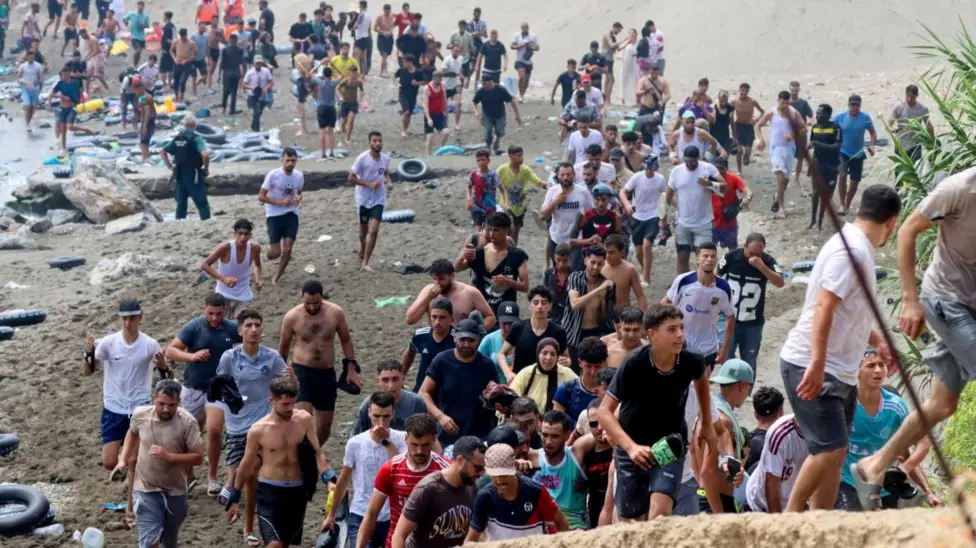
Spanish authorities said tens of thousands of migrants entered Ceuta over a short period, with many subsequently returning voluntarily to Morocco. Local media also reported dozens of fatalities during the crossing, highlighting the humanitarian cost of the unprecedented movement.
Border overwhelmed
Ceuta, together with Melilla, forms the European Union’s only land border with Africa. The enclave has long served as one of the principal gateways for migrants seeking entry into Europe. While attempted crossings occur regularly, officials said the latest influx far exceeded previous incidents.
Residents described scenes of thousands of exhausted arrivals reaching beaches and city streets after swimming around border barriers or entering via coastal routes. Authorities estimate that thousands of children were among those who crossed, underlining the humanitarian complexity facing emergency services and migration officials. Spain has since deployed additional military personnel and security forces to Ceuta and neighbouring Melilla while accelerating efforts to return migrants who entered unlawfully under existing cooperation agreements with Morocco.

Government blames trafficking networks
During a visit to Ceuta, Sánchez argued that organised trafficking groups had deliberately misrepresented a recent Supreme Court judgement concerning migrants intercepted at sea. According to the prime minister, criminal networks spread false claims that the ruling effectively opened access to the Spanish enclaves, prompting large numbers of people to attempt the crossing. He said Madrid was working closely with Moroccan authorities to strengthen border security while facilitating voluntary and legal returns where appropriate.
European political tensions
The crisis has quickly evolved beyond a bilateral issue between Spain and Morocco. Italian Prime Minister Giorgia Meloni described the scenes as evidence of uncontrolled migration posing a broader European security challenge and announced additional border checks affecting travel from Spain. Other European political leaders also called for tougher external border protection, while European Commission President Ursula von der Leyen said the situation required an immediate response. Spanish officials criticised some of the rhetoric from European partners, insisting that migration management required solidarity and coordinated action rather than political point-scoring.
Humanitarian concerns
Most of those arriving were reported to be young men, although women, children and infants were also among the crowds. Witnesses described chaotic scenes as exhausted migrants emerged from the sea searching for food, shelter and medical assistance. Local residents reported businesses temporarily closing while police attempted to restore order across parts of the city. Spanish authorities say thousands have already returned voluntarily to Morocco, while officials continue processing those who remain in accordance with Spanish and European law.
Why Ceuta matters
Although geographically located on the North African coast, Ceuta is Spanish territory and forms part of the European Union. Its strategic position has made it a focal point for migration routes from Africa into Europe for decades. Migration pressure typically rises during the summer months, with organised criminal groups often using social media to coordinate crossings. The latest events, however, represent one of the largest sudden movements ever recorded into the enclave and are likely to influence future discussions over EU migration policy, border management and cooperation with neighbouring countries.
Why this matters
The events in Ceuta highlight the continuing challenge European governments face in balancing humanitarian responsibilities with border security. For African countries, the crisis also reflects broader issues, including youth unemployment, irregular migration networks and the persistent economic pressures driving people to seek opportunities abroad. The response by Spain, Morocco and European institutions is likely to shape migration policy discussions well beyond the western Mediterranean.
Related posts:
 Afghanistan floods kill at least 20, as more than 100 remain missing.
  Europe Wildfires Force 20,000 Evacuations as Extreme Heat Fuels Fires Across France, Spain and Italy
  Southwark Council Recovers Property Linked to Sierra Leone First Lady After Housing Investigation
  Morocco Move Closer to Knockouts After Fastest Goal of World Cup 2026
  Kenya to Charge Eight Students With Murder Over Deadly School Dormitory Fire