

Ashanti Region records Ghana’s highest maternal deaths


Follow Nukunya
Get the latest breaking news and updates from Nukunya.
Ashanti Region records Ghana’s highest maternal deaths
The Ashanti Region recorded Ghana’s highest share of maternal deaths in 2025, with health authorities calling for stronger interventions to prevent women from dying during pregnancy and childbirth.
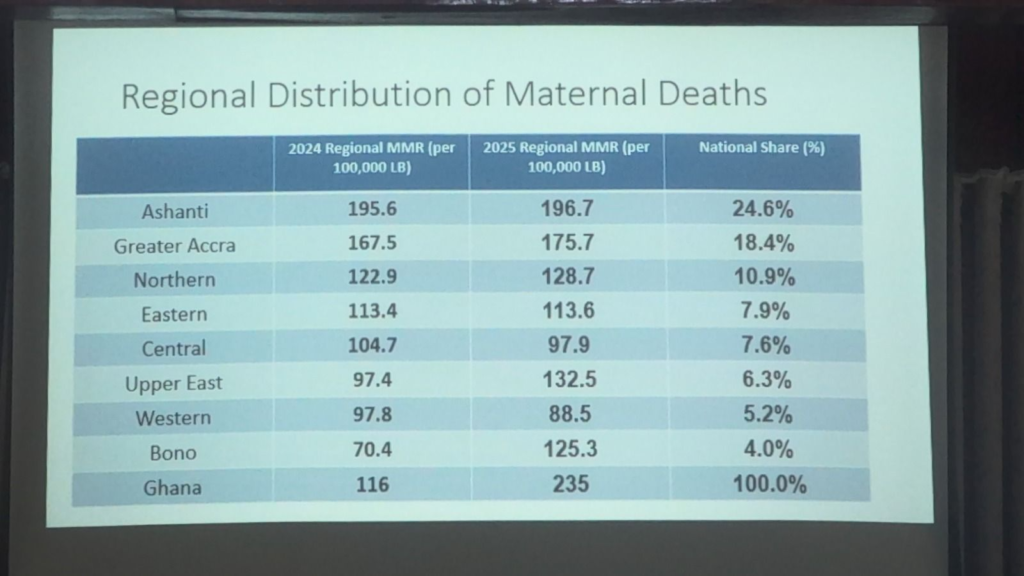
Data from the Ashanti Regional Health Directorate shows that the region’s maternal mortality ratio increased marginally from 195.6 deaths per 100,000 live births in 2024 to 196.7 in 2025.
The region accounted for about 24.6 per cent of maternal deaths recorded nationally in 2025, making it the highest contributor among Ghana’s regions.
Deputy Minister of Health, Dr Grace Ayensu Danquah, said the figures remain a major concern as Ghana works towards the Sustainable Development Goal target of reducing maternal mortality to 70 deaths per 100,000 live births by 2030.
Our maternal mortality index is actually 235 per 100,000 live births, she said, stressing the gap between Ghana’s current rate and the international target.
According to the Deputy Minister, Ghana has only four years to make significant progress towards the 2030 target.
Referral cases contribute to Ashanti’s figures
Health authorities have cautioned against interpreting Ashanti’s position on the maternal mortality table as evidence that the region’s health facilities are solely responsible for the deaths.
Ashanti is home to some of Ghana’s major referral facilities, including Komfo Anokye Teaching Hospital, which receives complicated cases from other parts of the country.
Regional Health Director, Dr Fred Adomako Boateng, said many women referred to the region arrive when their conditions have already deteriorated.
He said the situation can create the perception that deaths recorded at major referral hospitals originate from those facilities, when many of the patients were already critically ill before arriving.
Most of these women, by the time they get here, between 24 to 48 hours, the death has already happened, he said.
Dr Boateng explained that 92 per cent of the maternal deaths recorded at Komfo Anokye Teaching Hospital involve patients referred from outside the facility.
The referral burden therefore remains an important factor in understanding the region’s maternal mortality figures.
Health authorities strengthen interventions
Health authorities in Ashanti are implementing several measures aimed at reducing preventable maternal deaths across the region.
These include clinical mentorship programmes, quarterly reviews of maternal deaths and the introduction of a virtual labour room system.
The virtual system is expected to connect health workers in facilities outside major referral centres with specialists who can provide support when complicated cases arise.
Health authorities also say improved coordination and feedback between health facilities will be important in ensuring that women with complications receive timely and appropriate care.
Ghana faces 2030 maternal mortality target
The latest figures highlight the scale of the challenge facing Ghana as the country works towards achieving the SDG target of 70 maternal deaths per 100,000 live births by 2030.
Dr Danquah noted that Ghana’s current maternal mortality rate remains more than three times the target, leaving limited time for significant improvement.
For the Ashanti Region, health authorities say reducing preventable maternal deaths will require early detection of complications, faster referrals and stronger capacity at health facilities before patients reach major referral hospitals.
They also emphasise the need for effective coordination across the referral system to ensure that women receive timely treatment regardless of the facility where they first seek care.
Related posts:
 Health Ministry Summons KATH CEO After Emergency Unit Exceeds Capacity KATH CEO Suspended After Emergency Admissions Controversy
  KATH Doctors Begin Indefinite Strike Over CEO Suspension as Hospital Crisis Deepens
  GMA Backs KATH Doctors’ Strike, Demands CEO’s Reinstatement Within Three Days KATH CEO Suspension Sparks Governance Debate as Health Ministry Defends Decision