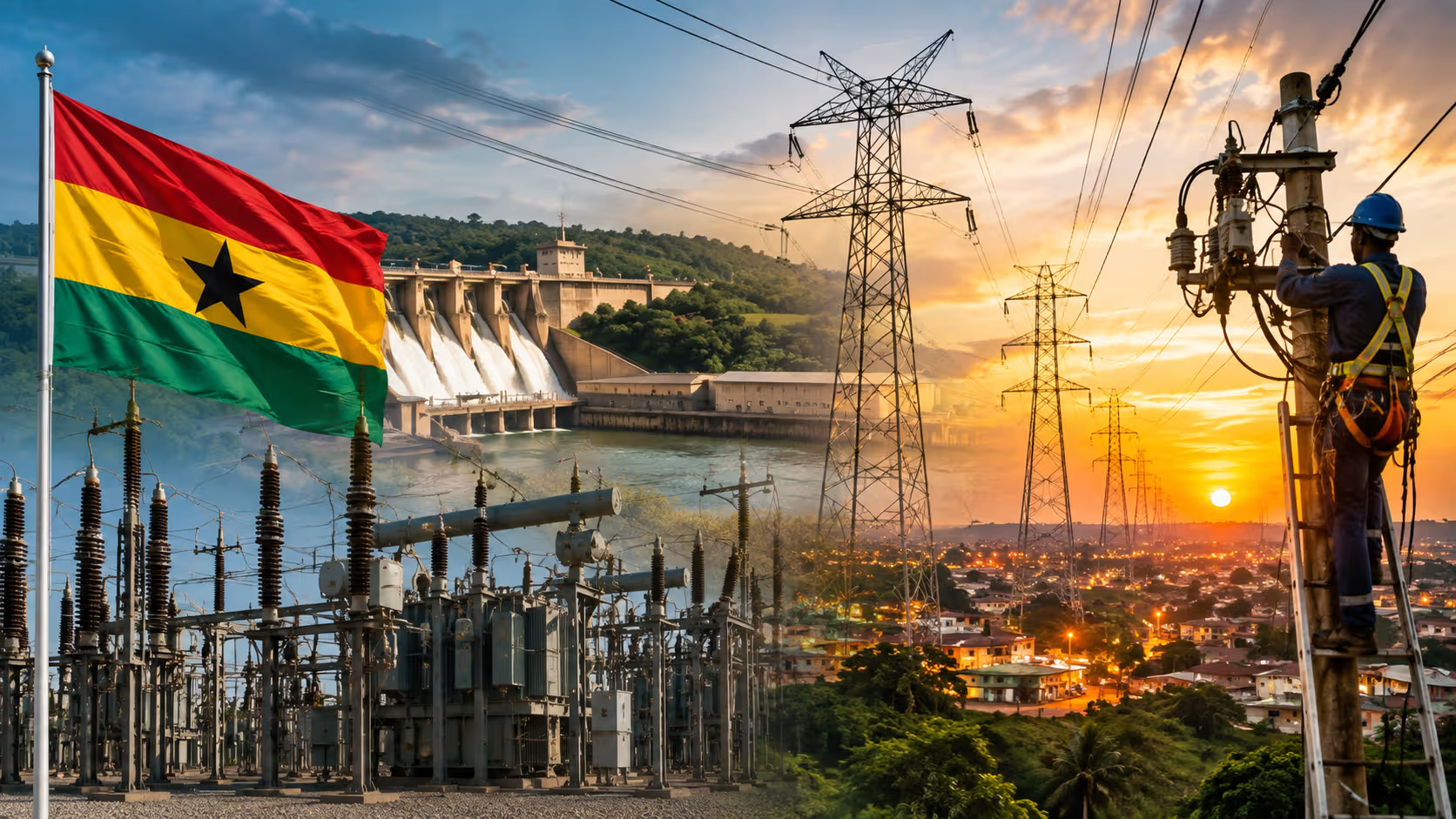
Why Ghana experiences power outages: GRIDCo, ECG and Ghana’s electricity system explained
Ghana's electricity system involves generators, GRIDCo, ECG, NEDCo and regulators. Nukunya explains how power reaches consumers, why outages happen and why every blackout is not necessarily dumsor.


Follow Nukunya
Get the latest breaking news and updates from Nukunya.
When the lights go off in Ghana, ECG is often blamed first. But electricity reaches consumers through a chain involving generators, GRIDCo, ECG, NEDCo and other institutions. Nukunya explains how the system works, where failures can occur and why not every blackout is the same thing as “dumsor”.
ACCRA, Ghana – When electricity suddenly goes off in a Ghanaian home, office or neighbourhood, one question usually follows: what caused it?
The immediate reaction is often to blame the Electricity Company of Ghana, particularly in areas served by ECG. But an electricity outage does not necessarily begin with the company that sends the customer a bill.
Ghana’s electricity system has distinct stages. Electricity must first be generated, then transported across the high-voltage transmission network and finally distributed through local infrastructure to homes, businesses and other consumers.
Different organisations are responsible for different parts of that journey. That distinction explains why one neighbourhood can lose electricity while another remains connected, why a transmission disturbance can affect several areas at once and why Ghana can have electricity available from generating plants while some consumers are still without power.
THE CENTRAL POINT IS :
A blackout tells you one thing with certainty:
Electricity did not reach the consumer.
It does not, by itself, tell you where Ghana’s electricity system failed.
POWER SYSTEM EXPLAINER
The short answer
Ghana can experience power outages because of problems at different points in the electricity system.
01 Generation Power is produced
→ 02 Transmission Bulk electricity is moved
→ 03 Distribution Power is delivered locally
→ 04 Consumer Homes and businesses receive supply
Possible causes include
Generation shortfall
Insufficient electricity available from generators.
Fuel constraints
Fuel shortages or supply constraints affecting thermal power plants.
Transmission faults
Faults or operational constraints on the high-voltage transmission network.
Substation problems
Faults affecting substations that switch, transform or route electricity.
Transformer overload or failure
Overloaded or faulty transformers can interrupt supply to local areas.
Feeder or cable faults
Distribution feeders, underground cables or local lines can fail.
Planned works
Maintenance, upgrades or infrastructure replacement may require controlled outages.
Weather or physical damage
Storms, falling objects, accidents or other damage can affect electricity infrastructure.
Automatic protection
Protection systems may disconnect equipment after detecting an electrical fault.
KEY TAKEAWAY
These problems can produce the same result for a consumer, darkness, but they do not necessarily have the same cause or solution.
How Ghana’s electricity system works
In simplified terms, electricity typically travels through Ghana’s power system like this:
01
Generation
Electricity is produced
02
Transmission
High-voltage power is moved across the grid
03
Substations
Power is switched and transformed
04
Distribution
Electricity enters local networks
05
Transformers
Voltage is reduced for local supply
06
Consumers
Power reaches homes and businesses
An interruption at any point in this chain can result in an outage for consumers further downstream.
But there is an important distinction between installed generation capacity and electricity that is actually available to the system at a particular moment.
A generating unit can exist but be temporarily unavailable because of maintenance, technical failure, fuel constraints or other operational conditions. That is why comparing Ghana’s total installed capacity with national demand does not, on its own, establish whether the system can meet electricity requirements at a particular time.
2. GRIDCo: moving electricity across Ghana
Once electricity has been generated, it must be transported from generating plants towards the areas where it is needed. That is the central role of the Ghana Grid Company, GRIDCo.
GRIDCo operates Ghana’s high-voltage National Interconnected Transmission System and performs important system-operation functions. In simplified terms, if generating plants are where electricity enters the wider power system, GRIDCo operates the high-voltage network that moves large quantities of it around the country.
This is fundamentally different from distributing electricity along local networks to individual households.
A fault affecting a significant transmission line, transformer, substation or other grid infrastructure can therefore have consequences beyond the location where the problem originated.
The interconnected system also requires electricity generation and demand to remain balanced. Protection systems can automatically disconnect equipment when they detect abnormal conditions. This is designed to protect infrastructure and prevent a fault from causing wider damage. That can produce a sudden outage even though the disconnection itself is a protective response.
3. ECG: the distribution network consumers see
For millions of consumers in southern Ghana, the electricity company they encounter most frequently is ECG. Its distribution infrastructure carries electricity towards homes, businesses and other customers within its operational area.
This is why ECG often receives the immediate blame when electricity goes off.
But an ECG customer losing electricity does not automatically mean ECG caused the original problem.
The interruption may have originated upstream on the transmission system.
Alternatively, electricity may have successfully reached ECG’s network before a local feeder, transformer, cable or other distribution component developed a problem.
That distinction is crucial.
Electricity can be available elsewhere in the national system while a particular community remains without power because of a local distribution fault.
4. What about northern Ghana?
ECG is not Ghana’s only major electricity distributor.
The Northern Electricity Distribution Company, NEDCo, distributes electricity across a large geographical area of northern Ghana, with its operational footprint extending into parts of other regions. This is why describing every distribution outage in Ghana as an “ECG problem” can be inaccurate.
What actually causes power outages?
From the consumer’s perspective, different electricity-system problems can look identical.
The lights go off.
Technically, however, several very different things may have happened.
Generation shortages
An outage can occur when insufficient electricity is available from generating plants to meet system requirements.
Generating units may be unavailable because of technical problems, maintenance, fuel shortages or other operational constraints.
Where available electricity cannot meet demand and consumption must deliberately be reduced, system operators can resort to load shedding.
That is different from a transformer failing in one neighbourhood.
Fuel constraints
Thermal power plants require fuel.
Natural gas is particularly important to Ghana’s thermal generation system, while some generating facilities can use alternative fuels depending on their technical configuration.
A power station can therefore be physically capable of generating electricity but unable to produce its expected output if adequate fuel is unavailable.
Electricity security is consequently connected not only to generating plants but also to the infrastructure and commercial arrangements required to supply them with fuel.
Transmission faults and constraints
Electricity may be successfully generated but unable to reach the relevant distribution network because of a transmission problem.
High-voltage lines, transformers, substations and other transmission infrastructure can develop faults.
Constraints can also occur where the network does not have sufficient capacity to move the required amount of electricity safely to a particular part of the system.
This is why building more generating capacity cannot solve every electricity reliability problem.
Additional generation is of limited benefit to a particular consumer if the network cannot reliably transport and distribute that electricity.
CLOSER TO THE CONSUMER
Distribution faults
Other outages occur much closer to the consumer, after electricity has already travelled through much of the power system.
01
↯
Feeder trips
A distribution feeder can trip and interrupt supply to the area it serves.
02
T
Transformer failure
A local transformer can fail, become overloaded or require emergency repair.
03
⌁
Cable fault
An underground cable or another part of the local network can develop a fault.
04
⚙
Equipment damage
Distribution equipment can be damaged or taken out of service for urgent repairs.
WHAT THE CONSUMER SEES Street or neighbourhood without power
WHAT IT DOES NOT NECESSARILY MEAN The entire national power system has failed
KEY DISTINCTION
A distribution failure can leave a street, neighbourhood or larger local area without electricity while the wider national power system continues operating.
PLANNED INTERRUPTION
Planned maintenance
Not every interruption represents an unexpected failure.
UNEXPECTED OUTAGE Something fails
Equipment, cables, transformers or other parts of the system develop a fault.
PLANNED OUTAGE Supply is deliberately interrupted
Engineers isolate part of the network so inspection, replacement or upgrading can be carried out safely.
WHAT THE WORK MAY INVOLVE
01 Transformers
02 Feeders
03 Substations
04 Conductors
05 Other network equipment
1
Electricity infrastructure needs inspection, replacement or upgrading.
→
2
Utilities temporarily disconnect supply so engineers can work safely.
→
3
Work is completed and the affected network can be returned to service.
THE TRADE-OFF
A planned outage can cause temporary inconvenience while forming part of work intended to improve network safety and reliability.
EXTERNAL CAUSES
Severe weather and physical damage
Heavy rain, strong winds, falling trees and other external hazards can affect electricity infrastructure.
☂
Heavy rain
Water and flooding can affect electrical equipment and access to infrastructure.
≈
Strong winds
High winds can damage conductors, poles and other exposed network equipment.
⌁
Falling objects
Trees, branches and other debris can strike lines or electricity infrastructure.
!
Physical damage
Accidents and other external events can damage equipment or conductors.
1 Damage or abnormal condition A problem develops on the network
→
2 Protection detects the fault Electrical protection responds
→
3 Affected section is isolated Equipment and the public are protected
WHY THIS MATTERS
When equipment or conductors are damaged, protection systems may isolate the affected section of the network. This can prevent a local fault from causing further damage.
GRID PROTECTION EXPLAINED
Why does electricity sometimes go off and return quickly?
A brief interruption does not necessarily mean that engineers repaired a fault within seconds. It can be the electricity system’s protection equipment responding automatically.
STEP 1
↯
Fault detected
Protection equipment detects a fault or abnormal electrical condition.
→
STEP 2
×
Supply disconnects
A feeder or other component may be temporarily disconnected for safety.
→
THEN THE SYSTEM DEPENDS ON ONE QUESTION
Has the disturbance cleared?
IF YES
DISTURBANCE CLEARS
Electricity may return quickly
If the abnormal condition disappears and the system can safely reconnect, the interruption may last only a short time.
Typical reader experience Power goes off → returns shortly afterwards
IF NO
FAULT REMAINS
The outage may continue
The affected section may remain disconnected while engineers locate, isolate and repair the problem before supply can safely resume.
Typical reader experience Power stays off until the fault is addressed
HOW TO READ THE OUTAGE
BRIEF INTERRUPTIONS May indicate automatic protection responding to a temporary disturbance
≠
PROLONGED BLACKOUT May indicate a persistent fault, damage or another problem requiring intervention
A series of brief interruptions can therefore indicate a different type of problem from a blackout lasting several hours.
LOCAL NETWORK EXPLAINER
Why can one neighbourhood have electricity while another does not?
Because neighbouring communities are not necessarily supplied by the same feeder, transformer or substation.
Two streets that are geographically close can be connected to different parts of the distribution network.
COMMUNITY A Electricity available
Connected to a feeder or circuit that remains operational.
COMMUNITY B Supply interrupted
Connected to another feeder, transformer or isolated section of the network.
Different feeders
Nearby streets can be supplied by different distribution circuits.
Different transformers
A transformer serving one area can fail while another continues operating.
Network isolation
Engineers can isolate one section for repairs while maintaining supply elsewhere.
KEY DISTINCTION
Electricity being available nearby does not, by itself, establish that an outage affecting another community is part of a national shortage.
SYSTEM PRESSURE
Growing demand puts pressure on the entire system
Ghana’s electricity needs are increasing.
Population growth, urban expansion, new housing, businesses, industrial activity and increased use of electrical appliances all place additional demands on the system.
01 Population growth
02 Urban expansion
03 New housing
04 Businesses
05 Industrial activity
06 More electrical appliances
As demand grows, generation, transmission and distribution infrastructure must expand with it.
DEMAND ↑ Electricity use rises
NETWORK LOAD ↑ Transformers, feeders and substations carry more load
INVESTMENT NEED ↑ Reinforcement and expansion become necessary
If local electricity demand grows faster than the infrastructure serving a community, transformers, feeders and substations can come under increasing pressure.
The same principle applies further upstream.
THE SYSTEM LESSON
A reliable electricity system requires investment across the entire electricity chain, rather than generation alone.
THE POWER-SECTOR PARADOX
Why doesn’t Ghana simply build more power stations?
Because generation capacity and electricity reliability are not the same thing.
A functioning electricity system requires the entire chain to work.
Generation + Fuel + Transmission + Distribution + Maintenance + Metering + Revenue collection + System management
A new generating plant does not repair
A damaged underground distribution cable.
It does not replace
An overloaded neighbourhood transformer.
It does not automatically remove
A constraint or fault on the transmission network.
THE PARADOX
Ghana can have substantial generation capacity and still experience electricity outages.
The correct solution depends on identifying where the constraint actually lies.
EFFICIENCY EXPLAINER
Why electricity-system losses matter
Electricity losses are another important part of the picture, but not all losses mean the same thing.
TECHNICAL
Technical losses
Some energy is lost as electricity travels through transmission and distribution infrastructure.
The level of those losses can be influenced by factors including network configuration, equipment, loading and distance.
Network configuration Equipment Loading Distance
COMMERCIAL
Commercial losses
Commercial losses concern electricity supplied but not fully converted into billed and collected revenue.
They can arise from electricity theft, illegal connections, metering weaknesses, inaccurate billing and collection failures.
Electricity theft Illegal connections Metering weaknesses Billing errors Collection failures
27% ECG distribution-system losses 2024
23% Loss-reduction target By 2030
86% ECG collection efficiency 2023
93% Collection-efficiency target By 2028
Source: Ghana National Energy Compact. Figures refer to the periods stated.
IMPORTANT
These figures do not explain the cause of an individual blackout.
They matter because electricity reliability ultimately requires utilities and the wider sector to finance maintenance, replacement, reinforcement and expansion of infrastructure.
Reducing losses and improving revenue collection are therefore part of the wider challenge of building a financially and operationally sustainable electricity system.
OUTAGE CLUES
Your lights are off: what can the pattern of the outage tell you?
Consumers cannot conclusively diagnose a network fault from home, but the pattern of an outage can provide clues.
Only your property appears affected
Check whether neighbouring properties have electricity and whether there is an obvious premises-level supply issue.
Several homes or a neighbourhood are affected
A distribution feeder, transformer or other local-network problem may be involved.
Several communities are affected
A larger distribution problem or upstream supply interruption becomes possible.
Large areas or multiple regions are affected
A wider transmission or generation-system disturbance becomes more plausible.
The interruption was announced beforehand
Planned maintenance or organised load management may be involved.
SAFETY + ACCURACY
These are clues, not a diagnosis. Only the relevant utility or system operator can confirm the cause of a particular outage.
Do not open, dismantle or attempt to repair electricity infrastructure yourself.
TERMINOLOGY
Is every power outage “dumsor”?
Not necessarily.
In everyday Ghanaian usage, “dumsor” has become a broad expression associated with unreliable electricity supply and recurring blackouts.
But greater precision is useful when discussing what actually happened.
LOAD SHEDDING Generation or wider system-supply constraint
LOCAL OUTAGE Feeder, cable, transformer or other local-network fault
EXAMPLE
A broken transformer can leave hundreds of customers without electricity. That is a power outage. It does not, by itself, establish that Ghana lacks sufficient electricity generation nationally.
The distinction matters because different problems require different solutions.
WHO REGULATES?
Who regulates Ghana’s electricity system?
Two regulators have particularly important roles.
Energy Commission
Technical regulation • licensing • planningThe Energy Commission licenses electricity-sector activities and performs technical, regulatory and energy-planning functions.
- Transmission licensing
- Wholesale supply licensing
- Distribution licensing
- Electricity sales licensing
- Technical and operational standards
Public Utilities Regulatory Commission
Economic regulation • tariffs • consumersPURC performs economic and service regulation, including electricity tariff decisions and oversight relating to consumers and utility performance.
- Electricity tariff decisions
- Consumer protection
- Utility-performance oversight
- Service regulation
IMPORTANT DISTINCTION
These regulators have different functions from the companies that physically generate, transmit or distribute electricity.
THE WHOLE SYSTEM
So who keeps Ghana’s lights on?
There is no single organisation responsible for the entire electricity chain.
Generating companies
Produce electricity.
GRIDCo
Operates the high-voltage transmission system that moves electricity around Ghana.
ECG, NEDCo and other licensed distributors
Carry electricity through distribution networks towards consumers.
TECHNICAL OVERSIGHT Energy Commission
Licensing, technical standards and planning.
ECONOMIC OVERSIGHT PURC
Tariffs, economic regulation and consumer protection.
FUEL + GAS Fuel suppliers and gas infrastructure
Thermal generators depend on reliable fuel supplies.
THE BIGGER POINT
Ghana’s electricity organisations are interconnected. That is precisely why assigning every blackout to one company can obscure what actually happened.
NUKUNYA ANALYSIS
Capacity is not the same as reliability
Ghana’s electricity debate frequently focuses on megawatts.
But generation capacity and electricity reliability measure different things.
GENERATION CAPACITY Can electricity be produced?
This concerns the amount of electricity generating facilities are capable of supplying.
RELIABILITY Can the whole system deliver it when needed?
This depends on generation, fuel, transmission, distribution, maintenance and system operation.
That distinction should increasingly shape how Ghana evaluates its power sector.
Transmission
Lines must be capable of moving additional electricity as demand grows.
Substations
Substations must have sufficient capacity to switch and transform power safely.
Distribution
Feeders and transformers must cope with growing local demand.
Fuel
Thermal generators need reliable fuel supplies to remain available.
Maintenance
Infrastructure must be inspected, maintained, reinforced and replaced.
Financial sustainability
Electricity supplied must be effectively metered, billed and collected.
THE POLICY QUESTION
The issue is bigger than whether Ghana has enough generating capacity. It is whether the whole electricity chain is sufficiently resilient to turn that capacity into reliable power at the socket.
This is also why diagnosis should come before blame.
01
Was sufficient electricity available from generators?
02
Could the transmission system move it where it was needed?
03
Did it reach the relevant distribution network?
04
Could the local network deliver it to consumers?
05
Was the interruption planned, accidental or a protective response to another fault?
GENERATION SHORTAGE Requires one response
TRANSMISSION CONSTRAINT Requires another
LOCAL TRANSFORMER FAILURE Requires another still
Understanding where the chain failed is therefore essential to understanding both the outage and its solution.
WHY THIS MATTERS
Why this matters for Ghana
Reliable electricity is economic infrastructure.
Power interruptions can affect manufacturing, healthcare, telecommunications, financial services, education, cold storage, retail and the digital economy.
Traders
Extended outages can mean spoiled goods, lost trading time and additional operating costs.
Manufacturers
Interruptions can halt production, damage processes and raise the cost of backup power.
Households
Repeated interruptions can disrupt work, education and everyday domestic activity.
Health services
Hospitals and other essential services face potentially much greater consequences.
Digital economy
Connectivity, payments, data services and digitally enabled businesses all depend on reliable power.
Investment
Electricity reliability influences business confidence, productivity and long-term capital decisions.
THE BIGGER POINT
The quality of Ghana’s electricity system affects much more than whether household lights remain on. It is connected to productivity, investment, public services and everyday economic life.
QUICK EXPLAINER
Five questions answered
What is the difference between GRIDCo and ECG?
GRIDCo operates Ghana’s high-voltage transmission system, moving bulk electricity through the national grid. ECG operates distribution infrastructure that carries electricity towards consumers within its licensed areas.
Does ECG generate electricity?
ECG’s principal role is electricity distribution and supply to customers. Electricity generation is undertaken by generating companies, while GRIDCo operates the national transmission system.
What causes dumsor?
“Dumsor” is widely used in Ghana to describe unreliable electricity supply or recurring blackouts. Where an interruption results from organised load shedding, electricity consumption is deliberately reduced because available supply or system conditions cannot meet requirements. Other outages can instead result from transmission or distribution faults.
Can Ghana have enough generation but still experience blackouts?
Yes. Electricity may be available from generators while transmission constraints, feeder faults, transformer failures, cable problems or maintenance interrupt supply elsewhere in the system.
Why isn’t there a timetable for every power outage?
Timetables can be issued for planned maintenance or organised load management. Unexpected equipment failures, transmission disturbances, cable faults and other unplanned events cannot always be predicted.
NOTE
These explanations describe how Ghana’s electricity system generally operates. The cause of a specific outage should be established from the relevant operator or utility.
TRANSPARENCY
How Nukunya researched this explainer
Nukunya reviewed primary and institutional information from Ghana’s Energy Commission, GRIDCo, ECG, NEDCo, VRA and PURC, alongside Ghana’s National Energy Compact.
Primary regulatory and institutional sources were prioritised for technical responsibilities, electricity-system structure and operational information.
This explainer deliberately distinguishes between generation, transmission and distribution because each can result in consumers losing electricity while involving a different underlying cause and solution.
Statistics are dated where appropriate because electricity demand, generation, infrastructure and network performance change over time.
01 Primary sources first
02 Institutional roles separated
03 Technical claims distinguished from diagnosis
04 Time-sensitive statistics dated
PRIMARY REFERENCES
Key sources
Energy Commission
Mandate, electricity regulations, National Electricity Distribution Code and electricity-sector technical framework.
Ghana Grid Company
Transmission-network and system-operation information.
Electricity Company of Ghana
Official operational, maintenance and outage information.
Northern Electricity Distribution Company
Institutional mandate and distribution information.
Volta River Authority
Electricity-generation information.
Public Utilities Regulatory Commission
Electricity tariffs, utility regulation and consumer-protection framework.
Ghana National Energy Compact
Electricity-sector reform, distribution-loss and collection-efficiency benchmarks.
Related posts:
 GRIDCo and ECG shut down Mallam and Achimota substations as Accra floods threaten power infrastructure
  GRIDCo power outage today: Parts of Accra face 15-hour electricity cut
  Ghana-UAE Energy Ties Deepen as UAE Eyes Petroleum Hub
  Power outages expected in Accra, Volta and Ashanti during ECG maintenance
  OMCs Increase Fuel Prices: Reasons Star Oil Raised Petrol to GH¢14.53 and Diesel to GH¢18.77