
BoG interest rates explained: How the Bank of Ghana policy rate affects loans, savings, inflation and the cedi
The Bank of Ghana policy rate is not the interest rate consumers automatically pay on loans. Nukunya explains the MPR, Ghana Reference Rate and how monetary policy reaches households and businesses.

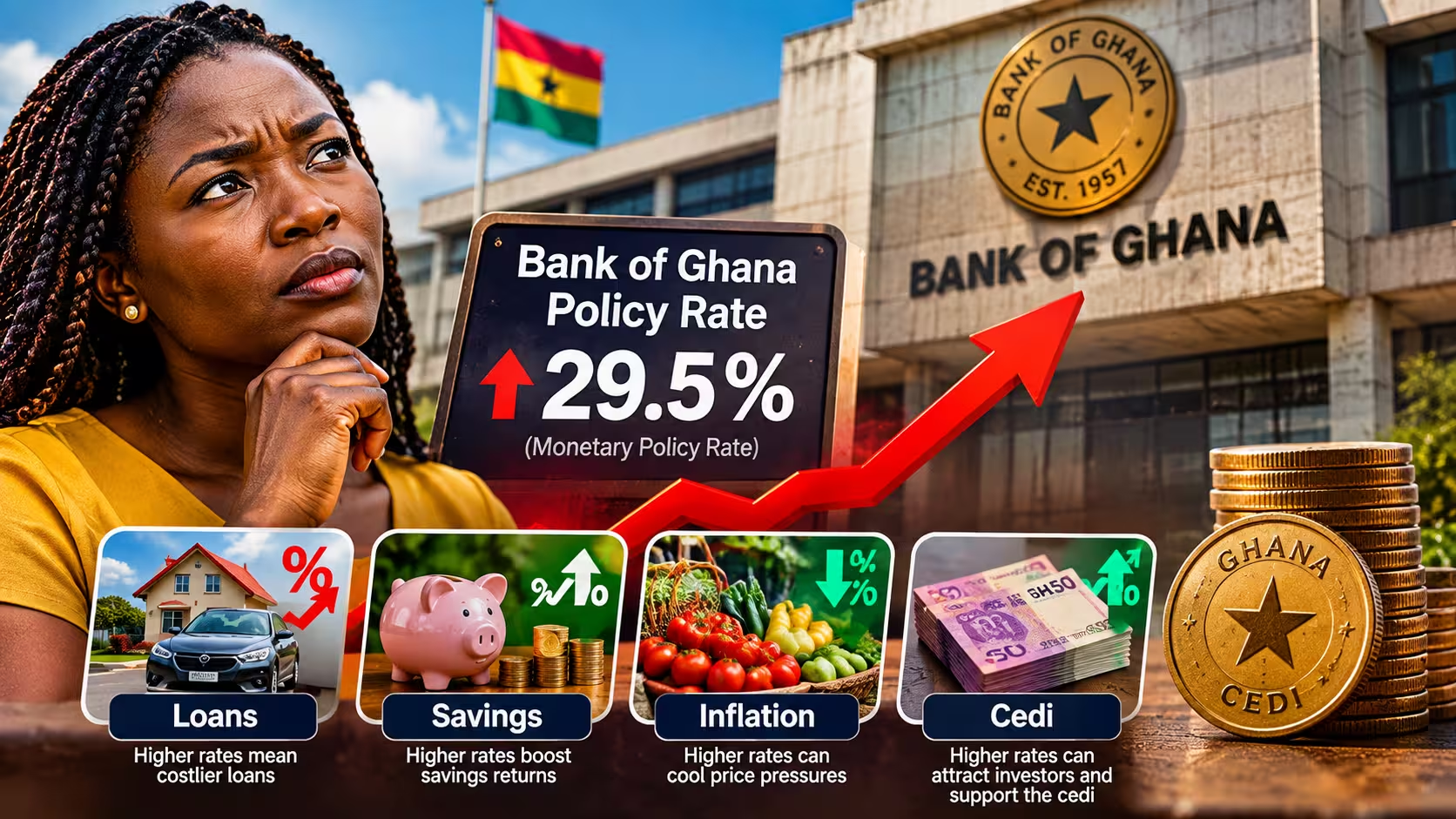

When the Bank of Ghana raises or cuts its policy rate, it does not directly set the interest rate on every loan or savings account. Nukunya explains what the Monetary Policy Rate actually is, why the central bank changes it, how those decisions move through Ghana’s economy and why borrowing rates may not fall immediately when the BoG cuts rates.
ACCRA, Ghana – Few economic announcements in Ghana attract as much attention as a change in the Bank of Ghana’s interest rate.
Headlines may say the central bank has “cut interest rates” or “raised rates”. Borrowers then wonder whether bank loans will become cheaper. Businesses ask what it means for credit. Savers want to know what will happen to deposit rates. Investors watch Treasury bill yields, while currency markets consider the implications for the cedi.
But there is an important distinction.
The Bank of Ghana does not directly set the interest rate on every loan, mortgage, overdraft or savings account in Ghana.
What its Monetary Policy Committee sets is the Monetary Policy Rate, or MPR.
The MPR is the central bank’s principal policy interest rate. It signals whether monetary policy is becoming tighter, looser or remaining broadly unchanged.
Changes in that rate can influence other interest rates across the economy, but the process is neither automatic nor instantaneous. That distinction is the starting point for understanding what people commonly call “BoG interest rates”.
How the Bank of Ghana policy rate affects the economy
The Bank of Ghana uses the Monetary Policy Rate as its principal monetary-policy tool under Ghana’s inflation-targeting framework.
Commercial-bank lending rates also depend on funding costs, borrower risk, operating costs, market conditions and other factors.
A 2 percentage-point cut in the Bank of Ghana policy rate does not necessarily produce a 2 percentage-point reduction in the interest rate charged on a customer’s loan.
What is the Bank of Ghana Monetary Policy Rate?
The Bank of Ghana describes the MPR as the rate that signals the monetary-policy stance and at which short-term monetary-policy operations are conducted with counterparties, principally commercial banks.
The central bank operates an interest-rate-oriented monetary-policy framework and seeks to keep the overnight interbank interest rate closely aligned with the MPR.
Signals the central bank’s monetary-policy stance.
Commercial-bank lending rates are priced separately.
Deposit rates are also determined separately.
Who decides the policy rate?
The decision is made by the Bank of Ghana’s Monetary Policy Committee, or MPC.
The Bank says the MPC normally meets six times a year. Before deciding whether to raise, cut or maintain the policy rate, members assess economic and financial conditions.
Inflation
Current inflation and the outlook for future price pressures.
Growth
Economic activity, domestic demand and business conditions.
Exchange rate
Movements in the cedi and conditions in the foreign-exchange market.
Money and credit
Liquidity, lending, credit growth and broader monetary conditions.
Government financing
Fiscal financing conditions and their interaction with financial markets.
Global conditions
External growth, commodity prices, financial conditions and international risks.
Financial stability
Conditions across banks and the wider financial system.
Risks
Potential shocks that could alter the inflation or growth outlook.
The MPC is not simply asking what inflation is today. It is asking what inflation and the wider economy are likely to look like in the months ahead, and what monetary-policy stance is appropriate for those conditions.
Why does the Bank of Ghana change interest rates?
The Bank of Ghana’s primary monetary-policy objective is price stability.
In practical terms, monetary policy seeks to prevent inflation from remaining persistently too high while avoiding unnecessarily restrictive financial conditions when inflationary pressures have subsided.
What happens when the Bank of Ghana raises the policy rate?
A rate increase is normally associated with tighter monetary policy.
Monetary conditions tighten.
Market rates can respond.
Households and businesses may postpone spending.
Some inflationary pressure can ease over time.
The Bank of Ghana cannot raise the MPR on Monday and expect the price of every product in Makola, Kumasi or Tamale to fall on Tuesday.
Policy works through the financial system and wider economy over time.
What happens when the Bank of Ghana cuts the policy rate?
A rate cut moves monetary policy in the opposite direction.
Policy-rate cuts can feed through to borrowing costs, but the rates do not necessarily move by the same amount or at exactly the same time.
Why doesn’t my bank loan rate equal the BoG policy rate?
Because they are different prices for different risks and transactions.
Cost of funds
What does it cost the bank to obtain the money it lends?
Credit risk
How likely is the borrower to repay?
Operating costs
What does it cost to originate, administer and service the loan?
Loan type + duration
Different facilities carry different maturity and repayment risks.
Collateral
Security can affect the lender’s assessment of potential losses.
Market conditions
Competition and liquidity conditions can affect loan pricing.
Fees + charges
The total cost of borrowing can extend beyond the headline interest rate.
This is why two customers can approach the same bank and receive different borrowing terms.
What is the Ghana Reference Rate?
The Ghana Reference Rate, or GRR, is not the same thing as the Monetary Policy Rate.
Bank of Ghana statistical publications describe the GRR as a base rate for pricing loans.
The GRR therefore provides a market-linked reference point for loan pricing. A bank can still add a risk premium and applicable charges when determining the cost of lending to a particular borrower.
MPR, GRR and your loan rate: the difference
| Rate | What it means | Who determines it? |
|---|---|---|
| Monetary Policy Rate (MPR) | Main rate signalling Ghana’s monetary-policy stance. | Bank of Ghana MPC |
| Interbank rate | Rate associated with short-term lending between banks. | Money market, influenced by BoG operations |
| Ghana Reference Rate (GRR) | Reference base used in pricing loans. | Calculated using specified market rates |
| Loan interest rate | Interest charged to an individual borrower. | Commercial bank or lender |
| APR | Broader annual borrowing cost including applicable pricing components and charges. | Depends on lender and loan |
Saying “BoG has cut interest rates” can be misleading if readers interpret it to mean that every retail lending rate has immediately fallen. More precisely, the Bank has changed its policy rate.
What is APR and why should borrowers care?
For someone actually taking a loan, the headline interest rate does not always tell the full story.
The Bank of Ghana publishes Annual Percentage Rates, or APRs, for bank loans to households, SMEs and corporate borrowers.
“What is the BoG rate?”
“What is the total annual cost of the loan I am being offered?”
Why can lending rates remain high after BoG cuts the policy rate?
A policy-rate cut creates conditions that can push market interest rates downward. It does not reset every loan contract overnight.
Credit risk remains
Banks still have to price the risk that a borrower may not repay.
Funding costs differ
A lender’s own cost of obtaining funds can move differently from the MPR.
Operating costs remain
Administration and servicing costs do not disappear because the policy rate fell.
Contracts matter
Existing loans may have fixed rates or contractual rules governing when pricing changes.
A policy-rate cut is a signal and monetary-policy action. It is not an instruction requiring every lender to reduce every customer’s interest rate by the same amount immediately.
How does the MPR affect Treasury bills?
Treasury-bill yields and the Monetary Policy Rate are different rates, but they can influence one another through financial-market conditions.
Treasury bills are short-term government securities. Their yields reflect factors including government financing conditions, market liquidity, investor demand, inflation expectations and monetary policy.
A fall in the MPR does not mechanically require a Treasury-bill yield to fall by exactly the same amount.
How do BoG interest rates affect inflation?
The main purpose of monetary policy is not to determine what banks earn on loans. It is to help maintain price stability.
Borrowing + spending
Higher rates can discourage some credit-financed consumption.
Business investment
Financing costs can affect whether projects remain attractive.
Financial markets
Interest rates influence returns, liquidity and portfolio choices.
Expectations
Policy can shape expectations about future inflation.
Exchange rate
Monetary conditions can interact with the cedi and imported inflation.
These channels collectively form what economists call the monetary-policy transmission mechanism. It can be powerful, but it is not instantaneous.
How do interest rates affect the cedi?
The relationship between interest rates and exchange rates is important, but it should not be oversimplified.
All else being equal, relatively attractive domestic interest rates can affect demand for cedi-denominated financial assets.
Does not guarantee that the cedi will appreciate.
Does not automatically mean the cedi will depreciate.
Interest rates are one influence among several.
What do higher BoG rates mean for businesses?
Higher interest rates can make financing more expensive.
That matters particularly for businesses dependent on bank credit for working capital, machinery, inventory or expansion.
Debt-funded investment becomes more expensive.
Some projects may no longer generate a sufficient return to justify borrowing.
Businesses may postpone projects or rely more heavily on internal funds.
Higher borrowing costs can increase the cost of financing inventory and operations.
Projects financed through debt become harder to justify when funding costs rise.
Businesses may delay new branches, factories, hiring or capacity expansion.
Businesses are also affected by inflation. Persistently high inflation creates uncertainty, raises input costs and complicates financial planning.
The central bank therefore has to balance the costs of restrictive monetary conditions against the economic damage that can result from inflation remaining too high.
What do BoG rates mean for ordinary households?
The effect depends partly on whether a household is primarily a borrower or saver.
Credit can become more expensive
Higher market interest rates can raise the cost of new personal loans, vehicle finance and other borrowing.
Some returns may improve
Higher market rates can potentially increase returns available on some deposits and fixed-income investments.
Individual products are priced by financial institutions and financial markets. Consumers should therefore check the actual interest rate, APR, fees, repayment structure and contractual terms rather than assuming a change in the MPR has produced an identical change in their own financial product.
Why does inflation matter so much for interest rates?
Because the nominal interest rate tells only part of the story.
The saver may receive more cedis at the end of the year, but the purchasing power of those cedis may have declined.
Real interest rate ≈ nominal interest rate − inflation
This is one reason central banks monitor inflation closely when setting policy rates. A rate that looks extremely high in nominal terms can imply a much smaller real return when inflation is also high.
Why doesn’t BoG simply keep interest rates low?
Because cheap money has consequences.
Very low interest rates can support borrowing, investment and economic activity.
If monetary conditions become too loose, demand and inflationary pressures can intensify.
Demand
Cheap credit can encourage faster spending and borrowing.
Inflation
Excess demand can reinforce price pressures when supply cannot keep pace.
Exchange rate
Lower rates can interact with capital flows and expectations around the cedi.
The goal is neither to make interest rates as low as possible nor to keep them high indefinitely.
It is to set monetary conditions consistent with price stability while taking account of the wider economy and financial system.
What is the current Bank of Ghana policy rate?
The Monetary Policy Rate changes over time and should not be hard-coded into an evergreen explanation without a date.
Held unchanged
The MPC unanimously maintained the rate at its July meeting after also holding it at 14% in May.
Readers should check the Bank of Ghana’s latest MPC announcement for the current rate because the Committee normally reviews monetary policy several times each year.
The policy rate is the beginning of the story, not the end
Ghana’s interest-rate debate often treats the Monetary Policy Rate as though it were the price of all money in the economy.
It is not.
The MPR is better understood as the anchor from which monetary policy begins to influence financial conditions.
From a Bank of Ghana decision to the rate a borrower sees
Changes the Monetary Policy Rate.
Interbank conditions and short-term rates respond.
Treasury yields, liquidity and funding conditions can adjust.
Funding costs, reference rates and credit pricing respond.
The price and availability of credit may change.
Each stage introduces additional influences. That is why monetary-policy transmission is neither instantaneous nor one-for-one.
“How can BoG cut its policy rate sharply while my bank loan still feels expensive?”
Reflects the central bank’s policy position and anchors short-term monetary conditions.
Also reflects funding costs, borrower risk, operating costs, loan characteristics and charges.
Diagnosis should go beyond asking whether BoG should cut again
If the MPR falls but borrowing costs remain persistently high, the analytical question should not simply be whether the Bank of Ghana should cut the rate again.
Policymakers should also ask how effectively monetary policy is transmitting through the banking system and what other factors are keeping the cost of credit elevated.
“Why hasn’t my bank copied the BoG rate?”
“How much of the change in monetary policy has reached businesses and households, how quickly, and what is preventing the rest from passing through?”
Five questions answered
The distinctions below resolve some of the most common misunderstandings about the Bank of Ghana policy rate.
What is the BoG policy rate?
The Monetary Policy Rate is the Bank of Ghana’s principal policy interest rate. It signals the monetary-policy stance and anchors short-term monetary conditions.
Does the BoG policy rate determine my bank’s loan rate?
Not directly. Commercial-bank loan pricing also reflects funding costs, credit risk, operating costs, loan characteristics, market conditions and charges.
If BoG cuts the MPR by 2%, should my loan rate fall by 2%?
Not necessarily. Monetary-policy transmission is not one-for-one, and an existing loan may also be governed by contractual terms.
What is the difference between the MPR and Ghana Reference Rate?
The MPR is the central bank’s policy rate. The Ghana Reference Rate is a reference base used in loan pricing and incorporates several market rates, including the MPR.
Why does BoG raise rates when inflation is high?
Higher policy rates tighten monetary conditions. This can reduce some borrowing and demand and help bring inflationary pressure back towards the central bank’s target over time.
The process takes time and is influenced by other economic conditions.
How Nukunya researched this explainer
Nukunya reviewed primary Bank of Ghana material including its Monetary Policy Framework, MPC decision statements, Monetary Policy Reports, Summary of Economic and Financial Data, interest-rate statistics and published bank-loan APR information.
Primary central-bank documentation was prioritised for explanations of Ghana’s monetary-policy framework, the Monetary Policy Rate, interest-rate transmission and banking-market rates.
Primary sources first
Institutional and central-bank documents are prioritised over secondary summaries for technical definitions and official statistics.
Rates are not conflated
Policy rates, money-market rates, Treasury yields, reference rates and retail borrowing costs are treated as distinct concepts.
Time-sensitive data are dated
The MPR, inflation, Treasury yields, the Ghana Reference Rate and commercial-bank lending rates can change materially over time.
Causality is not overstated
Rate changes are described as influencing financial conditions rather than mechanically determining every market or retail interest rate.
This explainer deliberately distinguishes between the policy rate, money-market rates, Treasury rates, reference rates and retail borrowing costs because treating them as interchangeable can mislead readers.
Key sources
These are the principal Bank of Ghana materials underpinning the technical explanations in this section.
Bank of Ghana, Monetary Policy Framework
Monetary-policy objectives, the MPR, the interest-rate corridor and the operational monetary-policy framework.
FRAMEWORK DOCUMENTBank of Ghana, MPC Decision Statements
Policy-rate decisions, the Committee’s assessment of economic conditions and the reasoning supporting monetary-policy decisions.
PRIMARY DECISION RECORDBank of Ghana, Monetary Policy Reports
Inflation developments, financial conditions, economic outlook and monetary-policy transmission.
POLICY ANALYSISBank of Ghana, Summary of Economic and Financial Data
MPR, interbank rates, Treasury-bill rates, Ghana Reference Rate, deposit rates and average lending-rate series.
OFFICIAL DATABank of Ghana, APR publications
Indicative borrowing costs for households, SMEs and corporate customers and information intended to improve loan-price transparency.
CONSUMER + CREDIT DATAWhere this wider explainer uses a current rate, yield or inflation figure, the figure should be accompanied by its reference period because these values change over time.
Related posts:
 Ghana Nears First Non-Interest Banking Licence as BoG Warns on Fintech Trust
  Cedi Sells at GHS12.30 Today: 7 Latest Dollar Exchange Rate Updates for July 27
  Bank of Ghana suspends proposed 0.75% mobile money transfer fee
  Supreme Court Halts Reinstatement of GN Savings Licence Pending Bank of Ghana Appeal
  OMCs Increase Fuel Prices: Reasons Star Oil Raised Petrol to GH¢14.53 and Diesel to GH¢18.77