Ghana Immigration Service apprehends 1,055 in street-begging operation, including 662 children
Ghana Immigration Service has apprehended 1,055 people, including 662 children, in Accra and Kumasi. Nukunya examines the immigration, trafficking and child-protection questions raised by the operation.



Follow Nukunya
Get the latest breaking news and updates from Nukunya.
The Ghana Immigration Service says 1,055 people, including 662 children, were apprehended in Accra and Kumasi during an intelligence-led operation targeting suspected organised street-begging and human-trafficking networks. Those taken into custody are undergoing profiling and immigration processing.
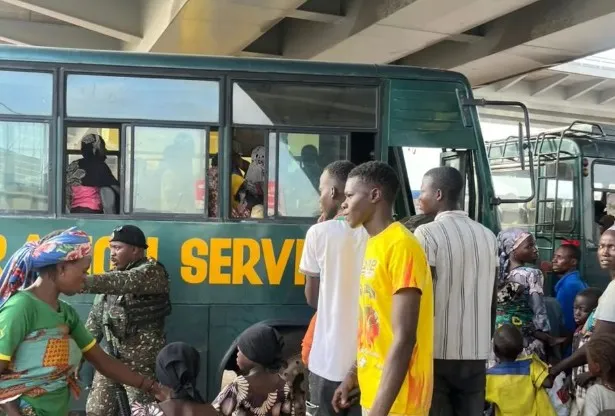
ACCRA, Ghana – The Ghana Immigration Service has apprehended 1,055 people in Accra and Kumasi in an operation targeting suspected organised street-begging networks and possible human trafficking. The intelligence-led exercise resulted in 662 children, 248 women and 145 men being taken into custody.
Several Ghanaian nationals suspected of acting as local facilitators were also apprehended.
GIS said the operation targeted what it described as criminal networks using organised begging to exploit and control vulnerable foreign nationals, particularly women and children. The Service has not established publicly that every person apprehended was unlawfully present in Ghana or that every child was trafficked.
All those taken into custody have been moved to a designated holding centre for profiling and immigration processing.
That distinction matters. The operation is simultaneously an immigration-enforcement exercise, a potential trafficking investigation and, because of the number of minors involved, a significant child-protection case.
Almost two-thirds of those apprehended were children
Children accounted for about 62.7% of the people apprehended.
GIS said the number of minors raised serious concerns about child vulnerability and what it described as a growing pattern of children being trafficked for forced begging. That is an allegation and assessment by the Service rather than a finding that every child was trafficked.
Individual screening will be required to establish who the children are, their relationship to accompanying adults and whether any were being exploited or controlled by trafficking networks.
The large number of minors is nevertheless the most consequential element of the operation. Street begging involving children can raise questions of immigration status, welfare, parental responsibility, exploitation and trafficking at the same time.

Where the operation took place
In Greater Accra, GIS targeted areas including Abossey Okai, Sabon Zongo, Madina Zongo Junction, Madina, Ashaiman and Tema.
In Kumasi, the operation covered Asawase, Alabar, Akwatia Line, Dagomba Line, Sabon Zongo, Airport Junction and Aboabo.
The spread of locations suggests a coordinated operation across known street-begging hotspots rather than a single sweep in one neighbourhood.
GIS has previously described organised street begging, irregular migration and child trafficking as among the abuses it says can occur within regional mobility arrangements.
In June, the Service warned that criminal networks were exploiting aspects of the ECOWAS free-movement system for activities including organised street begging and trafficking.

WHAT HAPPENS TO THE 1,055 PEOPLE NOW? 01 APPREHENDED 1,055 people → 02 CURRENT STAGE Profiling and status checks → 03 ASSESSMENT Individual circumstances established → 04 OUTCOME Depends on each case
Apprehension is the beginning of the process, not the legal conclusion
GIS says those apprehended are undergoing profiling and immigration procedures at a designated holding centre.
ONE OPERATION • DIFFERENT CIRCUMSTANCES IMMIGRATION STATUS Lawfully present? POTENTIAL VICTIM Trafficked or exploited? POTENTIAL OFFENDER Organiser or facilitator?
The 1,055 cannot automatically be treated as one legal category
Documentation and applicable immigration or regional-mobility requirements have to be checked.
Indicators of coercion, forced begging or control by another person require a safeguarding and investigative response.
Where exploitation is suspected, investigators need to distinguish those controlling the activity from those potentially being exploited.
THE CATEGORIES CAN OVERLAP
Migration status ≠ Trafficking status ≠ Criminal responsibility
THE ECOWAS DIMENSION QUESTION 1 Who is the person? Identity and nationality → QUESTION 2 What is their status? Documentation and lawful stay → QUESTION 3 Are they vulnerable? Trafficking or exploitation indicators → ONLY THEN Appropriate response
Being a foreign national is not itself evidence of unlawful presence
Some of those apprehended are West African nationals. Citizens of ECOWAS member states have regional mobility rights, subject to applicable documentation, residence requirements and Ghanaian immigration law.
THE NUMBER THAT CHANGES THE STORY 01 Who brought them to Ghana? 02 Who exercises control over them? 03 Who receives their earnings? 04 Are there indicators of coercion or trafficking? 05 What safeguarding arrangements are required? 06 What is a safe outcome for each child?
CHILDREN APPREHENDED 662
Almost two-thirds of the 1,055 people apprehended.
For children, this is also a safeguarding question
Where trafficking or forced begging is suspected, children cannot simply be treated as immigration offenders.
THE PUBLIC-INTEREST TEST
Clearing children from the street is not the same as protecting them
from the circumstances that may have put them there.
GIS’S STATED TARGET VULNERABILITY Women and children → SUSPECTED EXPLOITATION Organised begging → FINANCIAL INCENTIVE Money generated → ENFORCEMENT OBJECTIVE Identify and disrupt networks
The Service says the operation is also aimed at suspected exploitation networks
NOT A ONE-OFF OPERATION APRIL • GREATER ACCRA 305 APRIL • KUMASI 606 AUGUST • ACCRA & KUMASI 1,055
Earlier operations also involved large numbers of children
West African nationals encountered
113 childrenPeople reported rounded up
381 childrenPeople apprehended
662 childrenThe repeated presence of children makes safeguarding and investigation of suspected exploitative networks a continuing public-interest issue.
THE ENFORCEMENT TEST VISIBLE OUTCOME People removed from streets DEEPER OUTCOME Networks disrupted
Removing people from the street and dismantling exploitation are not the same outcome
The immediate public-space effect can be seen quickly.
That requires evidence about organisers, facilitators, trafficking, prosecution and victim protection.
THE QUESTION TO WATCH
Does enforcement reach the people allegedly profiting from vulnerable
migrants, or mainly those visible on the street?
WHY SAFEGUARDING CAPACITY MATTERS APPREHENDED Nigerien woman → MEDICAL ASSESSMENT Found to be in labour → HEALTH FACILITY Transferred for care → OUTCOME REPORTED BY GIS Baby girl delivered
One woman’s labour during the operation illustrates the vulnerability involved
The case demonstrates why an immigration operation involving vulnerable people also requires medical, child-protection and social-welfare capacity.
GIS ADVICE TO THE PUBLIC GIS’S CONCERN
Direct cash may increase the financial incentive behind organised begging
ITS SUGGESTED ALTERNATIVE
Support recognised charities, children’s homes or social-welfare organisations
Why GIS is asking people not to give cash directly to child beggars
IMPORTANT QUALIFICATION
The advice reflects GIS’s assessment that some begging may be commercially organised. It is not proof that every person begging on Ghana’s streets belongs to an organised network.
QUICK EXPLAINER
Five questions the operation now has to answer
01 Are all 1,055 people unlawfully in Ghana?
That has not been established from the information presented here. GIS says those apprehended are undergoing profiling and immigration procedures, meaning individual status still has to be determined.
02 What happens to people found to be unlawfully present?
They may face removal in accordance with Ghana’s applicable immigration procedures.
03 What happens if someone may be a trafficking victim?
That requires a different assessment. Potential victims, particularly children, may require safeguarding and social-protection intervention alongside any immigration process.
04 Why are the 662 children especially important?
Their presence raises child-protection questions about who brought them to Ghana, who controls them, whether they are being exploited and what arrangements are made to keep them safe.
05 How will we know whether the operation worked?
Street clearance alone cannot answer that question. More meaningful evidence would include immigration-status outcomes, trafficking assessments, safeguarding arrangements and investigations or prosecutions of suspected organisers.
NUKUNYA ANALYSIS THE VISIBLE TEST Are fewer people begging on the streets? → THE PUBLIC-INTEREST TEST Were vulnerable children protected and alleged exploiters pursued? 01
A West African national can be lawfully present in Ghana and still beg.
02
A person can be irregularly present and simultaneously be a trafficking victim.
03
A Ghanaian can potentially participate in an exploitative network.
The headline number is 1,055. The public-interest number is 662.
Almost two-thirds of those apprehended were children. That fundamentally changes how the operation should be assessed.
Immigration enforcement, child protection and trafficking investigations intersect here, but they are not interchangeable.
WHAT TO WATCH NEXT Immigration outcomes Trafficking assessments Investigations Child safeguarding
How many are ultimately found to lack lawful status?
How many potential victims are identified?
How many suspected organisers or facilitators are pursued?
What happens to the 662 children?
THE STANDARD FOR JUDGING THE OPERATION
Its long-term public value will depend not simply on how many people
were removed from the streets, but on whether lawful status was
established fairly, vulnerable people were protected and suspected
exploitation networks were actually disrupted.
Related posts:
 Ghana Parliament Passes Human Sexual Rights and Family Values Bill
  NDC Renames Headquarters ‘Jerry Rawlings House’ on Founder’s 79th Birthday.
  Ghana Police Arrest 44 as Ashanti Drug Network Allegedly Targeting University Students Is Dismantled
  Ghanaians Recruited Into Russia-Ukraine War: 272 Drawn Into Conflict, 55 Dead
  GRIDCo power outage today: Parts of Accra face 15-hour electricity cut