
Otumfuo at Howard: Asantehene calls for deeper diaspora ties and development-focused traditional leadership
Asantehene Otumfuo Osei Tutu II called for deeper Africa-diaspora relationships, development-focused traditional leadership and stronger university partnerships during his Howard University address.



Follow Nukunya
Get the latest breaking news and updates from Nukunya.
Asantehene Otumfuo Osei Tutu II used a major lecture at Howard University to argue that Africa’s relationship with its diaspora must move beyond symbolic homecoming, traditional leadership must remain relevant through service and accountability, and universities should work more closely with indigenous institutions.
WASHINGTON, D.C. – Asantehene Otumfuo Osei Tutu II has called for a deeper relationship between Africa and its global diaspora, arguing that reconnection must extend beyond ceremonial visits and be built through sustained relationships, responsibility and participation.
The Asantehene delivered the message during a lecture at Howard University in Washington on Tuesday, 25 August, as part of a wider discussion spanning governance, cultural preservation, traditional leadership and Africa’s relationship with people of African descent around the world.
Howard University had formally announced the Asantehene’s visit a day earlier, describing the engagement as an opportunity to examine governance, cultural preservation, traditional leadership and the enduring connections between Ghana and the global African diaspora.
But Otumfuo’s address went beyond celebrating those connections.
He challenged traditional institutions to demonstrate their relevance to contemporary society, warned against turning diaspora belonging into a commercial transaction, and called for stronger intellectual collaboration between universities and indigenous institutions.
Among his most concrete proposals was the creation of a Howard-Manhyia Dialogue, bringing scholars and traditional leaders together to examine governance, culture and diaspora relations.
Taken together, the speech presented a model of traditional authority built less around ceremony and more around stewardship, public value and institutional relevance.
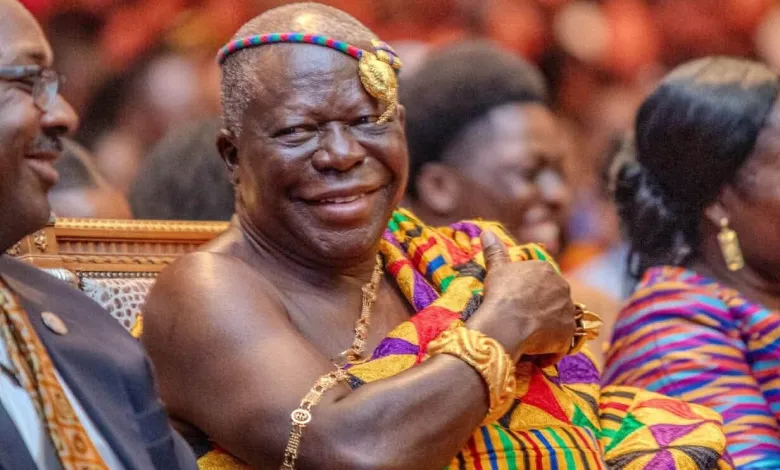
Diaspora ties must move beyond ceremonial homecoming
One of the clearest messages concerned Africa’s relationship with its global diaspora. Otumfuo argued that genuine belonging cannot be established through ceremonial homecoming alone. A visit to a historic site, adoption of an African name or participation in a festival may carry emotional and cultural significance, but these acts do not by themselves create a lasting relationship with the continent.
His argument was that genuine reconnection requires relationships, responsibility and sustained participation. That is a significant intervention in Ghana’s evolving relationship with the African diaspora. Ghana has become one of the continent’s most visible destinations for people of African descent seeking cultural and historical reconnection.
Initiatives such as the Year of Return and Beyond the Return have helped deepen tourism, cultural exchange and conversations about citizenship, investment and identity. Otumfuo’s argument pushes that conversation further.
It asks what happens after the homecoming.
If diaspora engagement is to become durable, relationships may need to extend into education, institutions, business, community participation and other forms of sustained involvement. That is a more demanding standard than measuring engagement through visitor numbers or ceremonial events.


Belonging should not become something that can be bought
The Asantehene also issued a warning about the commercialisation of diaspora identity. He argued that reconnecting Africa with its diaspora should not become a marketplace in which belonging or traditional titles are effectively sold. Traditional institutions, he said, have a responsibility to provide authentic cultural context without compromising their integrity to satisfy commercial or tourist demand.
The distinction is important. Diaspora tourism creates economic opportunities for Ghana and other African countries. Cultural festivals, heritage tourism and investment can also create genuine relationships between communities separated by history.
But commercialisation creates risks when cultural legitimacy itself becomes part of the transaction. Otumfuo’s position draws a boundary between welcoming diaspora communities and manufacturing cultural recognition for commercial gain. His broader argument is that belonging creates obligations on both sides. It cannot simply be purchased.

Traditional leadership must prove its modern relevance
The Asantehene also challenged the idea that traditional authority should be understood mainly as an institution inherited from the past. He argued that traditional leadership and culture should remain living resources capable of contributing to good governance, social cohesion, peace-building, education and development.
That distinction matters in Ghana.
Traditional authorities do not replace the country’s constitutional and democratic institutions, but chiefs continue to exercise significant cultural and community influence. The important question is therefore not simply whether chieftaincy survives.
It is what chieftaincy contributes.
Otumfuo’s argument places the burden of relevance on performance. Traditional authority should complement constitutional governance, strengthen communities, help resolve disputes, support education and exercise leadership grounded in ethical stewardship and accountability. That moves the conversation away from royal spectacle and towards institutional value.
Beyond the Golden Stool and royal spectacle
The argument is particularly significant because the Asante monarchy is one of Africa’s most visually recognisable traditional institutions. Its Golden Stool, royal umbrellas, state swords, drums, gold ornaments and major public ceremonies carry enormous historical and cultural significance.
But Otumfuo argued that focusing only on those visible elements can obscure the political philosophy beneath them. He presented the Asante political system as one in which authority is tied to public trust, responsibility and moral obligation.
The symbolism, in this interpretation, communicates identity and authority. It is not the entire institution. That distinction is particularly important for international audiences encountering African traditional systems largely through ceremonies, tourism or media imagery.
The intellectual challenge Otumfuo presented at Howard was to examine the underlying governance system rather than stopping at its visible symbols.
Leadership as stewardship for generations yet unborn
Another strand of the lecture focused on what today’s leaders owe to future generations. Otumfuo warned against political and traditional leadership that prioritises immediate interests while damaging resources and institutions that others will inherit.
He framed authority as temporary stewardship rather than ownership. That principle extends beyond traditional leadership. It has implications for natural resources, environmental protection, public institutions and long-term economic development.
For Ghana, the argument has obvious contemporary resonance amid continuing debates over mining, land use and environmental degradation. But it also fits the broader philosophy running through the Howard address. Leadership is not measured only by what those in authority achieve during their tenure.
It is also measured by what they preserve for those who follow.
Otumfuo proposes a Howard-Manhyia Dialogue
Perhaps the most tangible proposal to emerge from the lecture was the creation of a Howard-Manhyia Dialogue. Otumfuo proposed structured intellectual engagement through which scholars and traditional leaders could examine major questions involving governance, culture and African diaspora relations.
The proposed areas of collaboration are substantial.
They include comparative research into traditional constitutionalism, customary law, mediation, restorative justice, the role of queen mothers, environmental stewardship and community mobilisation.
Otumfuo also advocated digital preservation connecting archives, oral histories, royal records and endangered cultural knowledge, alongside faculty and student exchanges and professional partnerships spanning disciplines and continents.
Those proposals move the Howard engagement beyond the symbolism of a royal visit. If implemented, they could create a structured relationship between an important African traditional institution and one of America’s most historically significant Black universities.
At present, however, this remains a proposal.
Universities and traditional institutions should work together
The Asantehene’s argument went beyond Howard and Manhyia.
He called for universities and traditional institutions to stop operating as though they occupy entirely separate worlds. Universities can help document histories, preserve archives, evaluate development programmes and subject traditional systems to rigorous analysis.
Traditional institutions, meanwhile, can give researchers access to the cultural, historical and moral environments within which African societies actually function. The underlying proposition is compelling.
Academic knowledge can become detached when it loses contact with communities. Traditional knowledge can become distorted when it operates without documentation, research or critical scrutiny. Collaboration potentially strengthens both.
Tradition should be studied, not romanticised
One of the more intellectually significant elements of the lecture was Otumfuo’s insistence that indigenous institutions should be subjected to serious examination. The objective, he argued, should not be to celebrate traditional institutions uncritically but to study them rigorously.
That rejects two common extremes.
One treats traditional African institutions as outdated remnants that modern societies should leave behind. The other romanticises precolonial institutions and treats them as inherently superior because they are indigenous.
Neither approach provides a satisfactory basis for understanding contemporary African governance. Traditional systems can instead be examined for what works, what does not, how accountability functions and where adaptation is required. That makes the proposed academic partnership more consequential than a cultural exchange alone.
Culture is more than entertainment
Otumfuo also challenged the tendency to reduce African culture to its most visible forms. Music, dance, clothing, food and ceremony are important expressions of culture, but they do not constitute its entirety.
Culture also encompasses language, historical memory, political philosophy, customary law, moral traditions, spirituality, conflict resolution and ways in which communities understand the world.
The implication is significant for development policy. If culture shapes how societies understand authority, family, morality, conflict and community responsibility, it cannot simply be brought out for festivals and national celebrations while being excluded from serious discussions about governance and development.
That argument connects directly to the wider theme of the Howard lecture. Tradition remains relevant when societies understand its intellectual foundations rather than preserving only its visible forms.
Modernity does not require cultural abandonment
The Asantehene also addressed younger Africans and members of the diaspora. His message was that global professional achievement does not require abandoning African cultural identity.
A young African can pursue a career in science, medicine, engineering, law or another globally competitive profession while remaining deeply connected to cultural inheritance. The point is particularly relevant to diaspora communities.
Young people raised outside Africa frequently navigate multiple identities and may experience pressure to treat cultural heritage and professional modernity as competing choices. Otumfuo rejected that choice. African identity and global excellence can coexist.
African languages are part of that inheritance
The Asantehene extended the argument to language.
He warned that participation in the modern world should not require Africans to abandon indigenous languages, intellectual traditions or historical consciousness. Language, in this argument, is more than a communication tool.
It carries historical memory, philosophy and ways of understanding the world that cannot always be reproduced precisely in another language. The issue therefore goes beyond nostalgia.
When indigenous languages decline, societies risk losing parts of the knowledge systems embedded within them. For universities, policymakers and traditional institutions, that makes language preservation part of the wider challenge of maintaining cultural knowledge while adapting to modern life.
Why Howard was a significant setting
Howard University was not simply a convenient Washington venue. The university itself framed Otumfuo’s visit around scholarship, leadership, culture and connections between Ghana and the global African diaspora.
That made Howard a particularly relevant setting for the arguments contained in the speech. The encounter brought together two different traditions of Black institution-building.
Manhyia represents a living West African traditional institution with deep historical roots. Howard represents an American educational institution with a longstanding place in Black intellectual and professional life.
A conversation between those institutions creates possibilities that extend beyond ceremony. It raises questions about what African traditional knowledge can contribute to contemporary scholarship and what academic scrutiny can contribute to the evolution and preservation of traditional institutions.
GHANA + DIASPORA
What the speech means for Ghana-diaspora relations
The strongest idea running through Otumfuo’s address is that relationships and institutions must demonstrate their value through practice.
Leadership must serve
Traditional authority has continuing relevance only when it contributes meaningfully to society.
Diaspora belonging must become practical
Connection to Ghana has to extend beyond symbolism, nostalgia and occasional return.
Universities should engage living institutions
African institutions should be studied through dialogue and partnership, not only from a distance.
Modernity need not erase identity
Young Africans should not have to abandon cultural inheritance to participate in professional life.
Institutions should outlive the present generation
Leaders have a responsibility to preserve knowledge, resources and structures for those who come later.
THE THREAD CONNECTING THESE IDEAS
Heritage matters most when it remains useful.
THE DIASPORA TEST
Can Ghana move from reconnection to durable relationships?
Ghana has been successful in generating international interest around return, reconnection and cultural belonging.
The harder task is converting that interest into relationships capable of surviving beyond tourism campaigns, festivals and symbolic moments.
STAGE 1 Reconnection
Visits, heritage, cultural memory and symbolic return.
STAGE 2 Engagement
Academic exchange, professional networks and institutional dialogue.
STAGE 3 Institution-building
Durable programmes, research, archives and long-term partnerships.
Offer authentic opportunities to engage
Relationships need credible programmes, access, continuity and practical value.
Build beyond nostalgia
Engagement requires sustained participation rather than symbolic affiliation alone.
OTUMFUO’S MESSAGE PLACES RESPONSIBILITY ON BOTH SIDES
Durable diaspora engagement is not something Ghana can create alone, and it is not something diaspora communities can sustain without credible institutions to work with.
NUKUNYA ANALYSIS
From homecoming to institution-building
The significance of the Howard lecture lies in its attempt to move several familiar conversations beyond symbolism.
NOT MERELY Ceremony
BUT Service + institutional relevance
NOT MERELY Homecoming
BUT Long-term responsibility
NOT Something frozen
BUT An inheritance to preserve, examine + renew
NOT Separate from traditional society
BUT A potential institutional partner
THE DEVELOPMENT TO WATCH
The proposed Howard-Manhyia Dialogue could be the real test
A distinguished lecture can generate attention.
A functioning programme of research, archive preservation, academic exchange and sustained dialogue could create something much more durable.
Research
Collaborative scholarship on governance, history, culture and contemporary African institutions.
Archives
Preservation, documentation and improved access to institutional and historical records.
Academic exchange
Longer-term relationships between scholars, students and institutions.
Sustained dialogue
Repeated engagement rather than a one-off ceremonial encounter.
CURRENT POSITION Proposal / development to watch
WHAT IS NOT YET ESTABLISHED A fully functioning long-term programme
EDITORIAL CAUTION
There is not yet evidence that the proposed dialogue has reached the stage of a mature programme of research, archival preservation and institutional exchange.
WHAT WOULD SUCCESS LOOK LIKE?
Five tests for durable Ghana-diaspora engagement
The stronger test is not whether a speech receives attention, but whether the relationships it proposes become institutional.
01 Does engagement continue after the event?
Durable engagement requires structures that continue after ceremonies, visits and public attention have ended.
02 Are there functioning institutional partnerships?
Universities, traditional institutions, archives and diaspora organisations need formal and repeatable ways to work together.
03 Does the relationship produce knowledge or public value?
Useful outcomes could include new scholarship, preserved archives, educational exchange, policy learning or community programmes.
04 Is the relationship reciprocal?
Ghanaian institutions should not be treated merely as objects of study, while diaspora institutions should not be treated merely as sources of money or prestige.
05 Can the relationship survive leadership changes?
Institutional success means the work continues beyond individual office-holders, personalities or one celebrated moment.
NUKUNYA VIEW
The real ambition is bigger than homecoming
If the Howard-Manhyia Dialogue develops into a functioning programme, it would provide a practical test of the central argument Otumfuo took to Howard.
THE ARGUMENT
Inherited institutions preserve their relevance not by remaining unchanged, but by demonstrating that cultural knowledge, traditional authority and diaspora relationships can contribute to solving contemporary problems.
HERITAGE Memory + identity
→ ENGAGEMENT Dialogue + partnership
→ INSTITUTIONS Research + exchange
→ PUBLIC VALUE Useful, durable outcomes
For Ghana and its diaspora, that is a considerably more ambitious proposition than homecoming alone.
NUKUNYA ANALYSIS
The lasting significance of the Howard visit will therefore depend less on the ceremony itself
than on whether it produces institutions capable of carrying the relationship forward.
Related posts:
 Asantehene’s Howard University engagement puts Ghana-diaspora ties in focus
  Mahama Meets King Charles III as Ghana Seeks UK Investment
  Ghana Evacuates 345 More Citizens from South Africa as Other African States Study Rescue Plan
  Diaspora Affairs Office Backs New Volunteerism Initiative to Harness Ghanaian Talent Abroad
  Ghana moves nearly 900 citizens to safe havens ahead of South Africa protests