
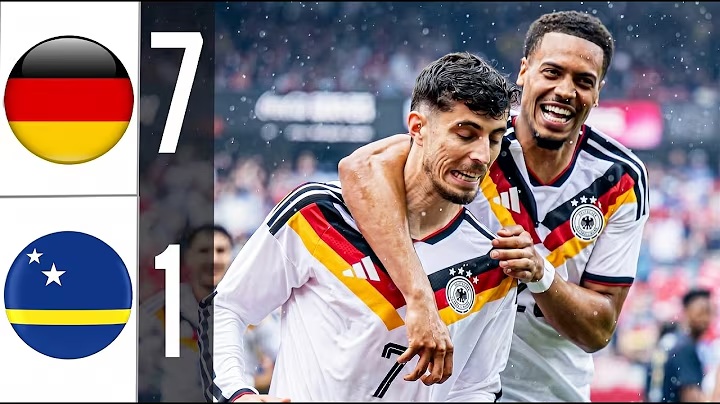
Germany vs Curacao: Historic Goal Stuns Giants as Nagelsmann’s Side Secures 7-1 Win


Follow Nukunya
Get the latest breaking news and updates from Nukunya.
A Tale of Two Nations: The Historical Context of Group E
The opening of Group E in the 2026 World Cup presented one of the most stark contrasts in the history of international football. On one side stood Germany, a four-time world champion and traditional powerhouse seeking to rediscover its identity under coach Julian Nagelsmann. On the other was Curaçao, a Caribbean nation that only established its national team in 2011 and has now become the smallest nation ever to compete in a World Cup.
The setting for this David vs. Goliath encounter was the NRG Stadium in Houston, United States, where an attendance of 68,021 gathered to witness the debut of the “Clockwork Mandarin.” While the gap in pedigree was vast—Curaçao represents an island population of approximately 150,000 to 160,000 people—the match would provide a moment of sporting history that transcended the final scoreline.
The ‘Clockwork Mandarin’ Stuns the World: Comenencia’s Historic Goal
While Germany dominated much of the proceedings, the defining image of the match occurred in the 21st minute. After falling behind early, Curaçao refused to buckle, and Livano Comenencia etched his name into the history books by scoring his country’s first-ever World Cup goal.
The equalizer to make it 1-1 sparked scenes of pure delirium. The Curaçao bench exploded with joy, and the goal resonated far beyond the stadium to the tiny Caribbean island where proud citizens watched their team beat legendary goalkeeper Manuel Neuer. For a brief period, the “Clockwork Mandarin” had stunned one of the giants of the game. Though the parity lasted only seventeen minutes, the goal served as a validation of the expanded 48-team World Cup format, allowing smaller nations to share the global stage.
Nagelsmann’s Modern Midfield: Nmecha and Pavlovic Take Charge
Despite the shock of the equalizer, Julian Nagelsmann’s tactical blueprint was evident from the opening whistle. Germany showcased a modern, versatile midfield pairing featuring Felix Nmecha and Aleksandar Pavlović. These players represent a shift away from traditional roles, moving fluidly across the pitch to dictate tempo and pressure.
Nmecha was particularly influential, scoring a “stunning” opener in the 6th minute. Arriving late near the box, he combined with Florian Wirtz before calmly finishing into the far corner. This early goal underlined Germany’s intent to move past the inconsistency of recent years and establish a more clinical, proactive style of play under Nagelsmann’s leadership.
Germany’s Ruthless Response: Five More Scorers Join the Board
Faced with the embarrassment of a potential upset, Germany responded with ruthless efficiency. The onslaught began in the 38th minute when Nico Schlotterbeck headed Germany back into the lead from a well-placed delivery. The momentum shifted entirely in favor of the Europeans, who began to find space with ease.
The second half saw a flurry of goals that showcased the depth of the German squad:
- Jamal Musiala (47′): Just over a minute after the restart, Musiala slotted the ball into the far corner following a perfectly threaded pass from Joshua Kimmich.
- Nathaniel Brown (68′): Brown celebrated scoring Germany’s fifth by hooking a volley into the bottom corner after a flick from Denis Undav.
- Denis Undav (78′): Undav added his own name to the scoresheet as Germany continued to apply pressure.
Nagelsmann expressed satisfaction that threats emanated from all areas of the pitch, with a total of six different players finding the net.
Kai Havertz Leads the Line: A Brace to Seal the Rout
Arsenal forward Kai Havertz proved to be the most consistent finisher of the night, bookending the dominant performance with two goals. His first came deep into first-half injury time (45+5′), where he fired home a penalty to give Germany a comfortable 3-1 lead heading into the break.
Havertz remained sharp until the final whistle, rounding off the scoring in the 88th minute to secure the 7-1 victory. His efficiency in the box will be a crucial asset for Germany as they progress through the tournament and face more disciplined defensive units than the debutants from the Caribbean.
Dick Advocaat and the Legacy of the ‘Blue Wave’
For Curaçao, the night was about more than just the scoreline. Their 78-year-old manager, Dick Advocaat, the oldest manager in World Cup history, was visibly moved by the occasion, wiping tears from his eyes during the pre-match ceremonies. Advocaat described the experience as an “incredible moment for the country,” noting that his team was essentially a “small town” compared to their illustrious opponents.
The 7,000-strong “blue wave” of supporters provided a vibrant atmosphere throughout the match. Despite the heavy 7-1 defeat, the Curaçao players received a standing ovation from both sets of fans at the final whistle. Their performance, particularly the historic Comenencia goal, ensured that the smallest nation in the tournament left an indelible mark on the world stage.
Looking Ahead: Germany’s Path Through Group E
With three points and a substantial goal difference, Germany has taken a significant step toward avoiding a third consecutive group-stage exit. However, the path ahead in Group E remains challenging, with matches against Ivory Coast and Ecuador still to come.
While this emphatic win over Curaçao provides a massive confidence boost, Julian Nagelsmann acknowledged that more accurate tests of his side’s strength are on the horizon. For Germany, the 7-1 victory is a statement of intent; for Curaçao, it was the night their World Cup dream became a physical, goal-scoring reality.
Related posts:
 Mexico Beat South Africa 2-0 in World Cup Opener Marked by Three Red Cards
  Omar Artan Handed UEFA Super Cup Final After World Cup Exclusion
  Ghana Challenges Canada’s Thomas Partey Visa Decision as World Cup Row Deepens
  Canada Earn Historic First World Cup Point as Larin Rescues Draw Against Bosnia
  Amad Diallo’s Late Winner Gives Ivory Coast Crucial World Cup Victory