Uganda Judiciary Rejects Lawyers’ Bid to End Colonial-Era Court Titles
Uganda's judiciary has rejected a directive from the Uganda Law Society calling for an end to colonial-era courtroom titles such as "My Lord" and "My Lady", highlighting a broader debate over judicial independence and legal reform across Africa.


Follow Nukunya
Get the latest breaking news and updates from Nukunya.
Uganda’s judiciary has rejected a directive from the country’s lawyers’ association urging advocates to stop using colonial-era courtroom titles. The dispute has opened a wider debate over judicial independence, legal reform and the place of colonial traditions in African justice systems.
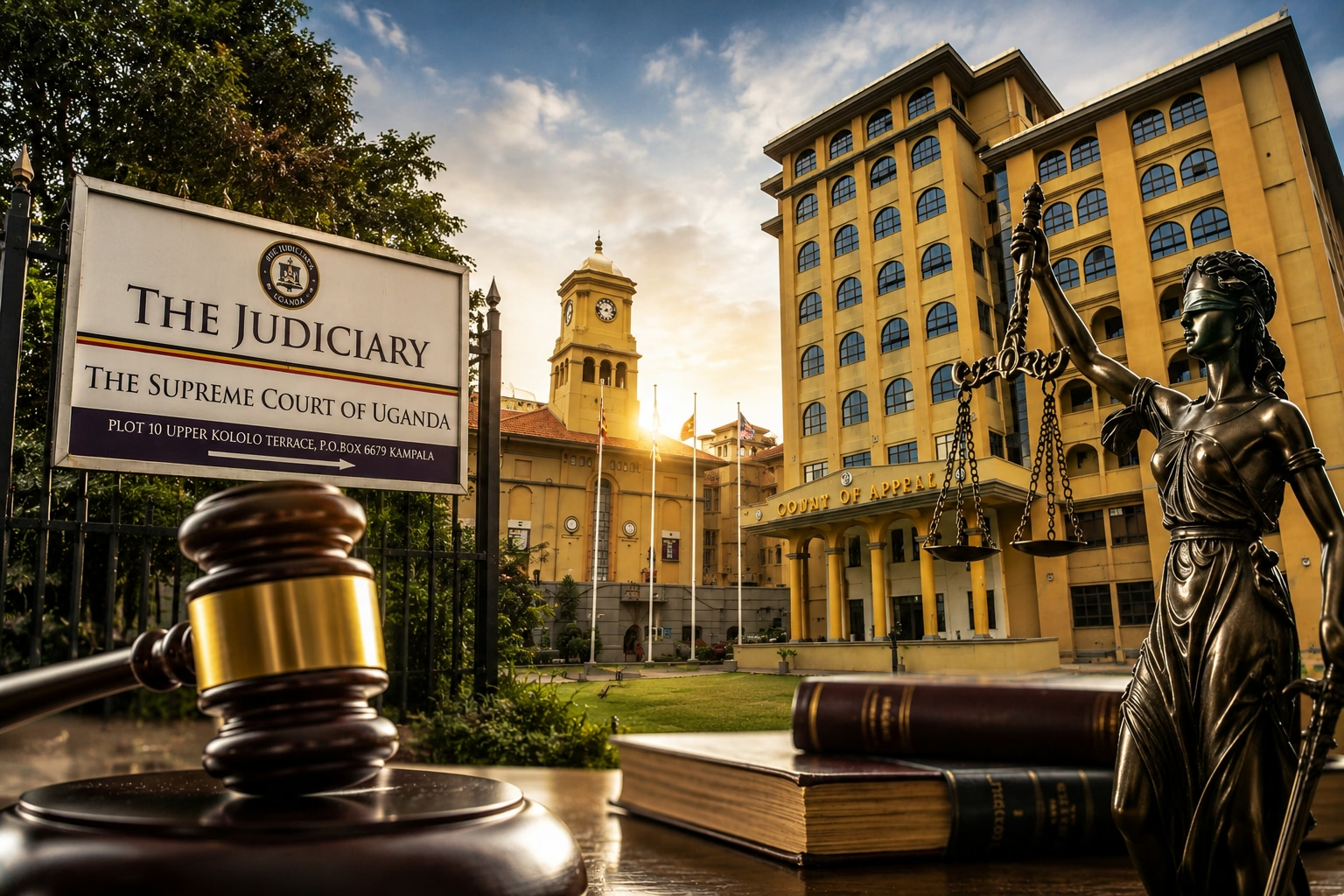
KAMPALA, Uganda — Uganda’s judiciary has rejected a directive issued by the Uganda Law Society (ULS) instructing lawyers to stop addressing judges using colonial-era titles such as “My Lord” and “My Lady”, arguing that courtroom protocol remains the exclusive responsibility of the judiciary.
The disagreement has developed into a broader debate over judicial independence, legal reform and whether legal traditions inherited during British colonial rule should continue to shape court proceedings in modern Uganda.
The Uganda Law Society, the professional body representing advocates, recently instructed its members to abandon what it described as “feudal and colonial honorifics” when appearing before judges and magistrates. The directive also advised lawyers to stop bowing before judicial officers, arguing that such practices reinforce outdated hierarchies that are inconsistent with constitutional equality.
Instead, the society recommended that judicial officers be addressed using neutral titles, including “Mr Justice”, “Madam Justice”, “Mr Judge”, “Madam Judge” or simply by their surnames where appropriate. It also instructed advocates and litigants to stand upright when addressing courts rather than bowing.
According to the ULS, these reforms form part of a wider effort to “decolonise justice” and restore dignity to court users by removing practices rooted in colonial administration.

Uganda’s judiciary has firmly rejected the directive.
The judiciary spokesperson James Ereemye said the Law Society had no authority to dictate how judges should be addressed or how courtroom proceedings should be conducted. He said the courts would continue to require established standards of decorum from advocates appearing before them.
Ereemye also stressed that Uganda’s judiciary is an independent arm of government whose internal procedures cannot be determined by outside organisations. He criticised the directive, saying changes to courtroom practice should be pursued through appropriate institutional processes rather than unilateral announcements.
The disagreement reflects wider conversations taking place across Africa over the legacy of colonial legal systems.
Like many former British colonies, Uganda inherited much of its judicial structure, courtroom procedures and legal terminology from the United Kingdom following independence. While many of those institutions remain intact, lawyers, judges and legal scholars in several African countries have increasingly questioned whether some traditions continue to serve modern constitutional democracies.
Similar debates have emerged in Kenya, Zimbabwe, Malawi and Ghana, where legal practitioners and reform advocates have challenged the continued use of colonial-era courtroom attire, forms of address and ceremonial practices.
In Kenya, former Chief Justice Willy Mutunga attracted international attention in 2011 when he chose to take his oath of office wearing a business suit instead of the traditional judicial robes and wig, describing the move as part of efforts to modernise the country’s judiciary.
Supporters of reform argue that removing colonial-era traditions would make courts more accessible and better reflect African constitutional values. Others maintain that courtroom rituals and formal titles reinforce respect for the rule of law, judicial authority and institutional continuity rather than colonial hierarchy.
The latest disagreement in Uganda illustrates how efforts to reform public institutions can also raise important constitutional questions about who has the authority to determine judicial practice and preserve the independence of the courts.
Although the immediate dispute centres on courtroom etiquette, legal observers say it touches on broader issues of governance, institutional autonomy and the evolving identity of African legal systems decades after independence.
For now, Uganda’s judiciary has indicated that existing courtroom protocols remain in force unless formally amended through the appropriate judicial processes.
Why this matters
The dispute extends beyond courtroom etiquette. It highlights the balance between judicial independence and legal reform, while reflecting broader efforts across Africa to reassess institutions and practices inherited from the colonial era.
Related posts:
 South Africa Police Chief Suspended Over $21m Corruption Probe
  Southwark Council Recovers Property Linked to Sierra Leone First Lady After Housing Investigation
  Uganda media shutdown exposes deeper struggle over press freedom and succession politics
  WHO Warns DR Congo Ebola Outbreak May Be Spreading Faster as Death Toll Hits 131
  Kenya to Charge Eight Students With Murder Over Deadly School Dormitory Fire