VIP bus fire on Kumasi-Sunyani road: Passengers escape unharmed


Follow Nukunya
Get the latest breaking news and updates from Nukunya.
Passengers evacuated after a VIP bus caught fire at Abuakwa in the Ashanti Region. The cause has not been officially established.
ABUAKWA, Ghana — Passengers travelling from Kumasi to Sunyani escaped without reported casualties after a VIP bus caught fire and was destroyed at Abuakwa in the Atwima Nwabiagya South Municipality of the Ashanti Region. The VIP bus fire on the Kumasi-Sunyani road occurred on Saturday evening after the vehicle reportedly began emitting smoke shortly after leaving Kumasi. Passengers were able to leave the bus before flames engulfed it at the Abuakwa section of the route. The cause of the fire had not been officially established by Sunday morning. An eyewitness suggested that the engine may have overheated, but that account has not been confirmed by the Ghana National Fire Service or another investigating authority and should not be treated as the cause of the blaze.

Passengers evacuate as a VIP bus fire spreads.
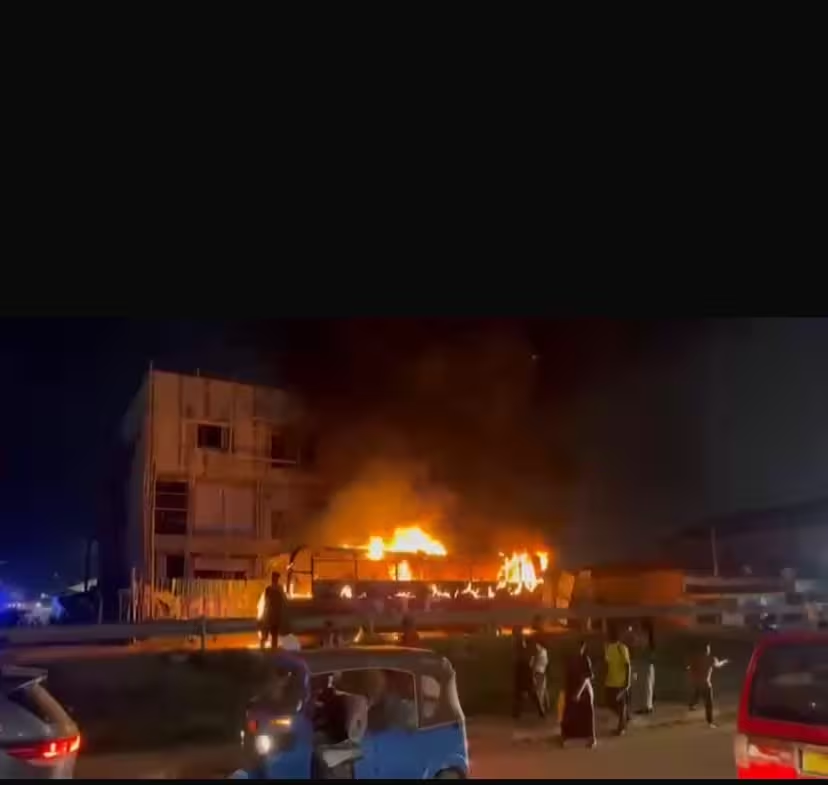
The bus was travelling from Kumasi towards Sunyani when smoke was noticed after it left the Kumasi station, according to the initial aagain.t of the incident. The situation deteriorated after the vehicle reached the Abuakwa stretch of the Kumasi-Sunyani road, forcing those on board to disembark. Images from the scene show flames spreading extensively through the passenger compartment and roof of the bus.
Eyewitness Ofori Boateng said the fire spread rapidly after smoke first appeared.
“When the vehicle started smoking, within less than five minutes, the whole bus was engulfed in flames,” Boateng said.
He said passengers managed to evacuate before the fire consumed the vehicle. No deaths or injuries were reported in the initial account, although belongings inside the bus were destroyed.
Photographs published from the scene underline the extent of the damage. Images on pages one and two of the source material show the bus burning intensely at night, while a later photograph shows its passenger compartment and bodywork extensively burnt after the flames had been extinguished.
Firefighters respond at Abuakwa.
Personnel from the Ghana National Fire Service in the Atwima Nwabiagya South Municipality responded and brought the blaze under control, according to the initial report. By the time firefighters intervened, however, the vehicle had already sustained extensive damage. The available images show little remaining of the bus interior after the incident.
The fire also disrupted traffic through Abuakwa. Police officers were deployed to manage congestion around the scene and help restore movement along the road. The incident happened on an important inter-city route connecting Kumasi with Sunyani and other communities towards Ghana’s middle belt. A disabled commercial bus and emergency response on the carriageway can therefore have consequences beyond the passengers directly involved, particularly when traffic builds around a scene.
No official statement establishing how many passengers were travelling on the bus was available in the material reviewed by Nukunya.
The cause of the Kumasi-Sunyani bus fire remains unknown.
The precise cause of the Kumasi-Sunyani bus fire remains a key unanswered question. Boateng said there were suspicions that the vehicle’s engine might have overheated. However, an eyewitness observation or suspicion is not equivalent to a technical finding, and no official evidence reviewed by Nukunya establishes overheating as the cause.
Determining whether a vehicle fire began because of an electrical fault, mechanical failure, fuel-system problem or another cause requires technical examination. Until such findings are released, the cause should be recorded as undetermined. There was also no verified information available on the vehicle’s maintenance history, roadworthiness status or any mechanical problems before the journey. Nukunya therefore cannot establish whether maintenance or regulatory compliance played any role in the incident.
That distinction is important because the National Road Safety Authority has regulatory responsibilities covering commercial road transport operators and road safety standards. The authority says its inspection mandate extends to transport services, terminals and locations where there are concerns about compliance with road safety requirements.
Commercial bus safety remains a regulatory issue.
The National Road Safety Authority requires road transport service providers, including transport companies and unions, to register as part of Ghana’s regulatory system for commercial transport.
The authority says the framework is intended to improve passenger safety and service quality and provides for compliance monitoring of operators. Pre-departure inspections form part of that regulatory approach. In an earlier exercise involving VIP buses, inspectors from the NRSA worked with the Motor Traffic and Transport Department and the Driver and Vehicle Licensing Authority to examine commercial passenger vehicles before departure. Checks included vehicle documentation and roadworthiness, while operators were told to correct identified shortcomings.
Those earlier inspections do not establish anything about the condition of the bus involved in Saturday’s fire. They do, however, show that commercial vehicle condition and pre-trip checks fall within Ghana’s existing road-safety framework. The NRSA says it regulates road transport and related services under the National Road Safety Authority Act, 2019, and can issue compliance notices to organisations that breach road-safety standards.
Why this story matters
The absence of reported casualties is significant because the fire appears to have spread rapidly after passengers became aware of the problem. The incident highlights the importance of passengers being able to evacuate quickly when an emergency develops on an inter-city vehicle. It also puts attention on vehicle maintenance, pre-departure inspections and emergency preparedness within Ghana’s commercial passenger transport system.
It would be premature, however, to interpret the Abuakwa incident as evidence of a wider maintenance failure or regulatory breach. No technical findings reviewed by Nukunya establish why the bus caught fire or whether any operator failed to comply with safety requirements. For passengers who regularly travel between Kumasi, Sunyani and communities along the route, the outstanding issue is whether investigators identify a preventable mechanical or electrical problem and whether any resulting safety action is required.
Investigation remains the next step.
The immediate emergency ended without reported loss of life, but important questions remain. Authorities have yet to publicly establish the origin and cause of the VIP bus fire, while the vehicle’s maintenance history and condition before departure have not been disclosed in the sources reviewed.
Any technical findings from the Ghana National Fire Service, National Road Safety Authority or other competent agency would provide a firmer basis for determining whether further regulatory or safety measures are necessary. Until then, the central facts remain that passengers evacuated the Kumasi-to-Sunyani bus before it was consumed by fire at Abuakwa, no casualties were reported in the initial accounts, and the cause remains unconfirmed.
Related posts:
 Ofankor Barrier Accident: 11 Dead as NRSA Demands More Signs
  Ghana Parliament Passes Human Sexual Rights and Family Values Bill
  Missing Newborn at Salaga Hospital Sparks Police Investigation
  Sedina Tamakloe Custody Dispute Deepens as Government and Critics Clash Over Transparency
  Ghana moves nearly 900 citizens to safe havens ahead of South Africa protests