France suspends Dover EU border checks after four-hour holiday queues


Follow Nukunya
Get the latest breaking news and updates from Nukunya.
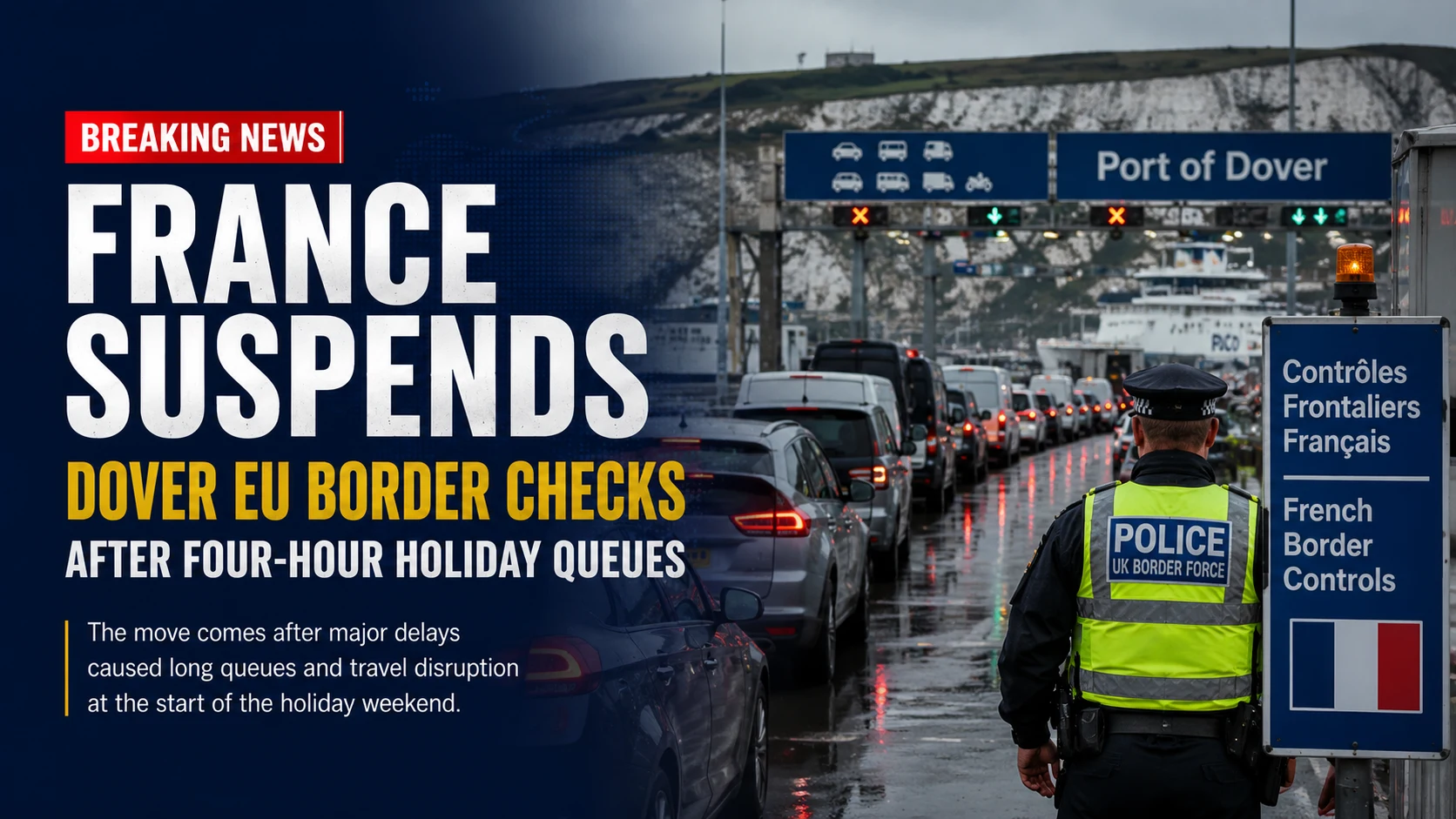
French authorities suspended additional EU Entry/Exit System checks at Dover after severe congestion left travellers facing delays of up to four hours during the UK bank holiday getaway.
LONDON, United Kingdom —
French authorities temporarily suspended additional European Union border checks at the Port of Dover after severe congestion left travellers facing delays of up to four hours during one of the UK’s busiest travel weekends of the year. The disruption came as thousands of holidaymakers travelled to continental Europe during the May bank holiday weekend, with unusually hot weather forecast across much of England. Officials at the Port of Dover said French border police activated emergency procedures under the European Union’s Entry/Exit System (EES) rules to ease mounting queues after traffic conditions became increasingly difficult around the terminal. Conventional passport checks remained in place.
What is the EU Entry/Exit System?
The EES is the European Union’s new digital border system designed to replace passport stamping for non-EU travellers entering the Schengen Area. The system records biometric information, including fingerprints and facial scans. The rules apply to British passport holders following the UK’s departure from the European Union and have raised concerns among transport operators over potential delays at major crossing points, including Dover. French authorities had not fully activated biometric scanning equipment at Dover, but border officials were still required to manually process traveller profiles linked to the system, contributing to delays.
Travellers face severe disruption at Dover
The Port of Dover warned travellers of “slow-moving” traffic throughout Saturday morning as congestion built on roads approaching the ferry terminal. Waiting times at one stage exceeded four hours for some passengers. Eurotunnel passengers also reported delays, with LeShuttle services between Folkestone and Calais experiencing longer border processing times than usual.
Port officials said passengers who missed scheduled crossings because of the delays would be moved to the next available ferry free of charge. Some travellers described spending several hours in stationary traffic approaching Dover as families began half-term and bank holiday journeys. The Port of Dover said this weekend represented the first major travel surge since implementation of the EES, increasing scrutiny of how the system performs during peak holiday periods.
Heatwave adds pressure to UK transport network
The travel disruption coincided with unusually hot weather across parts of the UK. The Met Office forecast temperatures of up to 31C in parts of southern England over the weekend. The UK Health Security Agency issued amber heat-health alerts covering London, the South East, the East Midlands and the West Midlands, warning of elevated risks for vulnerable people. Some forecasters said parts of southern England could become hotter than destinations including Athens and the Seychelles during the holiday period.
Fresh scrutiny over post-Brexit border systems
The disruption is likely to intensify scrutiny of post-Brexit border arrangements between the UK and the European Union ahead of the peak summer travel season. Industry groups and transport operators have previously warned that biometric border systems could create bottlenecks at high-volume ports unless infrastructure and staffing are expanded. Analysts say the delays at Dover may raise wider concerns about the readiness of European border systems to cope with large seasonal travel surges. Traffic conditions improved later on Saturday after French authorities suspended the additional checks, although congestion remained heavy around Dover and nearby routes.
Sources: BBC News
Related posts:
 UK Raises Terror Threat Level to ‘Severe’ After Golders Green Terror Attack
  Bank of England holds rates at 3.75% and warns Iran war could push UK inflation higher
  UK net migration falls as visa applications decline sharply
  UK rent prices rise as housing supply remains constrained
  EU digital border checks for Brits to continue as Portugal and Italy reject suspension