
Ebola Outbreak Passes 530 Cases as Africa Races to Contain Rare Strain With No Approved Vaccine


Follow Nukunya
Get the latest breaking news and updates from Nukunya.
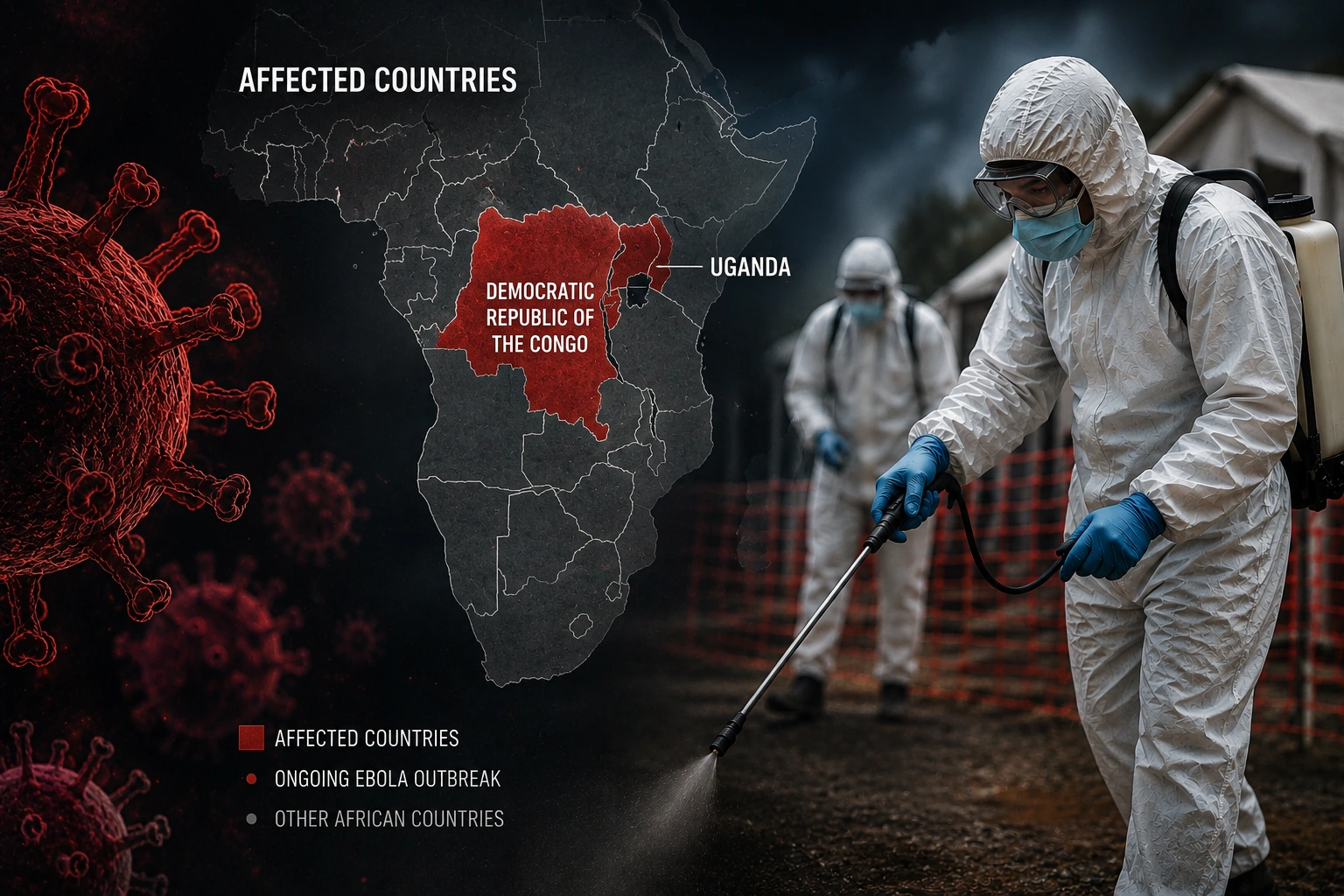
A rapidly expanding Ebola outbreak in the Democratic Republic of the Congo and Uganda has surpassed 530 confirmed cases and more than 90 deaths, prompting an emergency continental response. With no approved vaccine for the rare Bundibugyo strain, health authorities are racing against time to prevent a wider regional crisis.
KINSHASA/KAMPALA, June 9, 2026
The Ebola outbreak spreading across eastern Democratic Republic of the Congo (DRC) and neighbouring Uganda has grown to more than 530 confirmed cases and over 90 deaths, raising fears of a prolonged public health emergency in a region already grappling with conflict, displacement and fragile healthcare systems.
According to the World Health Organization (WHO), the outbreak is being driven by the Bundibugyo virus, a rare strain of Ebola for which there is currently no approved vaccine or specific treatment. As of June 6, the DRC had reported 515 confirmed cases and 91 deaths, while Uganda had recorded 19 confirmed cases, including two deaths and one probable death.
Health officials say the outbreak remains concentrated in the DRC’s eastern Ituri Province, where ongoing insecurity and attacks on healthcare facilities have complicated efforts to trace contacts, isolate infections and deliver medical supplies.
The WHO has classified the situation as a public health emergency and, together with the Africa Centres for Disease Control and Prevention (Africa CDC), has launched a continent-wide preparedness and response initiative seeking $518 million in funding to strengthen surveillance, laboratory capacity and emergency response systems across Africa.
Why This Outbreak Is Different
Unlike previous Ebola outbreaks linked to the Zaire strain — for which approved vaccines already exist — the current outbreak is caused by the Bundibugyo virus, first identified in Uganda in 2007 and later detected in the DRC in 2012.
Experts say Bundibugyo outbreaks are relatively rare, making vaccine development more difficult because opportunities for clinical trials have historically been limited.
The absence of an approved vaccine has heightened concern among public health specialists, particularly as the disease has spread across international borders and into densely populated communities.
Three vaccine candidates are now being fast-tracked for emergency evaluation and potential trials. They include projects backed by the International AIDS Vaccine Initiative (IAVI), Moderna and the University of Oxford, with manufacturing support expected from the Serum Institute of India.
However, experts caution that even accelerated development could take months or years before any vaccine becomes widely available.
Uganda Praised as Cases Cross Borders
WHO Director-General Dr Tedros Adhanom Ghebreyesus has praised Uganda’s response, describing it as prompt and effective despite the cross-border threat posed by the outbreak.
Ugandan authorities have intensified border screening, surveillance and contact tracing efforts, which health officials credit with helping to identify imported cases linked to the DRC outbreak.
The WHO nevertheless urged countries to avoid unnecessary border restrictions, arguing that containment efforts are most effective when focused on the outbreak’s epicentre rather than disrupting trade and movement.
Conflict, Misinformation and Humanitarian Challenges
Beyond the medical challenge, the outbreak is unfolding against a backdrop of armed conflict and humanitarian instability in eastern DRC.
The United Nations has warned that insecurity, population displacement and attacks on health facilities continue to undermine response efforts. More than half of the DRC’s internally displaced population lives in areas affected by the outbreak, further complicating disease control measures.
Health workers have also faced resistance in some communities. Recent incidents included attacks on Ebola treatment facilities and tensions linked to mistrust of health authorities, highlighting the persistent challenge of misinformation during disease outbreaks.
WHO officials have warned that gaps in contact tracing, shortages of medical supplies and limited treatment capacity could allow the virus to spread further if response efforts are not strengthened.
What Africa Can Learn
The outbreak serves as another reminder that epidemic preparedness remains uneven across the continent. While Africa’s public health institutions have improved significantly since the devastating West African Ebola epidemic of 2014–2016, experts argue that surveillance systems, laboratory networks and emergency funding mechanisms remain under pressure in many countries.
The rapid mobilisation of Africa CDC and WHO reflects lessons learned from previous outbreaks: diseases no longer remain confined within national borders, and delayed responses can dramatically increase both human and economic costs.
For countries across West, Central and East Africa, the current crisis underscores the need for stronger cross-border disease surveillance, improved public trust in health systems and greater investment in research for neglected diseases that receive little commercial attention until emergencies emerge. As scientists work to develop the first vaccine specifically targeting the Bundibugyo strain, health officials warn that the coming weeks could prove critical in determining whether the outbreak is contained or evolves into a larger regional health emergency.
Related posts:
 DR Congo Health Workers Battle Ebola Outbreak Amid Equipment Shortages and Security Risks
WHO Warns DR Congo Ebola Outbreak May Be Spreading Faster as Death Toll Hits 131
DR Congo Health Workers Battle Ebola Outbreak Amid Equipment Shortages and Security Risks
WHO Warns DR Congo Ebola Outbreak May Be Spreading Faster as Death Toll Hits 131
 Ebola Cases Nearly Double in DR Congo as WHO Chief Visits Outbreak Epicentre
 DR Congo Ebola outbreak grows as Oxford scientists fast-track vaccine
 Ghana Rejects $109m US Health Deal Over Data-Sharing Concerns