
How Qatar’s First World Cup Point Changed the Entire Group B Picture
Qatar earned their first-ever FIFA World Cup point with a dramatic 1-1 draw against Switzerland. Nukunya analyses what the historic result means for Group B, Switzerland's prospects, Canada's opportunity and Qatar's growing belief.


Follow Nukunya
Get the latest breaking news and updates from Nukunya.
Qatar’s dramatic late equaliser against Switzerland delivered the first World Cup point in the nation’s history. The result also transformed the outlook of Group B, leaving all four teams level and exposing vulnerabilities in one of the tournament’s pre-group favourites.
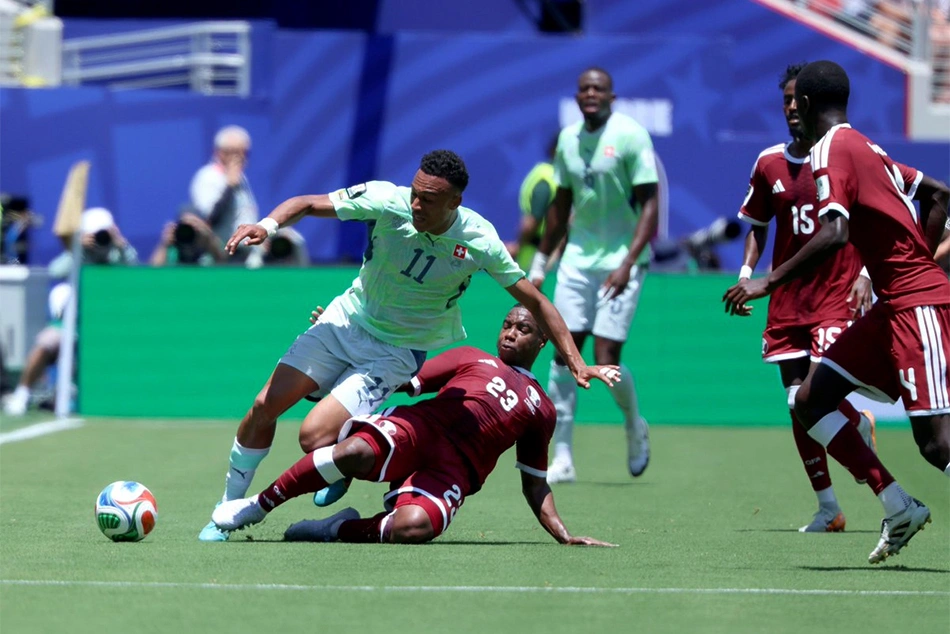
SANTA CLARA, California — Sometimes football produces results that defy logic, statistics and expectation. Qatar’s 1-1 draw against Switzerland at the FIFA World Cup 2026 was one of those matches.
For more than 90 minutes, Switzerland looked destined to begin their campaign with three points. They controlled possession, created chance after chance and appeared significantly superior in almost every measurable category. Yet when the final whistle sounded in California, Qatar had secured the first World Cup point in the country’s history, and Group B had been thrown wide open.
The result means all four teams in Group B — Qatar, Switzerland, Canada and Bosnia and Herzegovina — sit on one point after the opening round of matches. Canada and Bosnia and Herzegovina had drawn 1-1 a day earlier, leaving the group remarkably balanced heading into the second round of fixtures.
In practical terms, the group stage has effectively restarted.
That is excellent news for Qatar.
It is considerably less comfortable for Switzerland.
The Statistics Tell One Story. The Scoreline Tells Another.
Few draws in recent World Cup history have looked quite so improbable.
Switzerland finished with 26 shots compared with Qatar’s seven. They recorded an expected goals figure of 3.24 compared with Qatar’s 0.76 and repeatedly found themselves in dangerous positions throughout the contest. Yet they managed only a single goal, Breel Embolo’s first-half penalty.
The statistics suggest Switzerland should have won comfortably.
The scoreline suggests they failed to take their opportunities.
That distinction matters.
At major tournaments, qualification is rarely determined by possession statistics, expected goals or territorial dominance. It is determined by efficiency. Switzerland generated enough chances to secure victory several times over but repeatedly failed to convert. Dan Ndoye, Ruben Vargas and Embolo himself all missed opportunities that would have effectively ended the contest long before stoppage time.
The late equaliser was dramatic.
The missed chances were decisive.
The Goalkeeper Who Made History Possible
Much of the attention has understandably focused on Qatar captain Boualem Khoukhi, whose stoppage-time header sparked wild celebrations among players and supporters. Yet the foundations of the result were laid much earlier. Goalkeeper Mahmud Abunada produced a series of important saves that prevented Switzerland from turning dominance into a commanding lead. Ironically, Abunada was also responsible for the foul that led to Switzerland’s penalty. Rather than allowing that moment to define his afternoon, he recovered to deliver one of the most influential individual performances of the opening weekend. Viewers later voted Abunada player of the match, reflecting the extent to which his interventions kept Qatar alive when the game appeared to be slipping away. Without him, there would have been no late drama. Without him, Qatar’s historic point almost certainly would not have happened.
Why This Is Bigger Than One Point for Qatar
The significance of the result extends far beyond the standings.
Qatar arrived in North America carrying the burden of their disappointing home World Cup in 2022. They became the first host nation in tournament history to lose their opening match, the first to be eliminated after two games and ultimately finished without a single point.
That experience shaped international perceptions of the team.
Many observers expected a similar outcome this time.
Instead, Qatar produced arguably the most significant result in the nation’s football history. Spanish coach Julen Lopetegui described the draw as another “little dream” achieved by his players, while several members of the squad spoke afterwards about making history.
The importance of that achievement should not be underestimated. International football is often influenced by belief as much as tactical preparation. Teams that feel they belong on the biggest stage frequently outperform expectations. Teams carrying psychological scars often struggle to recover.
For the first time, Qatar have tangible evidence that they can compete and earn results at a World Cup finals. That confidence could prove valuable in the matches ahead.
Switzerland’s Real Concern
The Swiss will understandably focus on the late goal they conceded.
The larger concern should be what happened beforehand.
Switzerland entered the tournament with ambitions of progressing deep into the knockout stages. They possess experience, organisation and technical quality. Yet the draw highlighted a recurring challenge that has followed the national team through several major tournaments.
They often control games without fully finishing opponents off.
Captain Granit Xhaka acknowledged afterwards that Switzerland lost patience and failed to manage the match effectively after taking the lead. The inability to score a second goal ultimately transformed a dominant performance into a disappointing result.
The danger is not that Switzerland played badly. The danger is that they played well and still failed to win. That creates pressure before facing Bosnia and Herzegovina in their second group match.
Why Canada May Be the Hidden Winner
The draw may have produced an unexpected beneficiary. Canada.
Before the tournament began, many analysts viewed Switzerland as the strongest team in Group B. Had they defeated Qatar, the Swiss would have immediately gained control of the qualification race.
Instead, Canada remains level with every other team.
The co-hosts now face Qatar knowing that victory could place them in a commanding position heading into the final round of fixtures. At the same time, Switzerland must deal with the psychological impact of dropping two points from a winning position.
In tournament football, momentum can shift rapidly. Canada suddenly have an opportunity to seize the initiative.
The VAR Debate Will Continue
The match also generated controversy.
Several broadcasters and pundits questioned whether Remo Freuler may have been marginally offside in the build-up to the penalty that gave Switzerland the lead. FIFA later stated that a technical issue prevented the usual visual explanation from being displayed during the match, maintaining that the semi-automated offside technology had correctly judged Freuler to be onside.
The incident will continue to attract discussion.
However, focusing exclusively on that decision risks overlooking the broader story.
Even after taking the lead, Switzerland generated enough opportunities to secure victory independently.
Their failure to do so was ultimately more significant than any refereeing debate.
What This Says About the 2026 World Cup
Beyond Group B, the result offers an early reminder of how unpredictable this expanded World Cup could become.
Critics of the 48-team format argued that the gap between established football powers and emerging nations would produce more one-sided matches. Yet the opening days of the tournament have already delivered several tightly contested encounters.
Qatar’s draw against Switzerland is perhaps the clearest example.
A nation that left the previous World Cup without a point has now taken something from one of Europe’s most consistent international teams.
The lesson is straightforward.
At World Cups, reputation matters far less than performance.
What Happens Next?
The second round of Group B fixtures now carries enormous significance.
Switzerland face Bosnia and Herzegovina, knowing that another setback could leave qualification in serious doubt. Qatar meets Canada with a realistic opportunity to move into the top two and strengthen hopes of reaching the knockout stage.
The Swiss remain favourites to progress.
Their quality, experience and underlying numbers still support that assessment.
But football tournaments are not won by expected-goals models.
They are won by teams that take their chances when it matters most.
On Saturday, Switzerland failed to do that.
Qatar did. And because of one stoppage-time header, Group B has become one of the most fascinating stories of the 2026 FIFA World Cup.
Related posts:
 Canada Earn Historic First World Cup Point as Larin Rescues Draw Against Bosnia
  Ghana Challenges Canada’s Thomas Partey Visa Decision as World Cup Row Deepens
  Iran Says World Cup Ticket Allocation Revoked Days Before Tournament Opens
  Omar Artan Handed UEFA Super Cup Final After World Cup Exclusion
  ANALYSIS: The USA’s World Cup Statement Win Raises a Bigger Question: Have They Finally Joined Football’s Elite?