
ANALYSIS: The USA’s World Cup Statement Win Raises a Bigger Question: Have They Finally Joined Football’s Elite?


Follow Nukunya
Get the latest breaking news and updates from Nukunya.
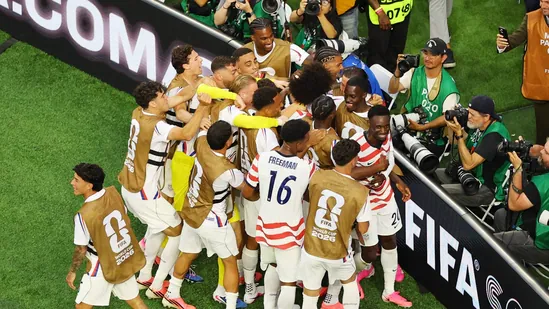
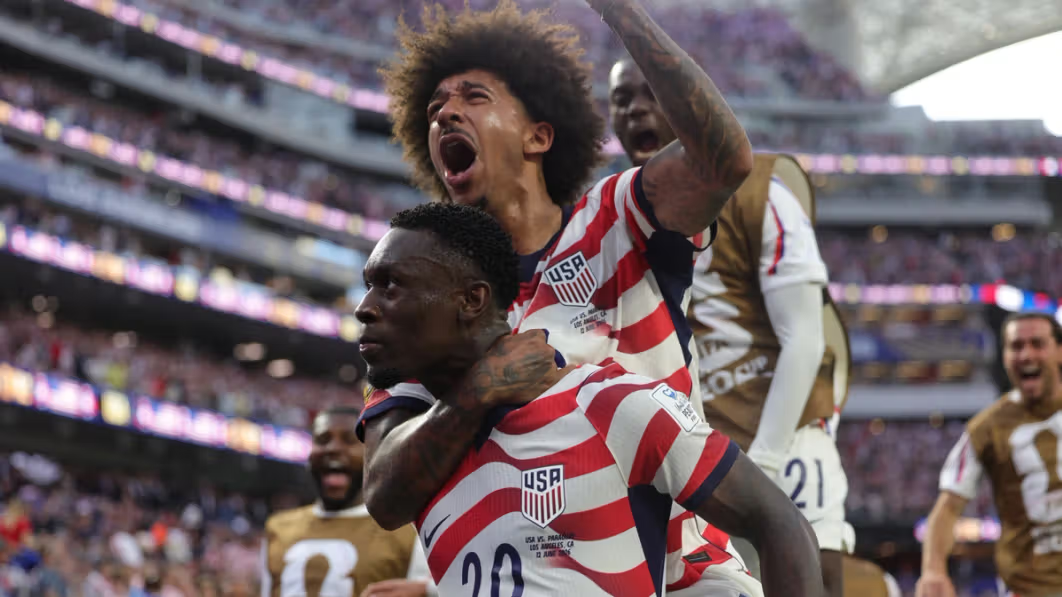
The United States began the 2026 FIFA World Cup with an emphatic 4-1 victory over Paraguay. Yet the bigger story may not be the scoreline itself. It is whether American football has finally matured from a developing project into a genuine global force.
| FIFA World Cup 2026™ · Today | Full-time | ||
 USA | 4 | 1 |  Paraguay |
| Group Stage · Group D | |||
| Damián Bobadilla 7′ (OG) Folarin Balogun 31′, 45+5′ Giovanni Reyna 90+8′ | ⚽ | Maurício 73′ | |
LOS ANGELES, United States – The United States could hardly have scripted a more convincing start to its home World Cup.
A 4-1 victory over Paraguay in Los Angeles gave the co-hosts three points, generated national excitement and reinforced growing belief that American football may be entering a new era. But beyond the celebrations, pundits, former players and supporters are asking a much larger question: has the United States finally become a serious football nation?
For decades, American football has lived in a state of promise.
The country possesses enormous resources, world-class sporting infrastructure and a population exceeding 340 million people. Yet despite occasional successes, the men’s national team has often struggled to translate potential into consistent performances on the global stage.
Saturday’s victory suggested something may be changing. Former Arsenal striker Folarin Balogun scored twice, while the United States displayed a level of confidence, tactical discipline and attacking quality that impressed observers across the football world. BBC Sport described the performance as a potential “opening statement” from a host nation seeking to make an impact on home soil.
From Potential to Performance
The United States has qualified for most World Cups since 1990 and reached the quarter-finals in 2002. Yet many observers have viewed American football as existing one tier below the sport’s traditional powers.
That perception has been shaped by inconsistent tournament performances and a lack of deep runs at major competitions. Under Argentine coach Mauricio Pochettino, however, the United States appears determined to change that narrative.
Pochettino inherited a talented generation featuring players developed in Europe and Major League Soccer. The squad includes footballers competing in some of the world’s most competitive leagues, a marked contrast to previous eras when American players often lacked elite-level experience.
Against Paraguay, the benefits of that evolution were visible.
The United States pressed aggressively, controlled possession and looked comfortable under pressure. The victory was not merely about individual moments of brilliance. It reflected a team playing with structure, belief and tactical clarity.
Former USA goalkeeper Tony Meola argued that American football has reached a stage where it should no longer view itself as an outsider. According to BBC Sport, Meola said the country now possesses a strong professional league, improved player development systems and a football culture that would have seemed unimaginable a generation ago.
What It Means for Africa
The American rise carries important lessons for African football.
For many African nations, discussions about football development often focus on talent. The continent undoubtedly produces extraordinary players, many of whom excel in Europe’s top leagues. The challenge has rarely been talent.
Instead, it has often been about infrastructure, coaching pathways, long-term planning and governance. The United States demonstrates how sustained investment can transform a football ecosystem. Major League Soccer has expanded significantly, youth academies have improved, and clubs now place greater emphasis on player development.
African football possesses a far deeper talent base than the United States. The question is whether institutions across the continent can create structures capable of maximising that talent. Countries such as Morocco and Senegal have already shown what is possible through strategic investment and long-term planning. Morocco’s run to the 2022 World Cup semi-finals and Senegal’s recent successes illustrate that African football is increasingly capable of competing with the world’s best.
The American example reinforces an important lesson: football success is rarely accidental.
A Tournament That Could Change Perceptions
Hosting the World Cup creates opportunities beyond results. The tournament is already attracting large crowds, extensive media attention and growing public engagement across North America.
BBC reporting from Los Angeles described a visible increase in football enthusiasm, with supporters filling public spaces and embracing the tournament atmosphere. For the United States, that cultural momentum may prove just as important as results on the pitch.
A strong World Cup performance could accelerate football’s growth in a country where the sport has historically competed with American football, basketball and baseball for attention. It could also reshape how the rest of the world views American football.
The Verdict
One victory does not place the United States alongside Argentina, Brazil, France or Spain. Football’s elite are defined by sustained excellence rather than a single result. Yet the performance against Paraguay suggested that the gap may be narrowing.
For years, observers have spoken about what American football could become. On Saturday, the conversation shifted slightly. The focus was no longer on potential.
It was a performance.
And for a nation determined to prove it belongs among football’s leading powers, that may be the most significant development of all.
Related posts:
 DR Congo seek FIFA ticket refunds after Ebola outbreak threatens World Cup travel
  The Senegal Model: How Africa’s Most Consistent Football Nation Became a World Cup Contender
  Omar Artan Handed UEFA Super Cup Final After World Cup Exclusion
  Ghana Challenges Canada’s Thomas Partey Visa Decision as World Cup Row Deepens
  Canada Earn Historic First World Cup Point as Larin Rescues Draw Against Bosnia