
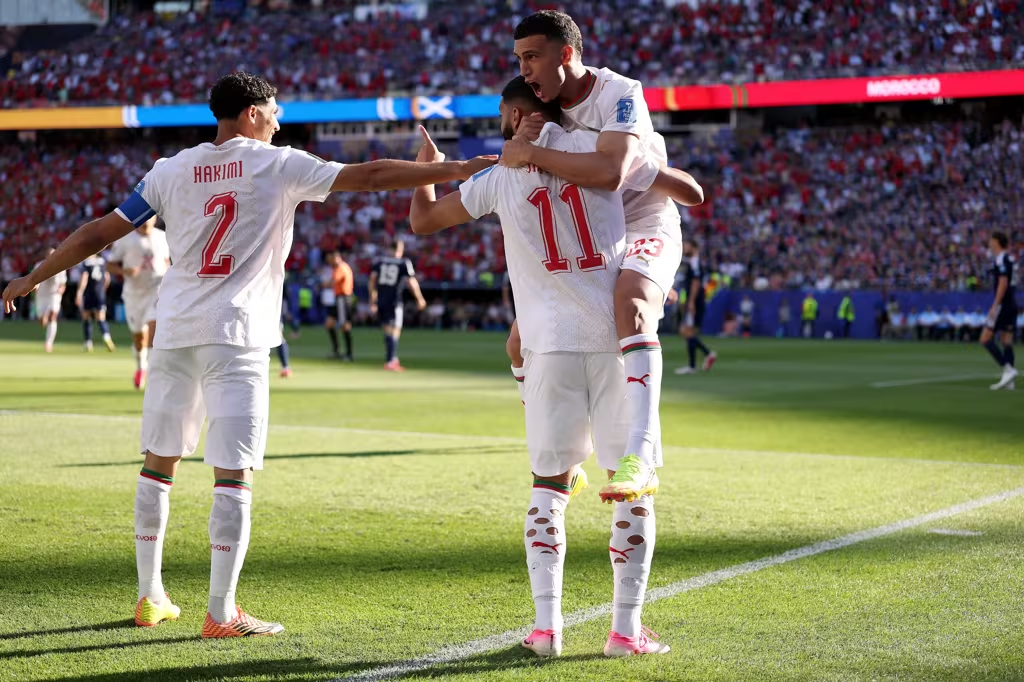
Morocco Move Closer to Knockouts After Fastest Goal of World Cup 2026


Follow Nukunya
Get the latest breaking news and updates from Nukunya.
Ismael Saibari’s early strike gave Morocco a crucial 1-0 victory over Scotland at the FIFA World Cup, strengthening the Atlas Lions’ hopes of reaching the knockout stage and providing fresh evidence of Africa’s growing influence in global football.
BOSTON, United States — Morocco strengthened their chances of reaching the knockout stage of the 2026 FIFA World Cup after defeating Scotland 1-0 in Group C, with Ismael Saibari scoring the tournament’s fastest goal so far just 70 seconds after kick-off.
The victory moved the Atlas Lions onto four points from two matches and placed them in a strong position ahead of their final group fixture against Haiti. Scotland remain on three points and now face a daunting encounter against Brazil in their bid to reach the next round.
Saibari struck after being released by a precise pass from Brahim Diaz, controlling the ball before finishing beyond Scotland goalkeeper Angus Gunn. The goal proved decisive in a match that highlighted Morocco’s growing maturity and confidence on football’s biggest stage.
The PSV Eindhoven midfielder’s strike was not only enough to secure victory but also set a new benchmark as the fastest goal of the tournament to date. Morocco subsequently controlled long periods of possession and created several opportunities to extend their lead.
Bilal El Khannouss twice came close to scoring, while Scotland relied on a series of interventions from Gunn to remain within reach. Despite Morocco’s dominance, the European side remained competitive throughout and increased the pressure during the second half.
Scotland‘s best opportunities arrived after the break as John McGinn, Scott McTominay and Ryan Christie attempted to force an equaliser. Steve Clarke’s side also questioned several refereeing decisions, including penalty appeals that were ultimately dismissed.
However, Morocco’s defence remained organised and disciplined. Led by captain Achraf Hakimi and supported by a technically accomplished midfield, the Atlas Lions successfully protected their advantage to secure a result that could prove decisive in determining qualification from Group C.
The match attracted an attendance of more than 64,000 spectators in Boston and demonstrated once again why Morocco are increasingly regarded as one of the world’s most consistent national teams.
Group C Situation
Morocco now sit on four points after two matches, following their opening draw against Brazil and victory over Scotland. Scotland remain on three points and must now face Brazil in their final group match while Morocco take on Haiti. The result means Morocco are well placed to reach the expanded knockout stage, while Scotland’s qualification hopes are likely to depend on producing a positive result against one of the tournament favourites.
| Group C | P | W | D | L | GF | GA | GD | TCS | Pts | Form | |
|---|---|---|---|---|---|---|---|---|---|---|---|
| 1 |  Brazil Brazil | 2 | 1 | 1 | 0 | 4 | 1 | 3 | -3 | 4 | – – – |
| 2 |  Morocco Morocco | 2 | 1 | 1 | 0 | 2 | 1 | 1 | -1 | 4 | – – – |
| 3 |  Scotland Scotland | 2 | 1 | 0 | 1 | 1 | 1 | 0 | -4 | 3 | – – – |
| 4 |  Haiti Haiti | 2 | 0 | 0 | 2 | 0 | 4 | -4 | -4 | 0 | – – – |
More Than Just a Win
For Morocco, this victory represents more than three points.
The Atlas Lions continue to demonstrate that their historic run to the semi-finals of the 2022 FIFA World Cup in Qatar was not a one-off achievement. That tournament saw Morocco become the first African nation to reach a World Cup semi-final, rewriting assumptions about how far African teams could progress on the global stage.
Four years later, Morocco remains among the most organised, tactically disciplined and technically gifted teams at the tournament. Their success reflects more than individual talent. It is the result of sustained investment in football development, elite academies, coaching structures and scouting networks that have been built over many years.
Africa’s Growing Influence
Morocco’s victory provides further evidence of the growing competitiveness of African football.
The continent’s leading teams are increasingly competing on equal terms with established football powers. Morocco, Senegal and others have shown that African nations can combine physical intensity with tactical sophistication, technical quality and organisational discipline.
The Atlas Lions have become a model for many federations because they successfully blend homegrown talent with players developed through diaspora communities in Europe. That approach has helped create a squad capable of competing consistently against top international opposition rather than relying on occasional tournament surprises.
The statistics underline that progress. Morocco arrived at the tournament on an unbeaten run stretching beyond 30 matches, one of the strongest records in international football. Their ability to maintain high standards across multiple competitions reflects a level of stability rarely achieved by national teams.
What Ghana and Other African Nations Can Learn
Morocco’s rise offers important lessons for other African football nations.
First, success has been built on long-term planning rather than short-term reactions to tournament results. Second, investment in elite youth development has created a sustainable pipeline of talent.
Third, Morocco has effectively integrated players from the diaspora while maintaining a clear national football identity.
Finally, coaching continuity and institutional stability have allowed the national team to evolve over time rather than repeatedly starting from scratch. For countries such as Ghana, Nigeria and others seeking sustained success at major tournaments, Morocco’s experience demonstrates that world-class performance is often the product of years of strategic investment rather than individual generations of talented players.
Looking Ahead
Morocco will now turn their attention to their final group match against Haiti knowing that another positive result could secure progression to the knockout stages.
For Scotland, the challenge is significantly greater. A final match against Brazil will likely determine whether their World Cup campaign continues. Regardless of how Group C unfolds, Morocco’s latest victory reinforces a broader reality emerging in international football: Africa’s leading teams are no longer outsiders hoping to cause occasional upsets. Increasingly, they are genuine contenders capable of shaping tournaments and competing with the world’s best.
Tournament Analysis
What It Means
1
Morocco move closer to the knockout stage.
2
Saibari scored the fastest goal of the tournament so far.
3
The Atlas Lions continue their impressive post-Qatar 2022 trajectory.
4
Scotland face a difficult final group match against Brazil.
5
Morocco’s football development model continues to attract attention across Africa.
Bottom line: Morocco remain firmly on course for the knockout rounds and continue to strengthen their reputation as one of Africa’s leading football nations.
Related posts:
 French Court Orders Morocco Captain Achraf Hakimi to Stand Trial Over 2023 Rape Allegation
  Omar Artan Handed UEFA Super Cup Final After World Cup Exclusion
  Amad Diallo’s Late Winner Gives Ivory Coast Crucial World Cup Victory
  DR Congo World Cup Preparations Disrupted by Ebola Fears
  Thomas Partey to Miss Ghana’s World Cup Opener After Canada Rejects Visa Appeal