
Ghana Diaspora Investment: How Record $7.8 Billion Remittances Are Shaping Ghana’s Economic Future


Follow Nukunya
Get the latest breaking news and updates from Nukunya.
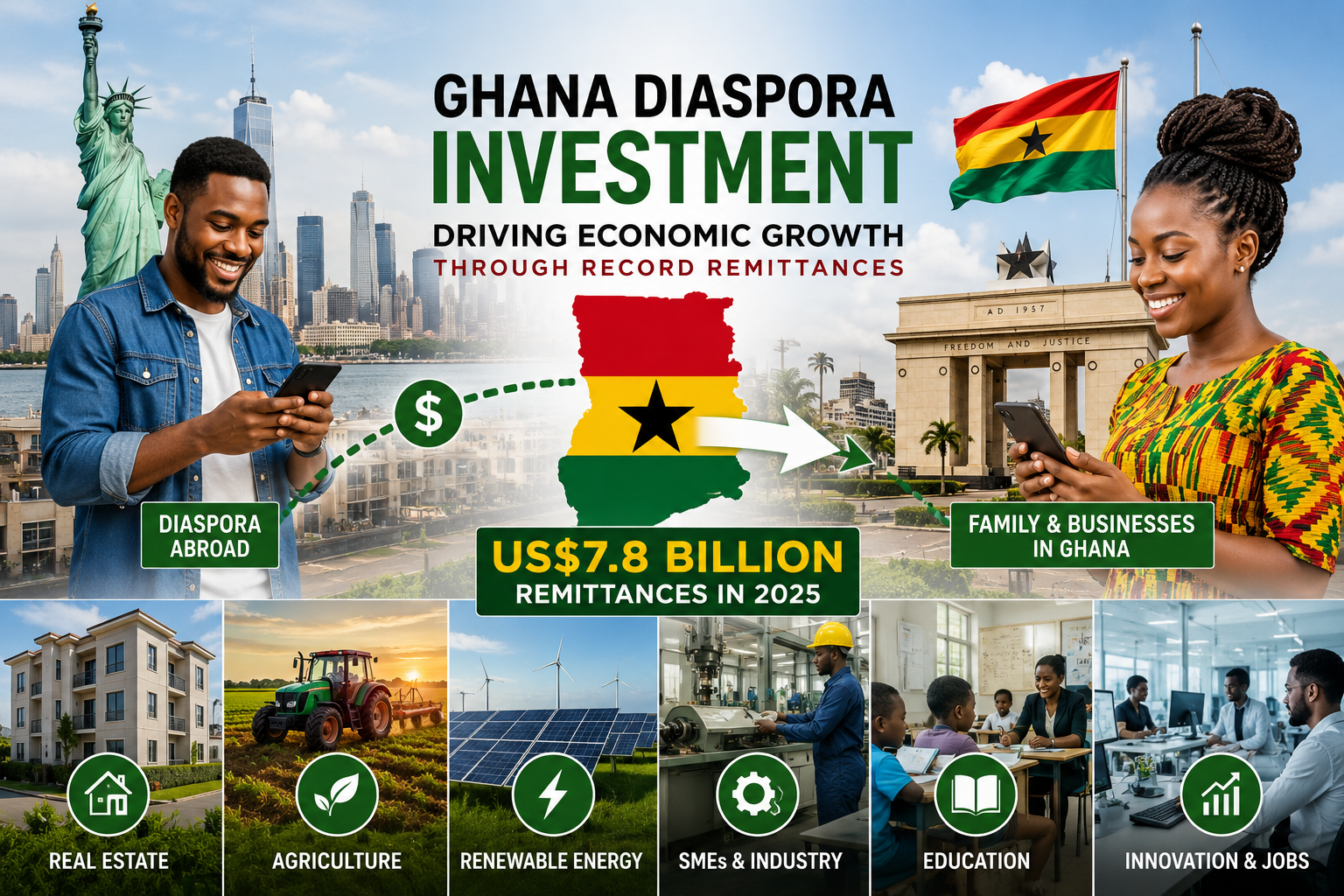
ACCRA, Ghana – Ghana is looking to unlock billions of dollars in new economic opportunities by encouraging more overseas citizens to invest in businesses, infrastructure and innovation after remittances reached a record US$7.8 billion in 2025.
The latest figures have placed Ghana diaspora investment at the centre of the country’s long-term economic strategy. While remittances have traditionally helped families pay school fees, healthcare costs and household expenses, policymakers now believe they can do much more by financing sustainable economic growth.
According to official data, remittance inflows have become one of Ghana’s largest sources of foreign exchange, exceeding foreign direct investment (FDI) and highlighting the growing importance of Ghanaians living abroad to the national economy.
Why Ghana Diaspora Investment Matters
The Ghanaian diaspora is estimated to number more than three million people spread across the United Kingdom, the United States, Canada, Germany, Italy, the Netherlands and several African countries. Every year, millions of dollars are transferred home to support relatives and communities. The Bank of Ghana says these transfers reached US$7.8 billion in 2025, the highest level ever recorded.
Economic experts say this represents far more than financial support for families. Increased Ghana diaspora investment has the potential to create jobs, strengthen local businesses and reduce the country’s dependence on external borrowing. Rather than relying solely on international loans or foreign investors, Ghana hopes to mobilise capital from its own citizens living overseas.
Government Wants More Investment, Not Just Remittances
Government officials are promoting policies aimed at converting remittances into long-term investments.
Among the proposals being discussed are:
- Diaspora bonds
- Infrastructure investment funds
- SME financing programmes
- Affordable housing projects
- Agricultural investment schemes
- Renewable energy investments
- Digital innovation funds
Officials believe these initiatives could encourage overseas Ghanaians to become shareholders, investors and entrepreneurs instead of limiting financial contributions to household spending. The strategy forms part of wider efforts to strengthen Ghana’s economic resilience and create sustainable employment opportunities.
Record Remittances Strengthen Ghana’s Economy
The latest remittance figures underline the growing financial influence of overseas Ghanaians.
Money sent home supports:
- Education
- Healthcare
- Housing
- Food security
- Small family businesses
- Community development
These inflows also increase foreign currency reserves, helping stabilise Ghana’s financial system and supporting international trade.
Economists note that remittances are generally more stable than foreign direct investment because they continue even during periods of global economic uncertainty. This makes Ghana diaspora investment one of the country’s most reliable economic assets.
Building Investor Confidence
Although interest in Ghana remains strong, experts say attracting larger diaspora investments will require continued improvements in transparency and governance. Following Ghana’s recent debt restructuring, many overseas investors are seeking greater confidence in the country’s economic outlook.
Financial analysts believe stronger regulation, improved digital investment platforms and efficient public institutions will encourage more members of the diaspora to invest. Clear policies, reduced bureaucracy and investor protection are also expected to play an important role in increasing long-term capital flows.
Diaspora Contributions Go Beyond Money
The Ghanaian diaspora contributes more than financial support. Professionals living abroad continue to share expertise in medicine, engineering, finance, technology, education and entrepreneurship.
Many have established businesses that create employment opportunities in Ghana, while others mentor young entrepreneurs and introduce international partnerships.
Knowledge transfer, innovation and professional networks are becoming increasingly valuable as Ghana seeks to build a modern, diversified economy. Experts believe combining financial investment with skills and technology could significantly accelerate national development.
Opportunities for Overseas Ghanaians
Financial experts say several sectors offer strong investment potential for the diaspora, including:
- Real estate
- Agribusiness
- Renewable energy
- Tourism
- Manufacturing
- Technology startups
- Healthcare
- Education
- Financial technology (FinTech)
These industries are expected to benefit from continued government reforms and growing domestic demand over the coming years.
Officials hope more overseas Ghanaians will view these sectors as opportunities to generate returns while contributing to Ghana’s economic transformation.
The Future of Ghana Diaspora Investment
As remittances continue to grow, Ghana is positioning its global diaspora as a strategic development partner rather than simply a source of household income. If even a modest proportion of the US$7.8 billion currently sent home each year is redirected into productive investments, economists believe billions of dollars could flow into businesses, infrastructure and innovation.
Such investment could create thousands of new jobs, expand exports and strengthen long-term economic growth. For many overseas Ghanaians, investing in their homeland represents not only a financial opportunity but also a chance to contribute to national development.
With record remittance inflows and growing government support for investors, Ghana diaspora investment is expected to remain one of the country’s most important economic stories in the years ahead.
Related posts:
 Mahama Meets King Charles III as Ghana Seeks UK Investment
  US Judge Strikes Down Trump Immigration Restrictions Affecting 39 Countries
  Former MASLOC CEO Sedina Tamakloe-Attionu Returned to Ghana to Begin 10-Year Prison Sentence After US Extradition
  From Poverty to Cambridge: Three Ghanaian Women Defy the Odds to Earn Master’s Degrees
  Sahel Coup Belt: 9 Ways Europe’s African Diaspora Is Shaping the AES Political Divide