
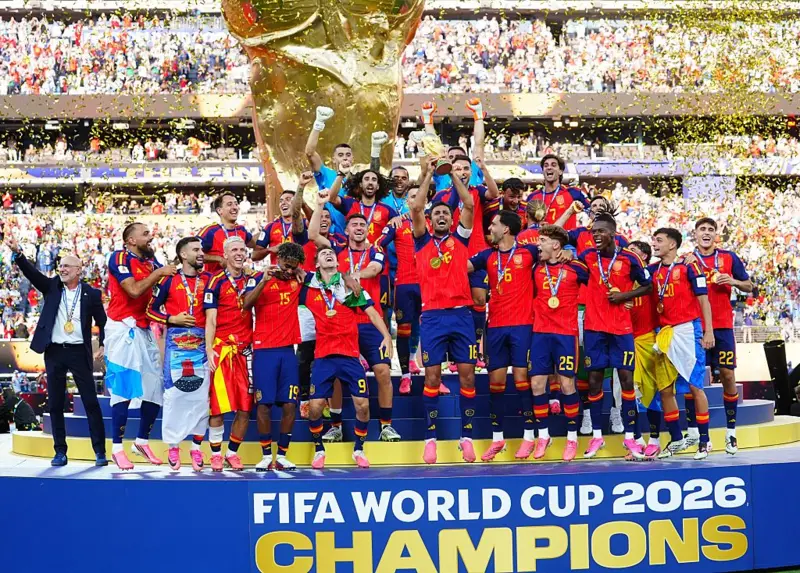
How Spain Rebuilt, Evolved and Conquered the 2026 World Cup
Spain won the 2026 World Cup through midfield control, defensive discipline and young talent. Here is how they defeated Argentina and reclaimed the title.


Follow Nukunya
Get the latest breaking news and updates from Nukunya.
Spain recovered from a slow start to defeat Argentina and win their second men’s World Cup. Possession, defensive control, an exceptional generation of young players and decisive substitutions shaped their path to the title.
NEW JERSEY, United States — Spain’s route to the 2026 FIFA World Cup title began without a goal and ended with a second star above the national crest. Luis de la Fuente’s side opened their campaign with a goalless draw against Cape Verde. They finished it by defeating defending champions Argentina 1-0 after extra time, with Ferran Torres scoring the decisive goal in the 106th minute.
The final was not a classic. It was frequently interrupted, increasingly physical and goalless through normal time. Yet Spain’s victory reflected more than one decisive finish. Across the match and the wider tournament, they demonstrated a clear playing identity, exceptional defensive control and a squad capable of changing matches from the bench.
Here is how Spain became world champions.
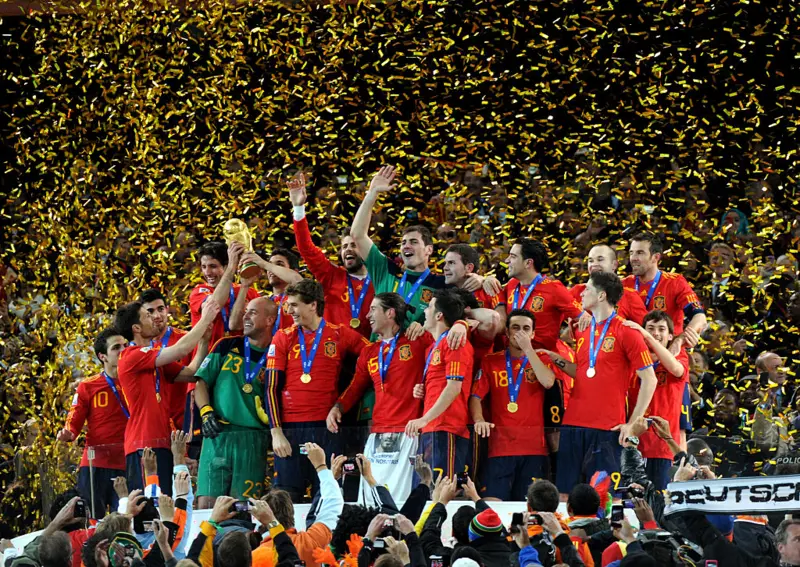
Spain grew into the tournament.
Spain did not begin the competition at their fluent best.
Their 0-0 draw with Cape Verde raised early questions about whether the reigning European champions could convert territorial control into goals. Rather than abandoning their approach, Spain became more efficient as the tournament progressed.
They defeated Austria in the round of 32, overcame Portugal in the last 16, beat Belgium in the quarter-finals and produced one of their strongest displays against France in the semi-finals. By the time they reached the final, Spain had developed the composure and defensive certainty required to manage very different opponents. Their campaign reflected a wider truth about tournament football: champions do not always begin at their peak. They must improve while continuing to survive.
A midfield built to control matches
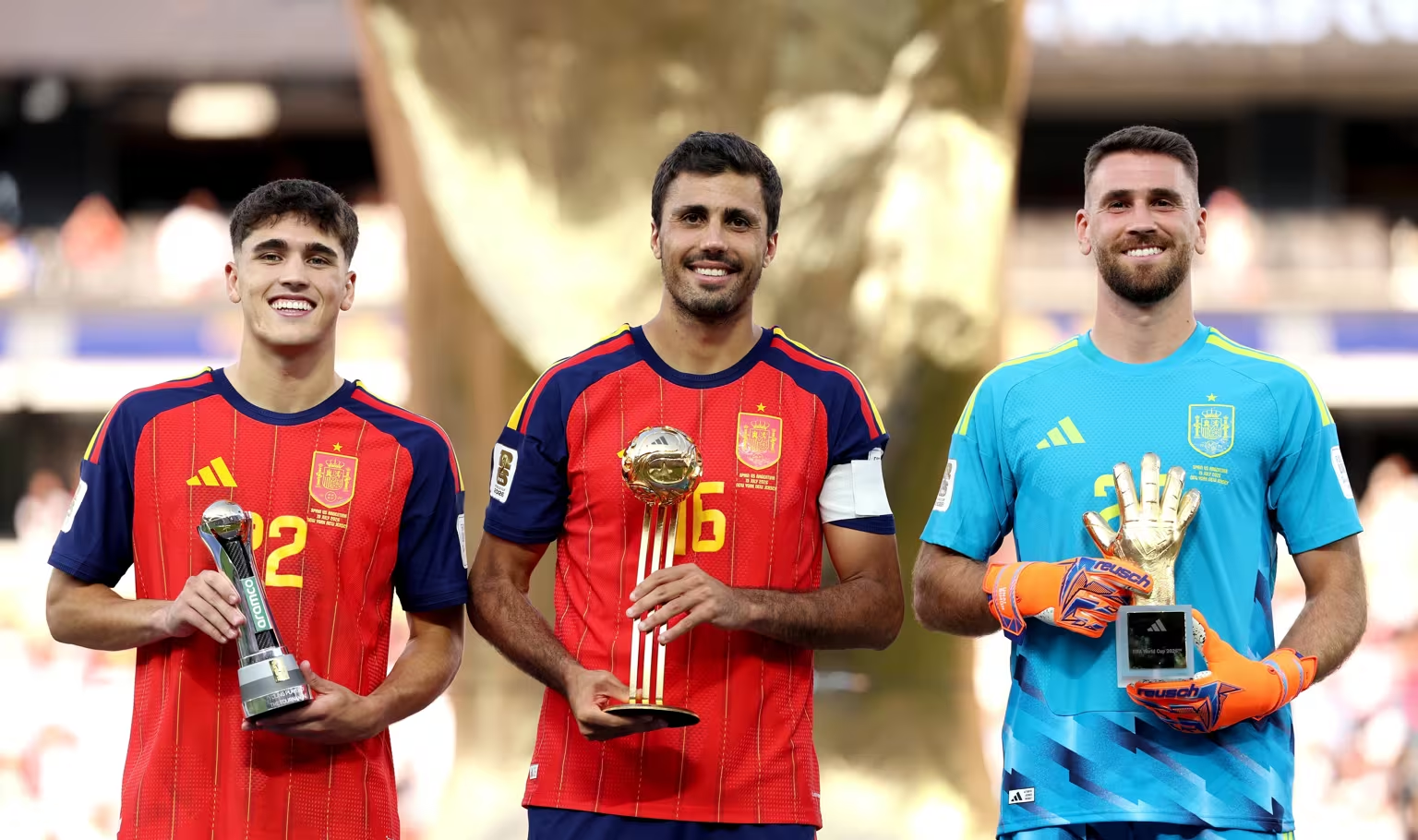
Spain’s central advantage against Argentina was their control of the ball. They recorded 65% possession and completed 852 passes, compared with Argentina’s 464. Rodri completed 101 passes and Pau Cubarsí 121, making them two of the few players on record to reach 100 completed passes in a men’s World Cup final.
Those numbers were not merely decorative.
Spain used possession to restrict Argentina’s attacking opportunities, move their opponents across the pitch and maintain pressure without exposing themselves unnecessarily to counter-attacks. Rodri provided rhythm and security in midfield. Dani Olmo, Pedri and Spain’s wide players offered movement ahead of him, while the defenders remained comfortable receiving the ball under pressure.
Spain did not always play quickly, but they repeatedly controlled where the match was played.
Defensive control provided the foundation.
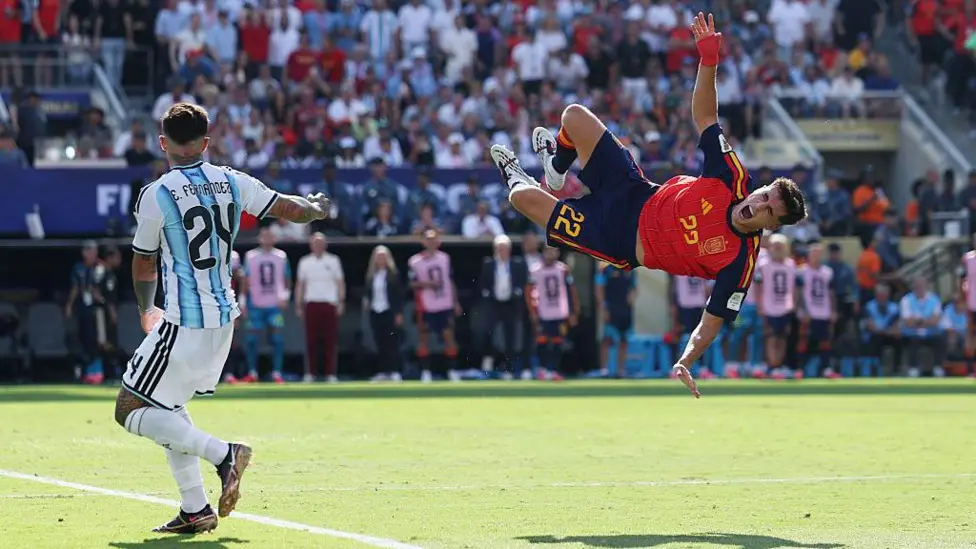
Spain conceded only one goal across the tournament, according to the supplied match analysis. Goalkeeper Unai Simón recorded seven clean sheets in eight matches and received the Golden Glove award. That record was built collectively. Spain pressed immediately after losing possession, limited the space available between midfield and defence and rarely allowed opponents to build sustained pressure.
Argentina did not record an attempt during the opening 90 minutes of the final. Their first shot arrived in the 117th minute, when Lionel Messi was unable to direct it on target. Spain’s defence therefore did more than resist Argentina. It largely prevented the defending champions from developing an attack.
Young players carried senior responsibility.
Spain’s success was also a product of youth development.
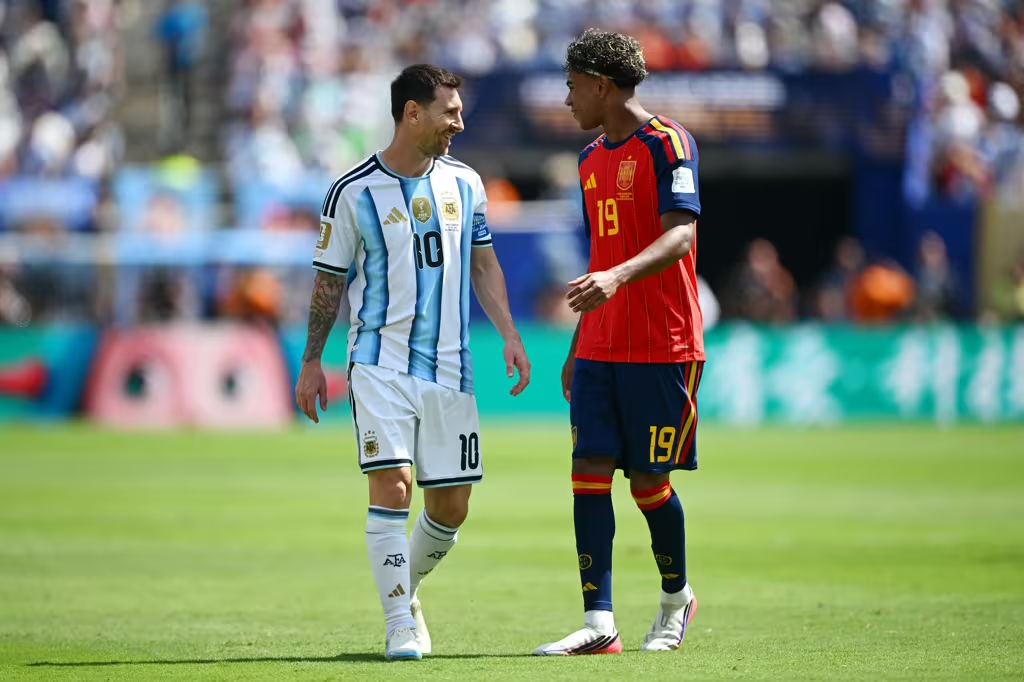
Pau Cubarsí, aged 19, delivered an assured performance in central defence and was named Young Player of the Tournament. Lamine Yamal, also 19, became the third-youngest player to appear in a men’s World Cup final and was rated Spain’s leading performer in the final by BBC Sport’s audience.
Their influence reflected Spain’s ability to introduce young players without weakening the team’s structure. Cubarsí was trusted to build attacks from defence and confront experienced forwards. Yamal supplied width, creativity and one-on-one threat, forcing Argentina to defend deeper on Spain’s right side. The presence of so many young contributors suggests the title may represent the start of a longer competitive cycle rather than the end of one.
De la Fuente’s substitutions changed the final
World Cup finals are often decided by the strength of a squad rather than the starting eleven alone. Argentina goalkeeper Emiliano Martínez made 11 saves, the highest recorded total by a goalkeeper in a men’s World Cup final, as Spain repeatedly threatened without scoring.
De la Fuente responded by introducing Nico Williams and Ferran Torres.
Williams added direct running and renewed Spain’s attacking intensity. In the 106th minute, he directed the ball into Torres’ path, allowing the forward to score from close range and finally break Argentina’s resistance. The goal demonstrated the depth of Spain’s squad. The two players directly involved in the winner had both begun the final on the bench.
Spain remained composed as Argentina lost discipline.
Argentina’s strategy focused heavily on disrupting Spain’s rhythm.
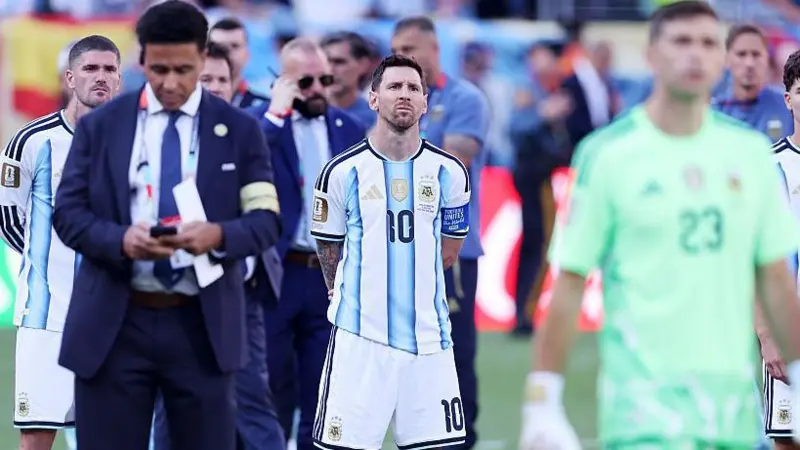
The defending champions defended deep, contested decisions and committed several late challenges. Enzo Fernández, who had already been booked, received a second yellow card following a reckless challenge on Cubarsí near the end of normal time. Argentina consequently played extra time with 10 men.
The dismissal altered the balance but did not create Spain’s superiority. De la Fuente’s side had already controlled possession and produced the better chances.
Further confrontations followed after the final whistle. Those incidents should not obscure Argentina’s achievement in reaching another final, but they underlined the contrast between Spain’s control and Argentina’s growing frustration. Argentina coach Lionel Scaloni acknowledged afterwards that Spain deserved the victory.
Tactical analysis
A Consistent Football Identity
Spain’s title was not founded on one star, one formation or one tactical trick. It emerged from a coherent system that remained recognisable throughout the tournament.
Their success combined several mutually reinforcing qualities:
- Patient possession without sterile circulation.
- Coordinated pressing immediately after losing the ball.
- Defenders comfortable progressing possession.
- Wide players capable of isolating and beating opponents.
- Midfielders able to control rhythm and territory.
- Substitutes who could alter the attacking profile.
- A clearly defined pathway for young players.
That structure allowed Spain to adapt without abandoning their fundamental identity. They could dominate possession, defend for longer periods when necessary and introduce different attacking profiles from the bench.
This balance separated them from teams constructed primarily around individual brilliance.
Spain’s Wider Era of Success
The men’s World Cup title added to a remarkable period for Spanish football across senior, women’s and age-group competitions.
Spain entered the tournament as European champions. The country also held the women’s world title, while its men’s Olympic side had recently won gold.
The 2026 triumph made Spain the first country to hold the men’s and women’s World Cup titles simultaneously, according to the supplied tournament coverage.
The men’s side also extended an unbeaten sequence that the match analysis placed at 38 games across all competitions, described as the longest recorded run by a European national team.
These achievements point to more than an exceptional senior squad. They reflect sustained investment in coaching, academies, technical education and a shared football philosophy across age groups.
- Men’s World Cup
- 2026 Champions
- Women’s World Cup
- Held Simultaneous world titles
- European Championship
- Won Entered as European champions
- Reported unbeaten run
- 38 Matches across competitions
African football perspective
What African Football Can Learn
Spain’s success offers useful lessons for African national teams seeking to convert abundant talent into repeatable tournament performance.
Africa continues to produce outstanding individual players. Morocco’s recent progress has also shown that African nations can compete deep into major tournaments.
The remaining challenge is building durable institutions that turn individual quality into consistent collective performance.
Spain’s model highlights the importance of:
- Consistent technical development.
- Coaching continuity and succession planning.
- Age-group pathways aligned with the senior national team.
- Sports science and performance analysis.
- Tactical familiarity across international windows.
- Squad depth beyond the starting eleven.
The lesson is not that African teams should copy Spain’s possession style. Football cultures, player profiles and domestic conditions differ.
The more transferable principle is institutional consistency. Spain’s players reached senior level already familiar with the technical and tactical demands of the national system.
That reduces the time required to create cohesion during short international camps.
Final assessment
Why Spain Were Worthy Champions
The final margin was narrow, but the performance gap was wider.
Spain recorded 20 attempts, placed 11 on target and generated an expected-goals figure of 1.94. Argentina produced almost no attacking threat until the closing stages of extra time.
Spain’s victory was therefore not the product of chance or a single defensive error.
It was the culmination of a tournament in which they became progressively stronger, defended with exceptional consistency and maintained confidence in a clearly defined method.
Ferran Torres supplied the goal that decided the final. The title itself was built by the entire system around him.
By the Numbers
The final statistics help explain why the scoreline understated Spain’s control.
- Final score
- Spain 1–0 Argentina After extra time
- Winning goal
- 106th minute Ferran Torres
- Possession
- 65% Spain
- Completed passes
- 852 Spain
- Argentina passes
- 464 Across the final
- Spain attempts
- 20 11 on target
- Expected goals
- 1.94 Spain
- Argentina’s first attempt
- 117th Minute
- Emiliano Martínez
- 11 saves Argentina goalkeeper
- Goals conceded
- 1 Spain across the tournament
- Unai Simón
- 7 clean sheets Across eight matches
- Final attendance
- 80,663 Reported crowd
The System Behind the Trophy
Player Development
Academies teach the technical skills required by Spain’s wider football philosophy.
Shared Principles
Age-group and senior players operate within recognisable tactical concepts.
Senior Integration
Young players can enter the first team without learning an entirely new football language.
Tournament Adaptation
Coaches can change personnel and match plans without losing the team’s core identity.
Key Takeaways
- 01
Spain won their second men’s World Cup, 16 years after their first.
- 02
Their defensive record provided the foundation for the title.
- 03
Rodri and Pau Cubarsí helped Spain control possession from central areas.
- 04
Lamine Yamal and Cubarsí demonstrated the strength of Spain’s youth pathway.
- 05
Luis de la Fuente’s substitutes created and scored the decisive goal.
- 06
Argentina’s red card mattered, but Spain had already been the stronger team.
- 07
The victory confirmed Spain as the dominant international football nation of the period.
Frequently Asked Questions
Who scored the winning goal in the 2026 World Cup final?
Ferran Torres scored in the 106th minute as Spain defeated Argentina 1–0 after extra time.
How many men’s World Cups have Spain won?
Spain have won the men’s FIFA World Cup twice, in 2010 and 2026.
Why did Spain beat Argentina?
Spain controlled possession, created more chances, defended effectively and benefited from decisive contributions by substitutes Nico Williams and Ferran Torres.
Who won the Golden Glove at the 2026 World Cup?
Spain goalkeeper Unai Simón received the Golden Glove after keeping seven clean sheets in eight matches.
Who was named Young Player of the Tournament?
Spain defender Pau Cubarsí was named Young Player of the Tournament.
Was Lionel Messi’s appearance his final World Cup match?
The supplied reporting did not confirm Messi’s international retirement. Argentina coach Lionel Scaloni said he had not discussed the matter with him, so any confirmed farewell claim would be speculative.
Reporting and Analysis
Reported Match Evidence
- Spain defeated Argentina 1–0 after extra time.
- Ferran Torres scored the winning goal.
- Spain controlled most of the possession.
- Spain recorded more attempts and shots on target.
- Unai Simón kept seven clean sheets during the tournament.
Analytical Conclusions
- Spain’s identity was more important than any single player.
- Coaching continuity and youth development strengthened the team.
- Substitutions expanded Spain’s attacking options.
- The model offers institutional lessons for African football.
- The title reflected a wider period of Spanish football success.
Related posts:
 Spain Outclasses France to Reach FIFA World Cup 2026 Final with Dominant 2-0 Victory
  Messi Scores as Argentina Survive Cape Verde Scare to Reach World Cup Last 16
  Cristiano Ronaldo’s World Cup Dream Ends in Tears as Portugal Exit to Spain
  Argentina Stage Stunning Comeback to Beat Egypt 3-2 as Lionel Messi Recovers from Penalty Miss
  Egypt Makes World Cup History as Salah Leads Pharaohs Past Australia into Last 16