
Angélique Kidjo makes Hollywood Walk of Fame history in a milestone for African music
Five-time Grammy winner Angélique Kidjo has become the first African musician and first Black African honoured with a Hollywood Walk of Fame star.



Follow Nukunya
Get the latest breaking news and updates from Nukunya.
Benin-born Angélique Kidjo has become the first African musician and first Black African to receive a star on the Hollywood Walk of Fame, marking a historic recognition for an artist whose four-decade career has helped carry African music across genres, languages and continents.
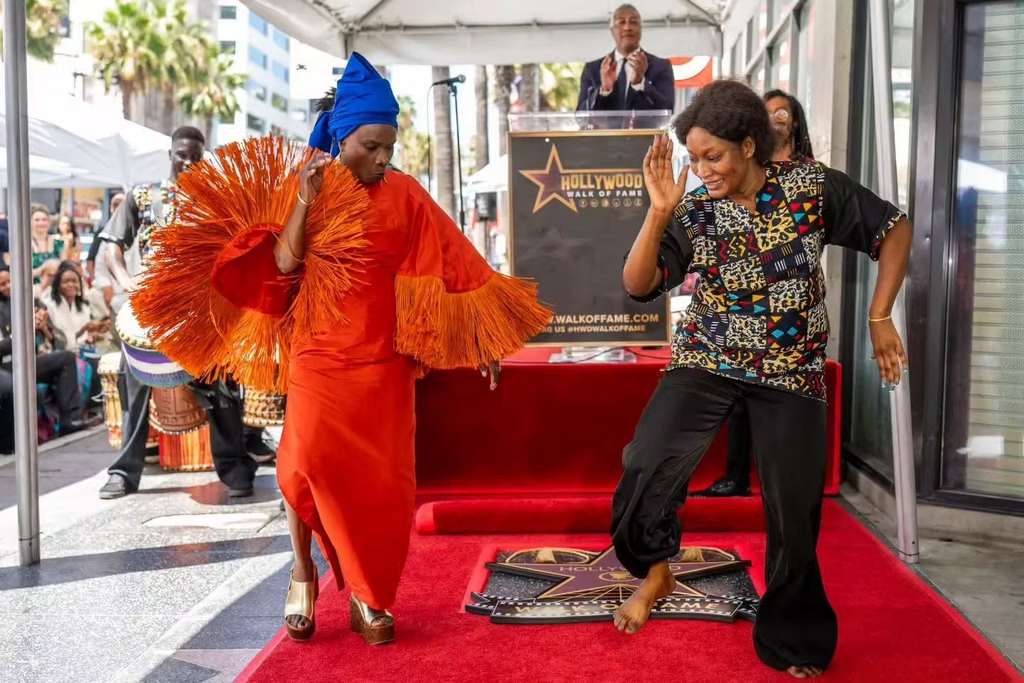
LOS ANGELES – Angélique Kidjo has made Hollywood Walk of Fame history, becoming the first African musician and the first Black African to receive a star on the celebrated Los Angeles landmark. The five-time Grammy winner received the 2,854th star on 18 August at 7011 Hollywood Boulevard, opposite the Hollywood Roosevelt Hotel.
Kidjo was honoured in the Recording category.
The Hollywood Chamber of Commerce, which administers the Walk of Fame, formally described the Beninese musician as the first African musician and first Black African to receive a star.
The ceremony was a historic first for a Black African performer. Actor Willem Dafoe and Recording Academy chief executive Harvey Mason Jr. joined Kidjo at the ceremony, which was hosted by Variety correspondent Angelique Jackson.
For an artist already decorated with five Grammys and decades of international recognition, the Hollywood star is unlikely to define her career.
Its significance lies elsewhere.
It places a Black African musician permanently within one of the American entertainment industry’s most visible public institutions and recognises a career that helped expand the international space available to African artists long before today’s surge in global interest in music from the continent.
What exactly has Kidjo made history for?
The historic claim needs to be stated precisely.
NOT THE CLAIM
First African-born person to receive a Hollywood Walk of Fame star
That would be inaccurate. Other African-born honourees preceded her, including South African-born actress Charlize Theron.
THE HISTORIC DISTINCTION
First African musician and first Black African to receive a Hollywood Walk of Fame star
That is the distinction identified in the Hollywood Chamber’s official announcement.
WHY THE WORDING MATTERS
Precise wording does not diminish the achievement. It makes the historical claim defensible and allows readers to understand exactly what changed.
1960 Permanent Walk of Fame begins
2026 Kidjo becomes its first Black African honouree
Kidjo’s star therefore arrived more than six decades after the first permanent Walk of Fame stars were installed.
FOUR DECADES OF MUSIC
A career built across borders
Kidjo was born in Benin and built an international career without treating African identity as something that had to be left behind.
Benin + West Africa
Her musical identity remained firmly connected to West Africa.
Multiple traditions
Her catalogue has moved across Afropop, funk, jazz, soul, Latin music and other forms.
A global African career
A body of work that crossed cultures and generations while remaining recognisably African.
RECORDING ACADEMY 5 Grammy wins
NOMINATIONS 16 recorded by the Academy
CAREER EVIDENCE
Winning projects include Djin Djin, Eve, Sings, Celia and Mother Nature.
WHY THIS MATTERS
Kidjo’s continued collaboration with younger African artists shows that her significance does not belong only to an earlier era of African music.
CULTURAL SIGNIFICANCE
Why the Hollywood star matters
A Hollywood Walk of Fame star is not a ranking of the world’s greatest musicians.
IT IS NOT A Grammy
A competitive recording-industry award.
IT IS NOT A universal ranking
It does not establish who the world’s greatest musicians are.
ITS PRIMARY SIGNIFICANCE Cultural visibility + permanence
The Walk places recognised entertainment figures into a highly visible permanent public record.
SINCE 1960
Permanent Walk of Fame stars
STARS 2,800+
Across entertainment categories
LOCATION Hollywood
Boulevard + Vine Street
THE HARDER QUESTION
Why did a Black African musician enter this permanent public record only in 2026?
Africa did not begin producing globally important musicians in the streaming era. Long before today’s chart breakthroughs and stadium tours, artists including Miriam Makeba, Fela Kuti, Hugh Masekela and Youssou N’Dour were shaping international perceptions of African music.
Kidjo belongs to that longer history.
BEFORE THE STREAMING ERA
From Benin to the global stage
Kidjo’s career developed during a very different international music economy.
No streaming platforms
Music could not instantly reach global audiences through today’s digital distribution systems.
Narrower distribution
African releases faced greater physical, commercial and gatekeeping barriers.
Broad industry labels
African musicians were often grouped under terms such as “world music” despite major differences between traditions.
Cross borders without erasing identity
Her catalogue moved across languages and musical traditions while retaining clear links to West Africa.
She demonstrated that an international African music career was possible before
the tools that now make global distribution faster and more direct.
AT THE CEREMONY
Her own message at the ceremony
Kidjo used the ceremony to emphasise common humanity rather than personal status.
Reuters reported that she described the world as a “small village”, emphasising equality across nationality, language and skin colour.
Reported at the Hollywood Walk of Fame ceremony
The message fits a public career extending beyond music.
UNICEF Goodwill Ambassador
Her advocacy has included children’s rights, girls’ education and issues affecting young people.
Batonga Foundation
Kidjo also established the foundation with a focus on girls and young women.
THE BIGGER CAREER
The Hollywood recognition therefore sits within a public life that extends beyond recording and performance.
AFRICAN MUSIC ACROSS GENERATIONS
A link between different eras of African music
Kidjo occupies an unusual position in the current African music landscape.
EARLIER GLOBAL ERA Kidjo’s generation
Built international careers before streaming and today’s Afrobeats-led commercial expansion.
NEWER GLOBAL ERA Contemporary African artists
Operate with streaming, social media, global touring and much wider collaboration networks.
2021 • MOTHER NATURE
The album featured younger African performers including Burna Boy and Mr Eazi and later won the Grammy for Best Global Music Album.
That connection matters because today’s global success of African music should not be treated as if it emerged without precedent.
WHAT HAS CHANGED Scale
WHAT HAS CHANGED Speed
WHAT HAS CHANGED Commercial infrastructure
Kidjo belongs to a generation that demonstrated an international African music career was possible before many of those tools existed.
CONTINENTAL SIGNIFICANCE
Why the milestone matters beyond Benin
Kidjo is Beninese, and the achievement belongs first to her and to the country in which her musical journey began.
Its wider significance, however, extends across West Africa and the continent.
Her career began there and remains strongly connected to the country.
A Beninese artist enters one of Hollywood’s most visible permanent institutions.
The achievement reflects a wider African presence in global popular culture.
Nigeria’s music industry has been especially visible in the current expansion, while artists from Ghana, South Africa and elsewhere have also developed increasingly international audiences.
THE LONGER VIEW
Kidjo’s Hollywood star connects that present commercial expansion with a much longer history of African artists crossing borders, reshaping genres and building international audiences.
RECOGNITION + REPRESENTATION
Recognition, but also a reminder
Historic awards are often described entirely as evidence of progress.
The picture here is more complicated.
The recognition is significant
For the first time, a Black African performer has entered the Walk’s permanent public record.
The lateness is significant too
African musicians had already shaped international culture for generations before that recognition arrived.
Both ideas can be true.
The star is a celebration. It is also evidence of how long the recognition took.
LEGACY BEFORE THE STAR
What Kidjo’s star does not need to prove
Kidjo did not need a star on Hollywood Boulevard to establish her importance.
01 Five Grammy victories
02 A career spanning decades and continents
03 More than two decades of UNICEF advocacy
04 Influence across generations of African music
THE DISTINCTION
The Walk of Fame honour works best as recognition of an existing legacy rather than evidence creating that legacy.
Its historic value comes from the institution finally placing a Black African musician within its permanent public record.
For younger African artists, that permanence also carries symbolic value.
NUKUNYA ANALYSIS
A milestone in a much longer journey
The most interesting question is not whether Angélique Kidjo deserves a Hollywood star.
Her career established its own importance long before the ceremony.
The more consequential question is what it means that she is the first Black African to receive one.
THE CENTRAL ARGUMENT
African music’s global influence did not begin in 2026.
Nor did it begin with streaming.
KIDJO’S ERA Build the pathway
Narrower distribution, fewer direct global channels and frequent treatment of African artists as peripheral to the international mainstream.
TODAY’S ERA Expand the pathway
More direct access to listeners, stronger commercial visibility and wider international collaboration.
Kidjo’s star sits at the intersection of those two eras.
HOLLYWOOD WALK OF FAME 2,854th star
HISTORIC FIRST First Black African honouree
NUKUNYA VERDICT
The star is ultimately a personal honour bearing Angélique Kidjo’s name.
Its historical significance is broader.
It is both recognition of how far African music has travelled and a reminder of how long some institutions have taken to acknowledge that journey.QUICK CONTEXT
Four questions that clarify the milestone
01 Was Kidjo the first African-born Walk of Fame honouree?
No. The historic distinction identified by the Hollywood Chamber is that Kidjo became the first African musician and first Black African to receive the honour.
02 Does the star prove she is one of the world’s greatest musicians?
The Walk of Fame is not a universal ranking of musical achievement. Kidjo’s artistic record is independently demonstrated by her career, recordings, awards and international influence.
03 Why is the recognition historically important?
It places a Black African musician into one of Hollywood’s most visible permanent public records for the first time.
04 Why does the milestone matter beyond Kidjo herself?
It connects today’s global expansion of African music with earlier generations that created international audiences under substantially less favourable conditions.
Related posts:
 South African Jazz Legend Abdullah Ibrahim Dies at 91, Leaving a Global Musical Legacy
  King Promise and African artists challenge ‘Afrobeats’ label as global music debate grows
  Gunfire and Explosions Hit Niger Airport, Trigger Major Security Operation
  Four charged in Sierra Leone’s first child marriage prosecution under new law
  Guinean student with sickle cell disease dies after imprisonment over exam cheating; family seeks investigation