Mahama backs $1bn AU Peace Fund as Africa seeks stronger conflict response
President John Mahama has backed faster capitalisation of the African Union Peace Fund towards its $1 billion target, arguing that Africa needs predictable financing to turn early warnings of conflict into early action.



Follow Nukunya
Get the latest breaking news and updates from Nukunya.
President John Dramani Mahama has called for predictable, sustainable and African-owned financing for peace and security, backing faster capitalisation of the African Union Peace Fund as leaders meeting in Luanda seek to strengthen the continent’s response to conflict.
LUANDA, Angola – President John Dramani Mahama has backed faster capitalisation of the African Union Peace Fund towards its $1 billion target, arguing that Africa needs predictable resources to turn warnings of emerging conflicts into early action.
Addressing the 21st Extraordinary Session of the Assembly of Heads of State and Government of the African Union in Luanda on Sunday, Mahama said Ghana attached particular importance to sustainable and African-owned financing for the continent’s peace and security agenda.
His intervention came as African leaders met specifically to examine weaknesses in the continent’s mechanisms for preventing and resolving conflicts.
The AU says the extraordinary summit is intended to improve the responsiveness and effectiveness of the African Peace and Security Architecture and African Governance Architecture, strengthen early warning and early action, and advance sustainable African financing for peace.
For Mahama, the financing question is directly connected to whether those institutions can respond before an emerging crisis becomes a larger conflict.
“Early warning must translate into early action,” he told the summit, arguing that this requires resources that are available predictably and in time.
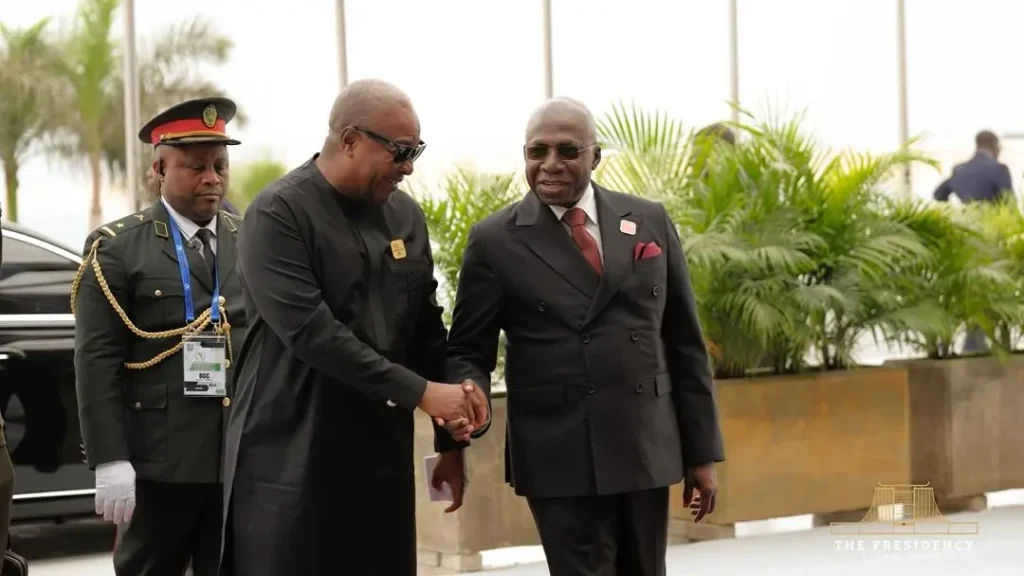
Ghana backs faster capitalisation of AU Peace Fund
Mahama identified the African Union Peace Fund as a central part of efforts to give the continent greater control over the financing of peace operations.
He called for accelerated capitalisation of the fund towards its $1 billion target, describing it as an important pillar of Africa’s ambition to support its own peace operations and reduce excessive reliance on external resources.
Ghana also backs implementation of the AU’s wider resource-mobilisation strategy, including the 0.2% levy on eligible imports, as well as contributions from African financial institutions and the private sector. The objective is not to end international financial support for African peace operations. Instead, Mahama’s position seeks a stronger and more predictable African financial base alongside international partnerships.
That distinction matters because the President also backed effective implementation of UN Security Council Resolution 2719, which provides a framework for eligible AU-led peace-support operations authorised by the Security Council to access UN-assessed contributions. AU Commission Chairperson Mahmoud Ali Youssouf also identified implementation of Resolution 2719 as an urgent priority during the Luanda summit.


LUANDA PEACE SUMMIT • GHANA 01 DETECTION Warning signs emerge → 02 ASSESSMENT Risk is evaluated → 03 TRIGGER Political response initiated → 04 OBJECTIVE Act before escalation
Mahama backs a model designed to turn early warning into early action
Ghana’s President has endorsed the Luanda Action Plan and backed the African Union Trigger Model, which seeks to strengthen the link between identifying instability and initiating a response.
THE IMPLEMENTATION GAP
The challenge is not simply detecting instability. It is ensuring
that warning produces timely political and operational action.
MAHAMA’S FINANCING ARGUMENT EARLY WARNING Analysis + POLITICAL AUTHORITY Decision + PREDICTABLE FINANCE Capacity = PREVENTIVE RESPONSE Early action
A warning system cannot mediate a conflict by itself
Early-warning institutions can identify growing political or security risks. Acting on that information requires people, diplomatic access, logistics and deployable funding.
Identify emerging political and security risks.
Governments and institutions agree that action is necessary.
Resources are available before the crisis escalates.
WHY “PREDICTABLE” MATTERS
Preventive diplomacy becomes harder if resources only arrive after
violence, displacement and humanitarian emergency have already begun.
THE SECURITY BACKDROP WAR Sudan CONFLICT Eastern DRC INSTABILITY Sahel SECURITY Somalia POLITICAL FRAGILITY Libya INSURGENCY Northern Mozambique
Luanda is meeting against multiple simultaneous crises
AU leaders are debating reform while several regions face conflict, political instability and transnational security threats.
WIDER THREATS
Terrorism Violent extremism Piracy Transnational crime
THE AU’S PRIORITY Prevention must become more effective before crises deepen.
WHY TIMING MATTERS BEFORE ESCALATION IF PREVENTION FAILS AFTER ESCALATION
Prevention and crisis response happen at very different stages
Conflict prevention
Early-warning analysis Mediation Preventive diplomacy Political dialogue
Escalation
Violence Displacement Infrastructure damage Humanitarian emergency
Crisis response
Emergency assistance Peace operations Reconstruction Long-term mediation
THE POLICY LOGIC
Acting earlier can be politically difficult, but waiting until violence
is entrenched usually makes intervention more complex.
THE LIMIT OF FINANCING FAILURE MODE 1 Political will without resources FAILURE MODE 2 Resources without political action
Money can enable action. It cannot create political will.
Institutions may agree intervention is necessary but lack deployable finance or operational capacity.
A financed institution can still be ineffective if governments resist mediation, ignore warnings or fail to implement agreed decisions.
WHAT EFFECTIVE PREVENTION NEEDS
Political authority + Timely decisions + Deployable resources
AFRICAN OWNERSHIP CONTRIBUTE Meet financing commitments → MANAGE Use resources transparently → DEPLOY Make funds operationally available → ACCOUNTABILITY Show what the money achieved
Financing more of Africa’s peace architecture brings an accountability test
Greater continental financing could reduce dependence on external funding decisions. But greater ownership also means greater responsibility for member states.
PEACE FUND BENCHMARK $1 billion
The amount mobilised matters, but the stronger test is what the AU can actually do when a credible warning requires action.
WHAT LUANDA IS TRYING TO CHANGE 01 Early warning → early action 02 Peace and Security Council 03 AU–regional coordination 04 Sustainable financing 05 Decision implementation 06 African ownership
The summit is addressing more than one institutional weakness
Reduce the gap between detecting risk and responding to it.
Strengthen the AU body’s role in preventive action.
Improve interaction between continental and regional institutions.
Ensure preventive mechanisms have usable resources.
Make collectively adopted commitments operational.
Increase continental responsibility for peace architecture.
THE EARLY-ACTION CHAIN WARNING Risk detected → POLITICS Leaders decide whether to act → ACCESS Mediation is accepted → FINANCE Resources available → ACTION Prevention deployed
Prevention can fail at several points
THE SYSTEM IS ONLY AS STRONG AS ITS WEAKEST LINK
Better warning technology will not solve delays caused by political
resistance, lack of access or unavailable resources.
HOW TO JUDGE THE LUANDA COMMITMENTS 01 Warning-to-action time 02 Available financing 03 Mediation deployment 04 Implementation 05 Regional coordination 06 Conflict outcomes
The Peace Fund balance should not become the only scorecard
How quickly does a credible risk trigger political response?
Can preventive interventions be funded when needed?
Can envoys and preventive diplomacy be activated early?
Are AU decisions actually carried out?
Do AU and regional organisations act coherently?
Does earlier intervention reduce escalation?
QUICK EXPLAINER
Five questions behind Mahama’s Luanda position
01 What is the central problem the summit is trying to solve?
One central problem is the gap between detecting signs of instability and mobilising an effective response before the situation becomes a larger conflict.
02 Why does Mahama emphasise predictable financing?
Mediation, preventive diplomacy and peace-support activity require deployable resources. Financing that arrives only after escalation weakens the preventive model.
03 Would a fully financed Peace Fund solve the problem?
No. Governments must still respond to warnings, permit mediation, implement collective decisions and provide the political authority necessary for institutions to act.
04 Why does African ownership matter?
Greater African financing could make continental mechanisms less dependent on external funding decisions, while placing greater responsibility on member states to fund and account for the system.
05 What would demonstrate that Luanda worked?
The stronger evidence would be whether the AU can mobilise political attention, mediation and resources quickly when a future credible warning emerges, rather than simply how much money is held in a fund.
NUKUNYA ANALYSIS THE CAPABILITY Africa can identify emerging instability. THE HARDER TEST Can institutions act quickly enough? POLITICAL WILL Authority to act + FINANCING Capacity to act + TIMING Ability to act early = THE OBJECTIVE Prevention
The real test is whether Africa can act before warning becomes war
Mahama’s intervention connects two weaknesses that are often discussed separately: early warning and financing.
A sophisticated warning mechanism has limited preventive value if political decisions come too late.
But political commitment can also fail if institutions recognise the danger and then lack the resources required to mediate or intervene.
THE LUANDA TEST
Success should not be measured only by how much money enters the
Peace Fund, but by whether African institutions can mobilise diplomacy,
political attention and resources before the next warning becomes
another war.
Related posts:
 AU ministers meet in Luanda as Africa confronts limits of its conflict-prevention system
  Ghana Parliament Passes Human Sexual Rights and Family Values Bill
  Mahama Calls for Renewed Pan-African Unity and Reparations Agenda During UK Visit
  Mahama urges Ken Ofori-Atta to return as Ghana pursues extradition process
  VP Opoku-Agyemang to Represent Mahama at Africa Forum in Kigali