AU ministers meet in Luanda as Africa confronts limits of its conflict-prevention system



Follow Nukunya
Get the latest breaking news and updates from Nukunya.
African Union foreign ministers are meeting in Luanda ahead of an extraordinary leaders’ summit examining why the continent’s extensive peace and security mechanisms are struggling to prevent and resolve persistent conflicts. The question facing the AU is increasingly not whether Africa has enough peace institutions, but whether governments are prepared to make them work.
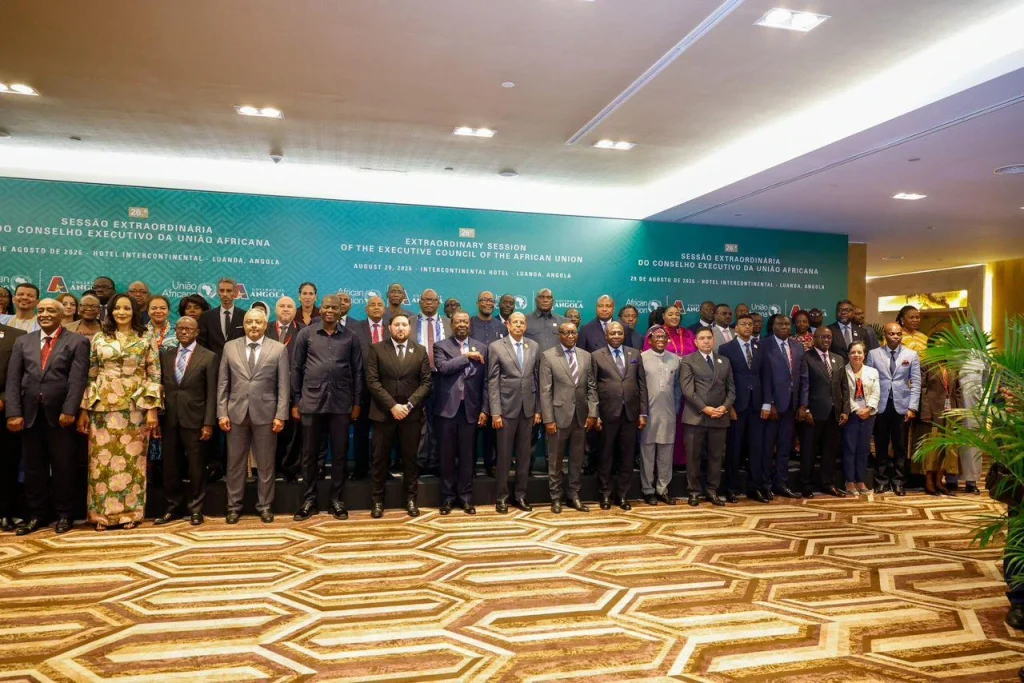
LUANDA, Angola – African Union foreign ministers are meeting in Luanda on Saturday ahead of an extraordinary summit of heads of state and government that will examine how Africa can respond earlier and more effectively to conflicts before they become harder and costlier to resolve.
The 26th Extraordinary Session of the AU Executive Council is the first stage of a two-day gathering devoted specifically to strengthening mechanisms for conflict prevention and resolution. Heads of state and government will take over on Sunday for the 21st Extraordinary Session of the Assembly of the African Union.
Unlike a routine AU summit covering a broad range of continental issues, the Luanda meeting has a tightly defined purpose. African leaders are being asked to assess whether the continent’s existing conflict-prevention mechanisms are working and consider practical measures to improve them.
The agenda includes early warning and early action, the role of the AU Peace and Security Council, coordination between continental and regional institutions, sustainable financing for peace, terrorism and violent extremism, and the implementation of Africa’s wider peace and governance architecture.
Africa does not lack a peace architecture
The African Union has spent more than two decades building institutions intended to prevent, manage and resolve conflict.
At the centre is the African Peace and Security Architecture, commonly known as APSA.
Its institutions and mechanisms include the Peace and Security Council, the Continental Early Warning System, mediation structures and arrangements for peace-support operations. The system is designed to work alongside regional economic communities and regional mechanisms across the continent.
Africa therefore enters the Luanda summit with a substantial institutional framework already in place.
That is precisely why this summit matters. The AU itself says leaders will undertake a strategic assessment of the effectiveness of existing continental mechanisms. The issue is no longer simply whether the institutions exist. It is whether warnings result in action, mediation produces agreements, agreements are implemented and peace operations receive the political and financial support they require.
THE CENTRAL PROBLEM 01 EARLY WARNING Identify emerging risk 02 EARLY ACTION Intervene before escalation
Africa can detect danger. The harder task is acting before it becomes war.
The African Union already has institutions designed to monitor political and security risks. Luanda is asking whether those warnings can be converted into sufficiently early political action.
Political tension, insecurity and other indicators suggest that a crisis may be developing.
THE GAP Political decision
Preventive diplomacy, mediation, political pressure or other action begins before positions harden.
THE DISTINCTION
Knowing that a crisis is developing is not the same as preventing it.
WHAT THE AU IS ALREADY DOING 24 AUGUST APRM CEWS
The Union is trying to improve its early-warning machinery
Shortly before ministers gathered in Luanda, the AU Peace and Security Council examined how institutions involved in continental early warning could coordinate more effectively.
Continental Threats Assessment and Risks Mapping Tool
Considered as part of efforts to strengthen continental risk analysis.
Early Warning System
Part of the wider institutional architecture feeding analysis into conflict prevention.
Continental Early Warning System
Reaffirmed by the Peace and Security Council as central to conflict prevention.
WHAT THE PSC CALLED FOR
Stronger analytical coordination between AU institutions and regional bodies.
THREE DIFFERENT TESTS
Sudan, eastern DR Congo and the Sahel expose different weaknesses
Africa’s conflicts do not present one uniform problem. The cases highlighted around the summit illustrate different pressures on the continent’s peace and security architecture.
SUDAN Escalation
When prevention fails, the conflict becomes harder to contain
Once a political crisis becomes full-scale war, mediation must contend with heavily armed forces, casualties, territorial calculations and external interests.
LESSON Act before the range of solutions narrows.
EASTERN DR CONGO Coordination
More diplomacy does not automatically mean coherent diplomacy
Multiple mediation tracks can bring leverage, but competing timetables, commitments and structures can also fragment peace-making.
LESSON Different processes need to move towards the same destination.
SAHEL Regional model
Military action alone cannot resolve every driver of instability
Armed groups operate across borders while weak institutions, local grievances, contested authority and economic exclusion can interact with insecurity.
LESSON Security responses need to connect with governance and prevention.
THE POLITICAL TEST WARNING Risk identified → DECISION Should outsiders intervene? → OBSTACLE Sovereignty concerns → CONSEQUENCE Delay can allow escalation
Early warning is technical. Early action is political.
Africa’s institutions may identify serious risk before violence becomes severe. The politically difficult question is what happens next.
THE TENSION
How early can continental institutions intervene without appearing
to override the sovereignty of a member state?
THE PEACE AND SECURITY COUNCIL CAN Consider emerging crises CAN Support mediation CAN Call for ceasefires CAN Help shape continental responses
Stronger institutions still depend on political backing
The Peace and Security Council is the AU’s standing decision-making institution for conflict prevention, management and resolution.
WHAT IT CANNOT EASILY DO
Manufacture cooperation from governments or armed groups determined
to resist collective action.
Strengthening the PSC therefore cannot be reduced to institutional redesign. Its effectiveness also depends on whether member states support collective decisions when those decisions become politically difficult.
AFRICAN OWNERSHIP
01 Diplomacy Mediators and sustained engagement 02 Personnel Peace-support missions 03 Logistics Transport, equipment and communications 04 Financing Predictable resources over time
Peace costs money
The principle of “African solutions to African problems” becomes harder to sustain when peace operations remain heavily dependent on external resources.
THE REAL CHALLENGE
Not simply finding more money, but creating financing reliable enough
to plan and sustain African-led peace operations before crises escalate.
WHY LUANDA?
Angola is not a neutral choice of venue
JOÃO LOURENÇO AU Champion for Peace and Reconciliation in Africa
Angola has played a prominent role in regional diplomacy, particularly around tensions linked to eastern DR Congo.
The AU says the extraordinary summit is being convened under Lourenço’s leadership.
BUT HOSTING TALKS IS NOT THE ENDPOINT
The credibility of mediation ultimately depends on implementation and
whether political agreements produce greater security for people.
THE “TALK SHOP” TEST LOW-VALUE OUTCOME HIGH-VALUE OUTCOME
Africa does not lack declarations about peace
The AU and its predecessor have adopted protocols, frameworks, roadmaps and initiatives over decades. The challenge is translating commitments into action.
Another declaration
Reaffirm the importance of peace without specifying what changes operationally.
Operational commitments
Clarify who acts, when they act, how interventions are coordinated and how they are financed.
THE TEST FOR SUNDAY’S DECISIONS Specificity.
WHY THIS IS ALSO ECONOMIC POLICY Roadsdamaged Hospitalsdamaged Schoolsclosed Farmersdisplaced Investmentfalls Trade routesdisrupted Budgetsredirected Familiesdisplaced
Preventing conflict protects development
War does not only create a security emergency. It destroys economic capacity and shifts public resources towards crisis response.
THE PARADOX OF SUCCESSFUL PREVENTION
A crisis stopped through diplomacy produces fewer dramatic images precisely because the feared conflict never happened.
Preventing war can therefore create enormous economic value that is difficult to observe directly. HOW TO JUDGE THE SUMMIT 01 02 03 04 05
What would make Luanda meaningful?
The summit cannot solve every conflict-management problem in one weekend. But its decisions can be judged against observable benchmarks.
Earlier intervention
Act when warning signs emerge rather than after violence is entrenched.
Less diplomatic duplication
Improve coordination between continental and regional mediation.
Clearer sovereignty rules
Define responses when member states resist preventive engagement.
A more responsive PSC
Improve the ability to react to rapidly developing crises.
Reliable financing
Create more sustainable funding for African-led peace efforts.
QUICK EXPLAINER
Five questions that define the Luanda debate
01 Does Africa lack conflict-prevention institutions?
Not primarily. The continent already has a Peace and Security Council, early-warning systems, regional organisations, mediators and wider peace and governance architectures. The summit is focused heavily on making those mechanisms more responsive and coherent.
02 Why is early action so difficult?
Governments guard sovereignty, leaders may resist outside intervention and regional institutions can hesitate to act before a crisis becomes severe.
03 Why do multiple peace processes create problems?
Different mediators can bring leverage, but competing timetables, commitments and negotiating structures can make diplomacy less coherent.
04 Why does financing matter?
Mediation and peace-support operations require personnel, equipment, logistics and sustained funding. Unpredictable financing can limit the ability to plan and act early.
05 When will we know whether Luanda succeeded?
Not necessarily when the summit closes. The stronger test will come when the next serious warning emerges and African institutions have to convert analysis into coordinated action.
NUKUNYA ANALYSIS SOVEREIGNTY Governments resist intrusion COMPLEXITY Conflicts have domestic causes ARMED GROUPS Non-state actors may ignore institutions EXTERNAL POWERS Foreign interests can shape wars LEVERAGE Mediators cannot force compromise CAPACITY AU resources are not unlimited BEFORE ESCALATION AFTER ESCALATION
Africa’s peace gap lies between warning and action
The most important word in Luanda may not be peace. It may be action.
AFRICA ALREADY HAS
Early-warning systems Diplomats Mediators Peace and Security Council Regional organisations Governance architectures
What repeatedly proves difficult is converting those mechanisms into sufficiently early and coordinated political intervention.
Those limitations mean it would be simplistic to treat every continuing African conflict as proof that the continental architecture has failed.
THE PARADOX
The harder intervention becomes after violence begins, the more important
prevention becomes before it does.
- political grievances;
- warning indicators;
- room for preventive diplomacy;
- lower human and economic costs.
- casualties;
- territorial control;
- displacement;
- military calculations;
- hardened political positions.
THE CENTRAL QUESTION FACING LUANDA
Does Africa need more peace mechanisms, or the political will to make
the mechanisms it already has work?
The summit’s success will therefore not be measurable simply by the language of its closing declaration.
WHAT WOULD MAKE LUANDA MATTER
If African institutions identify the next danger earlier, governments respond faster and diplomacy begins before violence becomes entrenched, the summit may eventually prove consequential.
If the outcome is another declaration followed by the same gap between warning and action, Africa will have diagnosed a familiar problem without solving it.Related posts:
 Africa’s drought crisis intensifies as food insecurity rises
  WHO Warns DR Congo Ebola Outbreak May Be Spreading Faster as Death Toll Hits 131
  Ebola Outbreak Passes 530 Cases as Africa Races to Contain Rare Strain With No Approved Vaccine
  DR Congo Ebola deaths rise to 447 as WHO launches first treatment trial
  VP Opoku-Agyemang to Represent Mahama at Africa Forum in Kigali