
DR Congo Ebola deaths rise to 447 as WHO launches first treatment trial
The WHO has launched the first clinical trial of Ebola treatments in DR Congo after the outbreak claimed 447 lives. Scientists hope the study will improve survival rates.


Follow Nukunya
Get the latest breaking news and updates from Nukunya.
The World Health Organization has enrolled the first patient in a clinical trial of experimental Ebola treatments as the outbreak in the Democratic Republic of the Congo continues to worsen, with 447 deaths now confirmed.
KINSHASA, Democratic Republic of the Congo — The World Health Organization (WHO) has begun the first clinical trial of experimental treatments for the Bundibugyo strain of Ebola after the latest outbreak in the Democratic Republic of the Congo (DRC) claimed 447 lives, marking a significant milestone in efforts to contain one of the country’s most serious public health emergencies in recent years.
The first patient has now been enrolled in the study, which is evaluating two potential therapies that researchers hope could improve survival among people infected with the virus. The trial comes as health authorities report more than 1,400 confirmed Ebola cases across the affected provinces.
WHO Director-General Tedros Adhanom Ghebreyesus described the start of the trial as an important step in expanding treatment options for a virus strain that currently has no approved medicines or vaccines specifically designed to combat it. Health officials say the study could provide evidence that shapes future responses to Ebola outbreaks caused by the Bundibugyo virus.
The outbreak has prompted renewed concern across Central and East Africa after cases spread rapidly in eastern DRC. Africa Centres for Disease Control and Prevention (Africa CDC) Director-General Jean Kaseya has warned that the situation remains “very serious”, noting that both infections and deaths have increased sharply compared with previous weeks.
First patient enrolled in landmark treatment study
The clinical trial is sponsored by WHO and coordinated with the DRC’s National Institute for Biomedical Research, Belgium’s Institute of Tropical Medicine and researchers from the University of Oxford. The programme will evaluate whether two therapies can significantly improve patient survival.
Scientists are testing the monoclonal antibody MBP134 alongside the antiviral drug remdesivir, both individually and in combination. Researchers say patients will continue to receive supportive medical care regardless of which treatment group they join.
Officials said additional therapies may be introduced later as more evidence becomes available, allowing researchers to compare multiple treatment options within the same adaptive trial framework.
Why the Bundibugyo strain matters
Unlike the better-known Zaire strain of Ebola, which has approved vaccines and antibody treatments, the Bundibugyo virus remains comparatively under-researched.
No approved vaccine or treatment currently exists specifically for this strain, making the new trial particularly significant for global health experts. Researchers hope the findings will establish the first evidence-based treatment for future Bundibugyo outbreaks.
According to WHO, the trial forms part of a broader international strategy to accelerate research during outbreaks so promising medicines can be evaluated while patients receive care.
The outbreak remains a major public health emergency
Congolese authorities reported 1,460 confirmed Ebola cases, including 447 deaths, while hundreds of patients remain in treatment or isolation facilities. Contact tracing teams continue monitoring thousands of people who may have been exposed to the virus.
Health workers are also facing significant operational challenges, including insecurity in parts of eastern DRC, community mistrust and the difficulty of reaching remote populations. WHO officials say attacks on healthcare facilities and humanitarian workers continue to complicate response efforts.
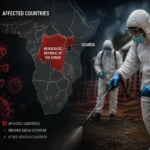
Neighbouring Uganda has also reported infections linked to the outbreak, prompting heightened regional surveillance and cross-border health monitoring.
Why this matters for Ghana and Africa
Although no Ebola cases have been reported in Ghana, the outbreak highlights the importance of regional disease surveillance and preparedness.
Following the devastating West African Ebola epidemic between 2014 and 2016, many African countries, including Ghana, strengthened border health screening, laboratory capacity and emergency response systems.
Public health experts say continued surveillance, rapid testing and regional cooperation remain essential as people and goods move frequently across African borders. Africa CDC has repeatedly emphasised that outbreaks anywhere on the continent require coordinated regional responses to minimise cross-border transmission.
Ebola outbreak timeline
May 2026
- First Bundibugyo Ebola cases confirmed in eastern DRC.
June 2026
- Cases continue rising across affected provinces.
- WHO declares the outbreak a Public Health Emergency of International Concern.
3 July 2026
- Death toll reaches 447.
- WHO enrols the first patient in a landmark treatment trial.
Key Takeaways
DeathsDR Congo has confirmed 447 Ebola deaths
InfectionsMore than 1,400 infections have been reported
TrialWHO has begun the first clinical trial targeting the Bundibugyo strain
MedicinesScientists are evaluating MBP134 and remdesivir
Risk levelAfrica CDC says the outbreak remains very serious
Treatment gapNo approved treatment currently exists specifically for Bundibugyo
Frequently Asked Questions
What strain of Ebola is causing the outbreak?
The outbreak is caused by the Bundibugyo strain of Ebola, one of several known Ebola virus species. Unlike the Zaire strain, there are currently no approved treatments specifically for Bundibugyo.
Why is the clinical trial important?
It is the first study designed to determine whether experimental therapies can improve survival among patients infected with the Bundibugyo virus.
Which medicines are being tested?
Researchers are evaluating the monoclonal antibody MBP134 and the antiviral drug remdesivir, individually and in combination.
Who is leading the study?
The trial is coordinated by WHO together with the DRC’s National Institute for Biomedical Research, Belgium’s Institute of Tropical Medicine and the University of Oxford.

Related posts:
 Ebola Outbreak Passes 530 Cases as Africa Races to Contain Rare Strain With No Approved Vaccine
  DR Congo Health Workers Battle Ebola Outbreak Amid Equipment Shortages and Security Risks WHO Warns DR Congo Ebola Outbreak May Be Spreading Faster as Death Toll Hits 131
  DR Congo Ebola outbreak grows as Oxford scientists fast-track vaccine
  Ebola Cases Nearly Double in DR Congo as WHO Chief Visits Outbreak Epicentre