
Ghana Allocates GH¢442 Million for Flood Recovery and Coastal Protection


Follow Nukunya
Get the latest breaking news and updates from Nukunya.
The Ghanaian government has committed more than GH¢442 million to flood recovery and coastal protection projects as climate-related disasters place growing pressure on communities, infrastructure and public finances across the country.
ACCRA — Ghana has committed more than GH¢442 million to disaster recovery and coastal protection programmes as climate-related emergencies increasingly threaten communities, livelihoods and economic stability across the country.
The funding package includes GH¢242.5 million earmarked in the 2025 budget for recovery, resettlement and compensation efforts linked to the 2023 Akosombo Dam spillage, alongside an additional GH¢200 million for coastal protection projects aimed at reducing erosion and flooding risks. The spending commitment reflects growing concern among policymakers over the economic and social costs of climate change, as Ghana experiences increasingly frequent flooding, coastal erosion, extreme heat and changing rainfall patterns.
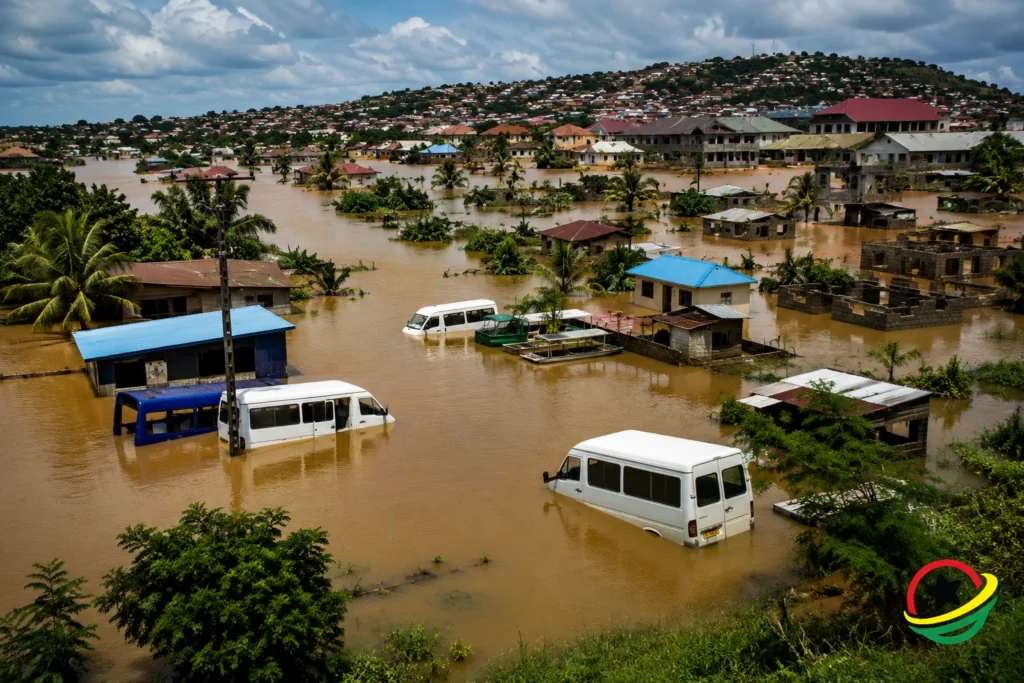
The funding package includes Akosombo recovery support and coastal defence projects as officials warn climate risks are increasing across Ghana.
Samuel Arkurst, Director of the Real Sector Division at the Ministry of Finance, announced the allocation during the Second Ghana Green Investment Dialogue and Capacity Building Workshop in Accra. The 2023 controlled spillage from the Akosombo Dam displaced thousands of residents across parts of the Volta, Eastern and Greater Accra regions, damaging homes, farms, businesses and public infrastructure. Recovery efforts have continued as affected communities seek to rebuild livelihoods and restore essential services.
Mr Arkurst said climate-related disasters were placing significant pressure on Ghana’s economy and fiscal position, increasing the need for investment in resilience and disaster preparedness. “Like many countries in Sub-Saharan Africa, Ghana faces mounting climate risks, from erratic rainfall and flooding to coastal erosion and heat stress,” he said.
According to the World Bank’s 2022 Country Climate and Development Report, climate-related shocks could push at least one million Ghanaians into poverty by 2050 if adaptation measures are not accelerated.
The report identifies climate vulnerability as a growing development challenge for Ghana, with rising costs expected across agriculture, infrastructure, energy and public health. Coastal communities in areas such as Keta, Ada and neighbouring settlements have for years faced advancing sea erosion that threatens homes, roads, schools and local economic activity. The challenges have prompted repeated calls for greater investment in coastal defence infrastructure and adaptation measures.
Mr Arkurst said Ghana’s climate agenda was aligned with the country’s commitments under the Paris Agreement and implementation of its Nationally Determined Contributions, which seek to strengthen climate resilience while supporting sustainable economic growth. He said investment in renewable energy, climate adaptation and green infrastructure would help improve energy security, reduce long-term vulnerabilities and attract sustainable investment.
Dickson Kyere-Duah, Member of Parliament for Berekum West, speaking on behalf of Parliament’s Environment, Science and Technology Committee, said climate investment had become an economic necessity rather than a policy choice. He said Ghana’s future competitiveness would increasingly depend on its ability to build resilient infrastructure, attract climate finance and transition towards a low-carbon economy.
The workshop, organised by Climate Parliament in partnership with the United Nations Industrial Development Organization (UNIDO) and Parliament of Ghana, brought together policymakers, development partners, financial institutions and renewable energy stakeholders to discuss climate finance mobilisation and investment priorities. Climate scientists and international agencies have warned that climate-related disasters are likely to become more frequent and severe across West Africa as rising temperatures, changing rainfall patterns and sea-level rise place increasing pressure on governments and vulnerable communities.
The government’s latest funding commitment signals a broader effort to strengthen disaster preparedness and climate resilience as Ghana seeks to protect communities while reducing the long-term economic costs of environmental shocks.
Reporting by Edem Hodasi, with additional reporting, verification and editorial analysis by the Nukunya News Desk using statements from the Ministry of Finance, Parliament of Ghana, the World Bank’s Country Climate and Development Report, UNIDO and Ghana News Agency reporting.
Related posts:
 Ghana’s inflation slows for third consecutive month as food prices ease
  Ghana floods displace families as heavy rains hit Cape Coast
  Ghana Premier League Fixtures Postponed as Funeral Rites Set for Slain Footballer Dominic Frimpong
  Ghana Pushes Border Cooperation as Sahel Insecurity Raises Regional Security Risks
  Ghana Partners Google for Education to Expand AI and Digital Skills in Schools