
Kelvin Owusu Nkwantabisa Sentenced to 17 Years in US$38 Million Email Fraud Case



A US federal court has sentenced Kelvin Owusu Nkwantabisa to 17 years in prison for his role in a transnational business email compromise scheme that authorities said stole more than US$38 million from victims across the United States and abroad.
A United States federal court has sentenced Kelvin Owusu Nkwantabisa to 17 years in prison for his role in a transnational business email compromise (BEC) fraud scheme that authorities said stole more than US$38 million from victims across the United States and other countries.
The sentencing was announced by the United States Attorney’s Office for the Southern District of Florida on 30 April 2026 following a federal prosecution involving four defendants accused of participating in a sophisticated email fraud and money laundering operation.
According to the U.S. Department of Justice (DOJ), Nkwantabisa, 33, who resided in Georgia and was also known as “Kevin Brown” and “KO”, pleaded guilty to conspiracy to commit money laundering in connection with the scheme. The DOJ said the fraud operation targeted businesses and individuals in the United States and abroad and generated losses exceeding US$38 million.
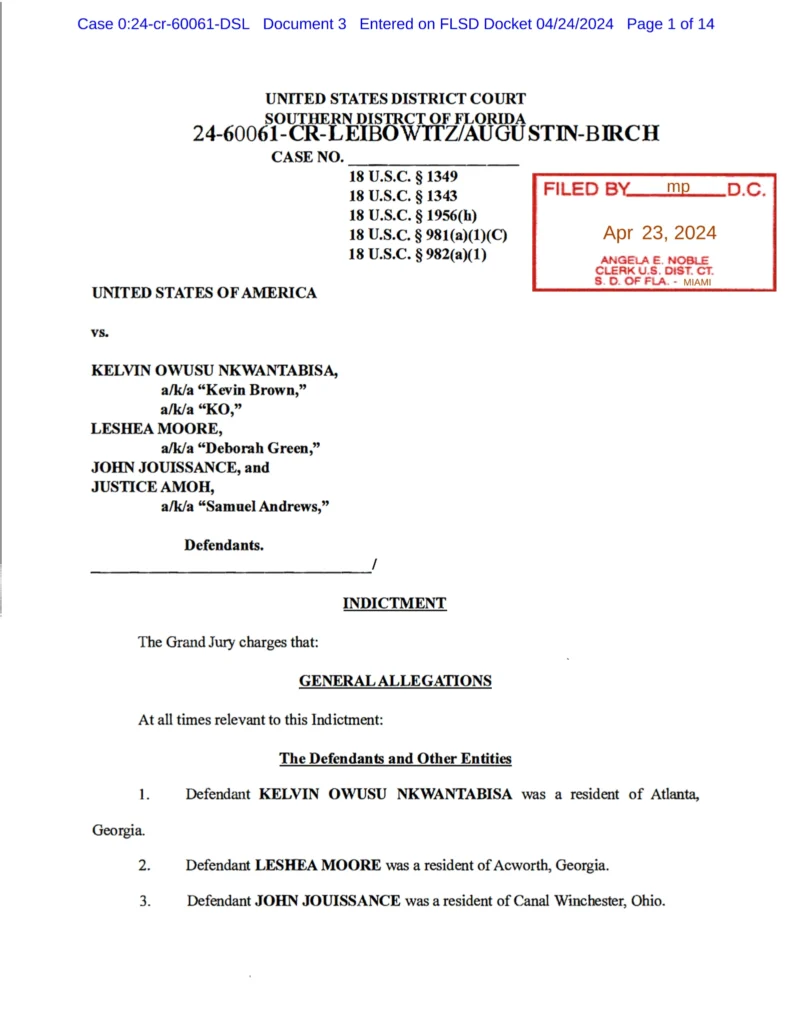
Nukunya reviewed the federal indictment filed in the United States District Court for the Southern District of Florida, publicly available court records and the DOJ’s sentencing announcement. Court records show that Nkwantabisa was charged alongside Leshea Moore, John Jouissance and Justice Amoh, who also used the alias “Samuel Andrews”.
According to prosecutors, members of the criminal organisation gained unauthorised access to victims’ email accounts and monitored communications relating to legitimate financial transactions. The group then allegedly impersonated trusted business partners and redirected payments into bank accounts under their control. Authorities said the stolen funds were subsequently moved through multiple bank accounts and shell companies in an effort to conceal their origin and avoid detection.
DOJ: Nkwantabisa Led US-Based Operation
The Department of Justice said Nkwantabisa led the United States-based arm of the operation. According to prosecutors, he coordinated with overseas co-conspirators, directed the creation of bank accounts across multiple states to receive victim funds, tracked incoming payments and instructed others on how to launder the proceeds.
“This was organized international fraud carried out through deception, stolen trust, and financial manipulation,” United States Attorney Jason A. Reding Quiñones said in a statement announcing the sentences. “These defendants infiltrated legitimate business communications, diverted millions of dollars, and laundered the proceeds through shell companies and fraudulent bank accounts to conceal their crimes.” He added that the sentences should serve as a warning that authorities will continue to pursue those who use the financial system to facilitate fraud and money laundering.
Co-Defendants Also Sentenced
According to the DOJ announcement, the remaining defendants also received prison sentences. Leshea Moore, 29, of Georgia, pleaded guilty to conspiracy to commit money laundering and was sentenced to more than 11 years in prison.
John Jouissance, 33, of Ohio, pleaded guilty to conspiracy to commit money laundering and received a four-year prison sentence. Justice Amoh, 37, of New York, who operated under the alias “Samuel Andrews”, pleaded guilty to conspiracy to commit wire fraud and was sentenced to three years in prison.
The Department of Justice said Moore established shell companies, opened bank accounts using fictitious identities and conducted transactions designed to launder fraud proceeds. Authorities said Jouissance established shell companies and bank accounts used to receive victim funds, while Amoh opened bank accounts using false identities and carried out financial transactions at Nkwantabisa’s direction.
One of the Costliest Forms of Cybercrime
Business Email Compromise is widely regarded as one of the most financially damaging forms of cybercrime globally. According to the Federal Bureau of Investigation (FBI), BEC scams typically involve criminals impersonating executives, suppliers or trusted business contacts to persuade victims to transfer money or disclose sensitive financial information.
Unlike many cyberattacks that rely on malware, BEC schemes often depend on social engineering, deception and the exploitation of trusted business relationships. Cybersecurity experts advise organisations to independently verify payment instructions, implement multi-factor authentication and provide staff training to reduce the risk of email compromise attacks.
International Significance
The case attracted attention in both the United States and Ghana because of the scale of the fraud, the international nature of the operation and the substantial prison terms imposed on those involved. It also highlights growing cooperation between law enforcement agencies in combating cross-border cyber-enabled financial crime and money laundering schemes.
The investigation was conducted by Homeland Security Investigations (HSI) Fort Lauderdale. Prosecutors from the United States Attorney’s Office for the Southern District of Florida handled the case. Court records reviewed by Nukunya did not contain an immediate response from defence representatives following the sentencing.
Editor’s Note
Sources: United States Department of Justice press release (30 April 2026); United States District Court for the Southern District of Florida case records; federal indictment in Case No. 24-cr-60061.
Related posts:
 Ghanaian popularly known as “Dada Joe Remix”, extradited to the US, pleads guilty in US$4.4m romance fraud case
  Ghana Extradites Abu Trica to US Over Alleged $8 Million AI-Linked Romance Fraud Scheme
  How New UK, US and EU Immigration Rules Are Affecting Ghanaians Abroad
  Police Arrest Convicted Fraudster Eric Afoakwa While Attempting to Leave Ghana
  Two Men Jailed 20 Years Each Over Human Trafficking and Cyber Fraud Scheme