Kenyan Court Finds Health Minister in Contempt Over US-Backed Ebola Facility


Follow Nukunya
Get the latest breaking news and updates from Nukunya.
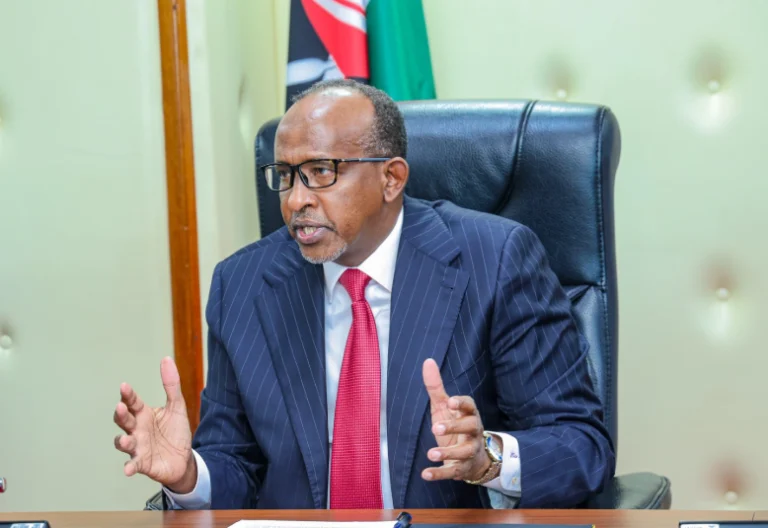
A Kenyan court has found Health Minister Aden Duale in contempt for allowing construction to continue on a controversial US-backed Ebola quarantine facility despite court orders halting the project. The ruling deepens a national debate over public health preparedness, sovereignty and government accountability.
NAIROBI, Kenya — Kenya’s High Court has found Health Minister Aden Duale in contempt of court after ruling that construction continued on a controversial US-backed Ebola quarantine facility despite judicial orders requiring work to stop.
The decision marks a significant escalation in a dispute that has exposed tensions between public health preparedness, government authority and public trust in East Africa’s largest economy. The facility, located at Laikipia Air Base near the town of Nanyuki in central Kenya, was intended to accommodate US citizens exposed to Ebola during the ongoing outbreak affecting parts of the Democratic Republic of Congo (DRC) and neighbouring Uganda.
Justice Patricia Nyaundi Mande ruled that Duale knowingly permitted construction to continue despite court orders issued in late May and early June. According to court documents, the judge concluded that the minister’s actions amounted to contempt because the government proceeded with work while legal challenges were still before the court. “The Court cannot permit its orders to be rendered hollow,” the judge said, according to court filings cited in reporting on the case.
Duale is expected to return to court for sentencing considerations and mitigation. Kenyan law allows penalties for contempt of court that may include fines or imprisonment.
Why the Facility Became Controversial
The project has triggered weeks of political controversy and public protests in Kenya.
Opponents argue that the facility was approved without sufficient public consultation and that details surrounding biosafety procedures, regulatory approvals and operational arrangements were not adequately disclosed. Rights groups challenged the project in court, claiming the development posed potential risks to public health and transparency. The Katiba Institute, one of the organisations involved in legal proceedings, sought information relating to health assessments and operational protocols associated with the centre.
Public concern intensified because Kenya has not recorded any Ebola infections linked to the current outbreak. Critics questioned why the country should host a quarantine facility for foreign nationals when the outbreak remains concentrated elsewhere in the region. The issue has become a broader test of confidence in government decision-making and crisis communication.
Government Defence
Kenyan President William Ruto has publicly defended the project, describing it as part of a wider preparedness strategy and international health partnership. He argued that Kenya was right to cooperate with the United States in strengthening regional Ebola response capabilities.
Government officials have also maintained that Kenya has a responsibility to contribute to regional disease containment efforts, particularly given its position as a transport and economic hub in East Africa.
Authorities further argued that some construction activities continued because they were being undertaken by the Kenyan government rather than directly by foreign partners. However, the court rejected that interpretation, ruling that the orders applied to all ongoing work at the site.
Regional Ebola Context
The legal dispute comes against the backdrop of a significant Ebola outbreak in the Democratic Republic of Congo. According to figures cited in the reporting, the outbreak has resulted in hundreds of infections and deaths, while Uganda has also recorded confirmed cases. Health authorities across East Africa remain on alert because of the movement of people across borders and the region’s extensive transport networks.
The facility at Nanyuki was intended as part of broader preparedness efforts should exposed individuals require quarantine outside outbreak zones. The United States has pledged funding to support Ebola preparedness initiatives in Kenya and across the wider region. Reports indicate that the quarantine project forms part of a larger package of regional health assistance.
Why the Ruling Matters
The judgement carries implications beyond the Ebola facility itself. Legal experts say the ruling reinforces the principle that government officials must comply with court orders regardless of policy objectives. The case is also being closely watched as a test of judicial independence and executive accountability in Kenya.
For public health authorities, the controversy highlights the challenges governments face when balancing emergency preparedness with public consent and transparency. As the court moves towards sentencing and the broader legal challenge continues, the future of the facility remains uncertain.
What is clear is that the case has become one of the most politically sensitive public health disputes in Kenya in recent years, raising questions about governance, public trust and how African states prepare for cross-border disease threats.
Related posts:
 Ebola Cases Nearly Double in DR Congo as WHO Chief Visits Outbreak Epicentre
  DR Congo Health Workers Battle Ebola Outbreak Amid Equipment Shortages and Security Risks
  Ebola Outbreak Passes 530 Cases as Africa Races to Contain Rare Strain With No Approved Vaccine
  South Africa Police Chief Suspended Over $21m Corruption Probe WHO Warns DR Congo Ebola Outbreak May Be Spreading Faster as Death Toll Hits 131