Solving Learning Poverty in Ghana With Data and Testing


Addressing Learning Poverty in Ghana Through Data
New educational data reveals the specific strategies the Ministry of Education is using to combat learning poverty in Ghana. Over the last two decades, Ghana has achieved remarkable success in broadening access to its classrooms. Data from the UNESCO Institute for Statistics (UIS) Data Browser highlights a significant transformation: primary enrollment rates surged from 65.52% in 2000 to 95.23% in 2024. Similarly, lower secondary enrollment expanded from 59.23% to 94.83% during the same period. While these figures suggest a nation on the brink of universal education, a deeper look at the data reveals a stark “learning paradox.”

Despite the high number of years spent in school, actual learning outcomes have struggled to keep pace. A 2020 World Bank estimate indicated that while a Ghanaian child could expect to complete approximately 12.1 years of school by age 18, their learning-adjusted years of schooling—a measure of what they actually know—is only 5.89 years. This discrepancy underscores the challenge of learning poverty in Ghana, where the physical presence of students in classrooms does not automatically translate into the acquisition of foundational literacy and numeracy.
Data as the Catalyst: The Role of the Ghana National Standardized Test (NST)
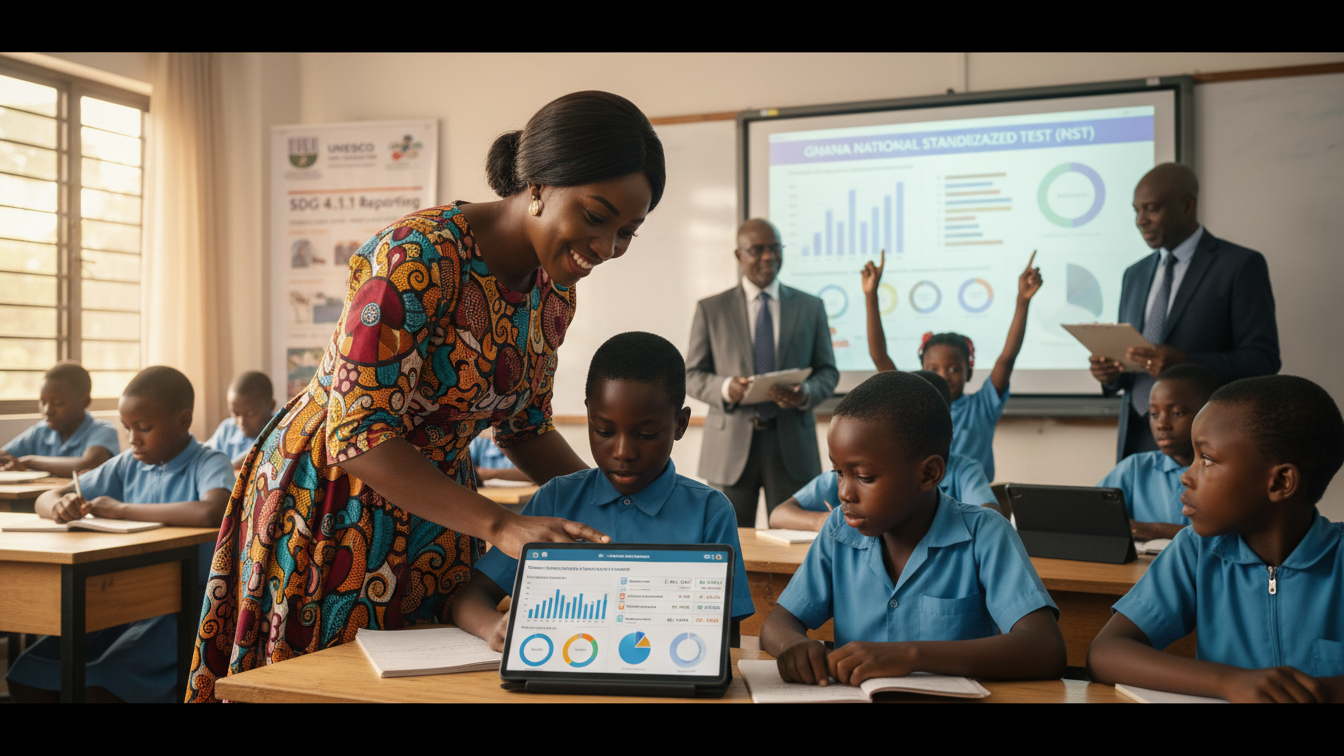
To address this gap, the Ghanaian Ministry of Education has shifted its focus from mere enrollment to measurable outcomes. The primary tool in this transition is the Ghana National Standardized Test (NST). Unlike sample-based assessments, the NST is a nationwide, census-based learning assessment designed to monitor progress and diagnose specific gaps in the education system.

By collecting high-quality data at the national level, policymakers can move beyond guesswork. Mr. Clement Osei Antwi, Deputy Director of Learning Assessment, Policy, and Implementation at the Ministry of Education, notes that the goal of these assessments is to provide “accurate evidence on learning poverty in Ghana” and to strengthen internal capabilities. This data-driven approach allows the government to identify exactly where learners are falling behind and to drive evidence-based policy-making to ensure public investments are translating into actual skills.
A Global First: Pioneering the UIS Data Readiness Review
Ghana has recently achieved a global milestone by becoming a pioneer in bridging the gap between national assessment data and international benchmarks. Historically, data from the Ghana National Standardized Test (NST) was used almost exclusively for domestic policy. However, through the UIS Data Readiness Review and Support Mechanism, Ghana has successfully leveraged the NST for official SDG 4.1.1 reporting.

SDG 4.1.1 reporting is the global standard for tracking whether children are acquiring foundational skills at three critical stages: the end of lower primary, the end of primary, and lower secondary education. Achieving this required significant technical work to ensure that the NST’s design, administration, and documentation met the stringent criteria for international comparability. By aligning its national test with these global standards, Ghana can now benchmark its progress against the rest of the world, making its claims regarding educational improvement more credible and transparent.
Pillars of Success: Leadership, Structure, and Collaboration
The journey to international data alignment was not without hurdles, including gaps in previous assessment documentation and the need for enhanced national capacity. According to Clement Osei Antwi, Ghana’s success in this area rests on three fundamental pillars:
- Leadership Commitment and Political Will: High-level support was essential to prioritize data quality and international transparency.
- Functional Institutional Structures: Creating a systematic framework for assessment ensured that the data collected was robust and met technical requirements.
- Effective Collaboration: The process required intense coordination between multiple internal departments and external international bodies like the UNESCO Institute for Statistics.
This collaborative effort has not only improved reporting but has also helped the Ministry understand the extent to which Ghanaian learners attain international proficiency levels in literacy and numeracy.
The Private Sector’s Contribution: Ghanaian EdTech Startups
While the government focuses on standardized testing and policy, the private sector is playing an increasingly vital role in solving the learning crisis. Education has become the fourth most popular industry for startups in Ghana, with Ghanaian EdTech startups introducing innovative ways to engage students outside of traditional rote learning.
Notable examples from the 2026 landscape include:
- EduSpots: An organization focused on community-led, digitalized education, which raised $60,000 from the Mastercard Foundation EdTech Fellowship to expand its reach.
- Robotek: Based in Kumasi, Robotek specializes in robotics curriculum development and kits. Their programs are designed to provide hands-on skills in technology for students ranging from lower primary to the Senior High level, partnering with institutions such as KNUST Basic School and St. Louis SHS.
These private initiatives complement national data efforts by providing the tools and training necessary to bridge the “learning-adjusted years” gap identified by the World Bank.
Conclusion: Scaling the Ghanaian Model for Global Education Goals
Ghana’s proactive approach to the UIS Data Readiness Review serves as a vital blueprint for other nations. By turning the Ghana National Standardized Test (NST) into a tool for global accountability, the country has moved beyond the simple metric of school enrollment to focus on the quality of learning. Through the combination of strong political will, rigorous data alignment, and a thriving EdTech ecosystem, Ghana is demonstrating that “counting what matters” is the first step toward ensuring every child acquires the skills they need to thrive in the 21st century.